
- by WengGracy
How to Rock Baby to Sleep in a Nursery Chair: 7 Proven Techniques
- by WengGracy
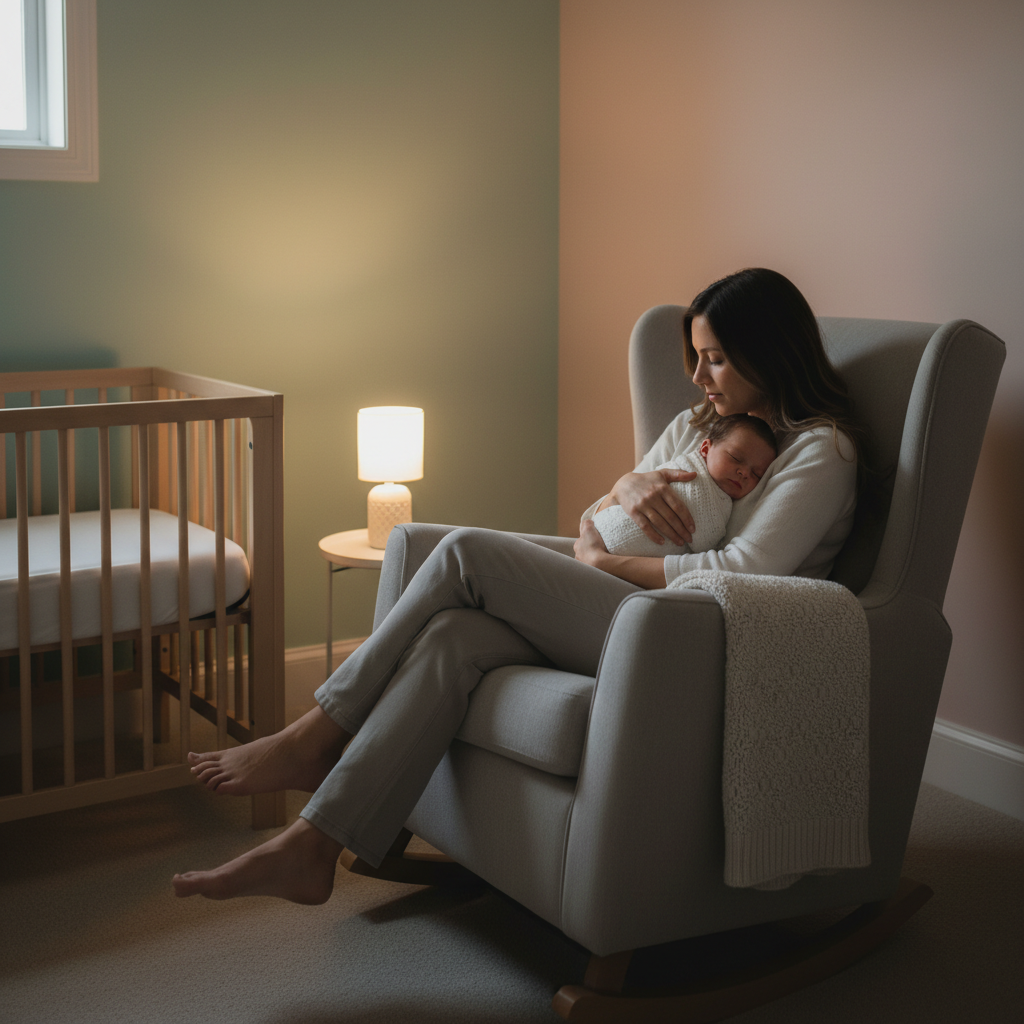
It is 2:47 a.m., your newborn is wide awake, and you have already tried every soothing trick in the book. Sound familiar? You are not alone. According to a survey shared by The Bump, 81 percent of parents use a nursery chair as their go-to tool for rocking baby to sleep. There is real science behind why this ritual works — and knowing the right technique can transform those long nights into something genuinely peaceful.
At Mamazing, we have spent years studying how parents actually use nursery chairs at 3 a.m. — which features matter, which holds calm the fastest, and how to transfer a sleeping baby without that heartbreaking startle. Before diving into technique, setting yourself up with a well-designed nursing chair makes every one of these methods easier to execute comfortably. Below are 7 proven techniques pediatric experts and experienced parents swear by — plus the chair features that make each one work.
Rocking is not just a sweet bedtime ritual — it is biology in action. Your baby's vestibular system (the inner-ear network that controls balance and motion sensing) is wired to interpret rhythmic movement as a signal of safety. That motion mirrors what your little one experienced in the womb, which is why the "fourth trimester" concept emphasizes recreating intrauterine sensations during the first three months.

There is solid research backing this up. A widely cited study in Current Biology (2019), led by Laurence Bayer at the University of Geneva, found that rocking synchronizes brain oscillations and helps people fall asleep faster and stay asleep longer. Pediatricians point to additional benefits: rhythmic contact lowers cortisol, releases oxytocin (the bonding hormone), and helps regulate your baby's heart rate. For a deeper science-based walkthrough of why this works, see how rocking chairs actually help babies sleep.
According to the American Academy of Pediatrics, in their guidance on calming a fussy baby, rocking remains one of the most reliable soothing tools when paired with safe sleep practices from the American Academy of Pediatrics. The chair you choose matters too — because your hold, your back, and your ability to stay still during the crib transfer all depend on how well the rocking chair supports you.
Best for: Newborns 0-3 months
The cradle hold is the most instinctive rocking position, and for good reason. You tuck your baby's head into the crook of your arm, facing up, while their body lies horizontally across your forearms and lap. Then you rock slowly and evenly — think gentle back-and-forth, not a wide arc swing.
If your arms tire halfway through, you will start subtly bouncing — which startles a drowsy baby right back to alert. That is why armrest depth matters more than most first-time parents realize.
Best for: Colicky babies, gassy infants, babies with reflux
Some babies will fight the cradle position because lying flat aggravates reflux or trapped gas. For these little ones, the upright chest press is a game-changer. Hold your baby vertically against your chest, with their chin resting just above your shoulder and their belly pressed gently to yours. The contact transmits your heartbeat directly — a soothing signal your baby has known since week 6 of pregnancy.
Combine a slight vertical bounce (from your knees, not your arms) with a soft side-to-side sway. Reflux babies often relax within minutes because gravity finally works in their favor. The challenge for you: holding an upright newborn for 15-30 minutes is brutal on the lower back and shoulders unless your chair does some of the work.
For this technique, the Mamazing Lullapod's HugAssist motorized armrests and adjustable recline keep you fully supported during extended upright holds — letting you rest your elbows at the perfect height without losing the chest-to-chest seal.
Best for: Overtired babies who resist lying down
The "second wind" baby — eyes wide, fists clenched, crying past the point of tired — needs more than just motion. They need a sensory reset. The slow sway and shush combines gentle lateral gliding with a rhythmic "shhhh" sound that mimics the whooshing of blood flow inside the womb.
Why this combination works: you are activating the auditory, vestibular, and tactile senses simultaneously, which overwhelms the overtired wakefulness signal. Most babies relent within 5-7 minutes if you stay consistent.
Best for: Gassy babies and colic (3-12 weeks)
Also known as the "tiger in the tree" hold, this position is a colic-soothing legend among NICU nurses and pediatric sleep consultants. Your baby lies face-down along your forearm, head near your elbow, with their legs straddling your wrist. Your other hand supports their back.
Add a gentle rocking chair motion and the magic compounds: gravity helps trapped gas escape while the rhythmic glide regulates breathing. According to Cleveland Clinic guidance, colic typically starts around 2-3 weeks, peaks at 6 weeks, and resolves by 3-4 months — which is exactly the window when this hold is most useful.
Safety reminder: Maintain a firm grip the entire time. Once your baby drifts off, gently rotate them onto their back for the crib transfer. A low-profile rocking chair for babies with a firm seat height keeps your feet grounded — which gives you the stability you need for this asymmetric hold.
Best for: 3-6 months; building healthy sleep independence

This is the technique pediatric sleep consultants recommend most often, and it is endorsed by the American Academy of Pediatrics, which advises placing babies in the crib "drowsy but awake" to foster self-soothing skills. Here is how it actually works in practice:
The hardest part is resisting the urge to rock until your baby is fully out. But that habit creates a strong sleep association — meaning every night waking will require another full rocking session. The drowsy-but-awake fade teaches your baby that the crib itself is a safe landing place.
Chair tip: A glider rocker with a smooth, silent stop is critical here. Squeaky joints or jerky end-of-arc movement will wake a barely-asleep baby every time.
Best for: Newborns 0-8 weeks (before rolling milestone)
Even the smoothest rocking motion can trigger your newborn's Moro reflex — that startling arm-fling that wakes them every time you slow down. A swaddle solves this by gently containing the arms, which essentially turns your baby into a calm little burrito who cannot startle themselves awake.
Chair tip: A 360-degree swivel on your nursery rocker is a small detail that pays off here. You can pivot toward the bassinet to check on baby, or back toward the door to listen for a partner — all without breaking your rocking rhythm.
Best for: All ages; the secret to crib transfers that actually work
Even a perfect rocking session falls apart at the moment of transfer. Your baby has linked the motion to safety; the second you stop, their nervous system goes on alert. The gradual slow-down method is the solution — and once you master it, you will use it for months.
| Step | Action | Why It Works |
|---|---|---|
| 1 | Start with active rocking matching baby's alertness | Meets baby at their level |
| 2 | Slow pace every 2-3 minutes | Gradual deceleration avoids startle |
| 3 | Hold still 60 seconds before standing | Confirms deep sleep stage |
| 4 | Stand slowly using swivel to face crib | No pivoting that jostles baby |
| 5 | Lay baby bottom-first, then head | Maintains body angle continuity |
| 6 | Keep hand on chest 10-15 seconds | Bridges the contact-loss moment |
The Mamazing Lullabud's smooth 30-degree rocking motion and 360-degree swivel make the gradual slow-down transfer seamless — you can orient directly toward the crib and rise without breaking stillness, no awkward shuffle required.
Every technique above depends on one thing: the chair under you. A wobbly rocker, a squeaky glider, or an armrest that hits at the wrong height will sabotage even the best soothing method. Here is what to look for when shopping for a rocking chair for babies, a nursery rocker, or a glider rocker that genuinely supports nighttime parenting.
| Feature | Why It Matters for Rocking |
|---|---|
| Smooth glide mechanism | Prevents jerky stops that startle baby awake |
| Adjustable armrests | Supports cradle and upright holds without fatigue |
| 360-degree swivel | Enables crib-facing transfers and easy partner handoffs |
| Reclining backrest | Lets you rest during long soothing sessions and cluster feeding nights |
| Washable covers | Practical for inevitable spit-up and diaper-leak moments |
| Low seat height | Keeps feet grounded for controlled, deliberate rocking |
If you have ever tried to rock a baby in a kitchen chair, you already know how much the design matters. A purpose-built nursery rocker accounts for hours of holding, sudden one-handed pivots, and the awkward stand-up-from-deep-recline maneuver during transfers. A glider rocker with a controlled track produces quieter, more consistent motion than a traditional curved-runner rocking chair — which is why most modern nurseries lean glider. For a fuller breakdown of models, motion types, and price points, our editors compiled the best rocking chairs for the nursery in 2025.
Want to see designs built around exactly these scenarios? Explore the Mamazing collection of award-winning nursery seating in the carousel above — every model is engineered for the rocking techniques in this guide.
Rocking is safe and beneficial — but the chair is for soothing, not sleeping. The American Academy of Pediatrics is clear that infants must be transferred to a flat, firm sleep surface once asleep. The CDC reports that thousands of sudden unexpected infant deaths occur each year, with chair and sofa co-sleeping cited among the higher-risk environments. Here are the key safety practices every caregiver should follow:
According to AAP HealthyChildren guidance on calming a fussy baby through rocking and skin-to-skin contact, rhythmic holding also strengthens the parent-infant connection — but only when caregivers are fully alert and pair it with safe sleep environments afterward.
No — the AAP and pediatric sleep experts confirm rocking is safe and beneficial as a soothing tool. The key distinction is that a rocking chair for babies is a calming environment, not a sleep surface. Once baby is asleep, transfer to a firm, flat crib. Rocking can create a sleep association over time; using the drowsy-but-awake technique helps build independent sleep skills gradually.
Most babies settle within 5-15 minutes of consistent rocking. Pediatricians suggest keeping nursery chair sessions to under 20 minutes for sleep-onset purposes. For very fussy evenings or the witching hour, sessions may run longer — which is when a glider rocker's ergonomic support becomes especially important to prevent caregiver back strain during extended holds.
A traditional rocking chair moves in an arc using curved base runners, requiring more floor space and leg effort. A glider rocker moves forward and backward on a fixed track with minimal physical effort, producing a quieter, smoother motion ideal for nighttime use. A glider rocker's controlled, consistent motion is generally preferred because abrupt stops are less likely to startle a drowsy baby — and the track design tends to be quieter through the years.
There is no universal age — most parents naturally transition between 4-8 months when babies become developmentally ready for more independent sleep. Signs it may be time to reduce rocking include frequent night wakings that require re-rocking, baby resisting being put down, or caregiver exhaustion. Beginning with the drowsy-but-awake technique helps gradually shift the sleep association without an abrupt change that often triggers protest crying.
Use the gradual slow-down transfer method. Slow your rocking progressively over several minutes, hold completely still for 60 seconds, then stand slowly using a swivel nursery chair oriented toward the crib. Lay baby bottom-first and keep one hand on their chest for 10-15 seconds after placement. A briefly warmed crib sheet (heating pad removed before placement) also helps prevent the startle of a cold mattress against warm skin.
Seven techniques, one underlying truth: when you know how to rock baby to sleep in a nursery chair with intention, the long nights get shorter — and the bonding moments get sweeter. Whether you are using the classic cradle rock, the upright chest press, or the gradual slow-down transfer, the right rocking chair for babies is the quiet co-parent that makes every method work. A thoughtfully engineered nursery rocker or glider rocker is not a luxury — it is a sleep tool you will use thousands of times.
That is why Mamazing designs every chair around the actual moments parents live through at 3 a.m. — smooth glides, supportive armrests, silent swivels, and recline angles that work for feeding and rocking. Browse the carousel above to find the chair that will be there for every cradle hold, every shush, and every successful crib transfer in the months ahead.
No — the AAP and pediatric sleep experts confirm rocking is safe and beneficial as a soothing tool. The key distinction is that a rocking chair for babies is a calming environment, not a sleep surface. Once baby is asleep, transfer to a firm, flat crib. Rocking can create a sleep association over time; using the drowsy-but-awake technique helps build independent sleep skills gradually.
Most babies settle within 5-15 minutes of consistent rocking. Pediatricians suggest keeping nursery chair sessions to under 20 minutes for sleep-onset purposes. For very fussy evenings or the witching hour, sessions may run longer — which is when a glider rocker's ergonomic support becomes especially important to prevent caregiver back strain during extended holds.
A traditional rocking chair moves in an arc using curved base runners, requiring more floor space and leg effort. A glider rocker moves forward and backward on a fixed track with minimal physical effort, producing a quieter, smoother motion ideal for nighttime use. A glider rocker's controlled, consistent motion is generally preferred because abrupt stops are less likely to startle a drowsy baby — and the track design tends to be quieter through the years.
There is no universal age — most parents naturally transition between 4-8 months when babies become developmentally ready for more independent sleep. Signs it may be time to reduce rocking include frequent night wakings that require re-rocking, baby resisting being put down, or caregiver exhaustion. Beginning with the drowsy-but-awake technique helps gradually shift the sleep association without an abrupt change that often triggers protest crying.
Use the gradual slow-down transfer method. Slow your rocking progressively over several minutes, hold completely still for 60 seconds, then stand slowly using a swivel nursery chair oriented toward the crib. Lay baby bottom-first and keep one hand on their chest for 10-15 seconds after placement. A briefly warmed crib sheet (heating pad removed before placement) also helps prevent the startle of a cold mattress against warm skin.
Featured Products


Buying a Used Stroller: Is It Safe? What to Check Before You Buy
Small Nursery Layout Ideas: Finding the Perfect Spot for Your Nursery Chair