
Best Sleeping Positions During Pregnancy: A Trimester-by-Trimester Guide
- by WengGracy
Getting comfortable in bed keeps getting harder as your bump grows, and sleep that used to come easily now feels like a nightly negotiation. If you've ever stared at the ceiling at 3 a.m. wondering whether you rolled onto your back in your sleep, you are not alone. The good news? Most fears around the right pregnancy sleeping position can be calmed with simple, clear information. At Mamazing, we believe rest is a form of prenatal care, not a luxury, and the right sleeping position during pregnancy can make a real difference, both for your comfort and for your baby's circulation.
In this guide, you'll learn which positions work best in each trimester, when back sleeping starts to matter, how pillows can transform your nights, and what to do when summer heat and a growing belly conspire against you. By the end, you'll know how to set up a sleep routine that supports you, your baby, and the months ahead.
Your uterus grows from the size of a pear to the size of a watermelon over nine months. As it expands, it presses on nearby blood vessels, organs, and nerves, which is why the position you sleep in starts to matter in ways it never did before.
The main anatomical concern is the inferior vena cava, or IVC, the large vein that runs along the right side of your spine and returns blood from your lower body to your heart. After roughly 20 weeks, a growing uterus can compress this vein when you lie flat on your back. This is called supine hypotensive syndrome, and it can reduce blood flow back to your heart and, in turn, the oxygen-rich blood that reaches your placenta. Side sleeping keeps that pressure off the IVC and supports steady circulation to your baby. According to the American College of Obstetricians and Gynecologists, lying flat on your back during late pregnancy can compress major blood vessels, which is why side sleeping is recommended.
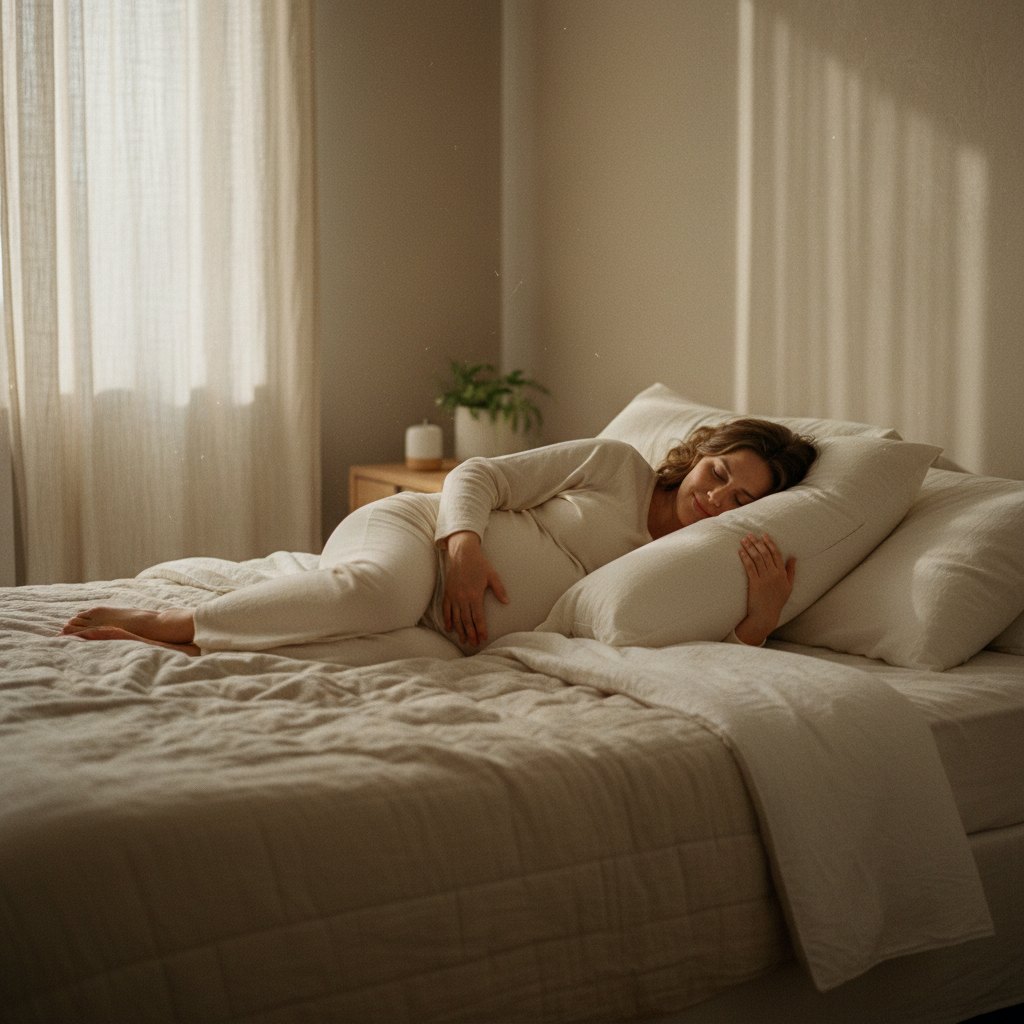
The best pregnancy sleeping position is consistently side sleeping, often called the SOS position (Sleep on Side). From the second trimester onward, sleeping on your side supports healthy blood flow, reduces pressure on the inferior vena cava, and helps your kidneys process fluid efficiently, which can ease swelling in your feet and ankles. The ideal posture: knees slightly bent, a pillow tucked between them, and a relaxed, gently curled spine.
Many pregnant women find that committing to the SOS position takes practice if they were lifelong back or stomach sleepers. Starting early, even in the first trimester, helps your body adjust before it becomes essential.
The left side is traditionally recommended because the IVC runs to the right of your spine. Lying on your left shifts the weight of your uterus away from this vein, easing pressure and supporting kidney function. That extra kidney support is why left-side sleeping is also linked with reduced swelling in the legs and feet.
That said, the right side is not the enemy. A 2019 individual participant data meta-analysis of maternal going-to-sleep position found that supine going-to-sleep posture after 28 weeks carries a higher stillbirth risk than either side, while left- and right-side sleeping were broadly comparable in this regard. Left is still slightly preferred for IVC and kidney reasons, but if you wake up on your right side, simply roll back left and carry on.
Pregnancy is not one long stretch of identical days. What feels fine at 10 weeks may feel impossible at 30. Here's how to think about positions trimester by trimester.
In the first trimester, nearly any sleeping position is safe. Your uterus is still tucked low in your pelvis and small enough that it does not press on major blood vessels. Back sleeping and stomach sleeping are both still comfortable and pose no known risk.
Use this stretch to your advantage. Try practicing left-side sleeping now so it feels natural by the time it matters. Early pregnancy brings its own sleep disruptors, like breast tenderness, nausea, and frequent bathroom trips, so a body pillow can help even before the bump arrives. If sleep struggles are part of your early weeks, our companion piece on first-trimester insomnia covers what's normal and what helps.
Around weeks 16 to 18, stomach sleeping usually becomes uncomfortable on its own as the bump becomes noticeable. Most physicians recommend transitioning fully to side sleeping by week 20, when the uterus is large enough that lying flat can begin to reduce circulation.
Heartburn often appears in the second trimester. Left-side sleeping plus a small head elevation can quiet nighttime reflux. Round ligament pain, that sharp tugging sensation when you shift, can make rolling over harder, so pillows that prevent abrupt position changes are useful.
From 28 weeks onward, the relationship between sleeping position and your baby's wellbeing becomes most direct. According to Cleveland Clinic obstetric guidance, going to sleep on the back from 28 weeks onward has been associated with an increased risk of stillbirth, which is why side sleeping is so strongly emphasized late in pregnancy.
The third trimester also brings hip pain, shortness of breath, restless legs, more frequent bathroom trips, and the kind of fatigue that no nap fully fixes. A few comfort strategies help:
Back sleeping is safe in the first trimester, worth transitioning away from at 20 weeks, and most strongly avoided after 28 weeks. The reason: as your uterus grows, lying flat presses it against the IVC, slowing blood return to your heart and reducing oxygen-rich blood flow to your placenta. Symptoms of significant IVC compression include dizziness, shortness of breath, lower back pain, and nausea when lying flat. Your body usually signals discomfort long before anything serious happens, which is why most pregnant women instinctively shift positions during the night.
Don't panic if you wake up on your back. One isolated instance is not considered dangerous, even in the third trimester. Tommy's pregnancy charity confirms that if you wake on your back, simply turn onto your side and go back to sleep. To discourage rolling back, place a firm pillow or rolled towel behind your lower back as a gentle barrier.
Stomach sleeping is fine in early pregnancy and physically becomes impossible around weeks 16 to 20 as your bump grows. Your baby is well cushioned by amniotic fluid and the muscles of your uterus, so brief stomach moments in the first trimester are not a concern. Specialty pregnancy pillows with a belly cut-out exist for those who really miss this position, though most women adjust to side sleeping by the second trimester.
Sleeping on your left side keeps stomach acid below the esophageal junction, reducing reflux. Elevating the head of your bed by 4 to 6 inches, or using a wedge pillow under your upper torso, further reduces nighttime symptoms. Avoid eating within 2 to 3 hours of bedtime, and skip late-night spicy or fatty meals if reflux is a recurring problem.

Hip pain from lying on a firm mattress is one of the most common third-trimester complaints. Rotating from your left side to your right and back distributes pressure across the night. A memory foam mattress topper can cushion pressure points, and a pillow between your knees reduces the rotational strain that aggravates hip joints.
Left-side sleeping supports your kidneys, which helps process excess fluid that pools in your legs. Before sleep, elevate your legs on a small pillow or footstool for 10 to 15 minutes to encourage fluid drainage. Hydrating well during the day (counterintuitive, but true) also helps reduce overnight swelling.
In the third trimester, your uterus presses upward on your diaphragm, which can leave you breathless when lying flat. A semi-reclined position, with your head and upper body elevated to about 30 to 45 degrees, takes that pressure off. A supportive chair with an adjustable recline can serve as a comfortable daytime alternative when bed feels too flat.
Pregnancy pillows have gone from niche to mainstream, and for good reason. They turn the daily challenge of finding a comfortable position into a one-time setup. There are four main types worth knowing:

| Pillow Type | Best For | Trade-off |
|---|---|---|
| U-shaped | Full-body wrap-around support; belly, back, and knees at once | Large; takes up bed space |
| C-shaped | Front and back support; good for couples sharing a bed | Slightly less full-body coverage |
| Wedge | Targeted belly support, back support, or head elevation for reflux | Less full-body comfort |
| J-shaped | Flexible single-side support; easy to reposition | Less symmetry than U-shaped |
Most pregnant women start using a maternity pillow in the second trimester and rely on it heavily in the third. If you're a committed back or stomach sleeper, starting earlier helps your body adjust to side sleeping before discomfort sets in.
Position is half the story. The room around you is the other half. The Sleep Foundation recommends a bedroom temperature between 65 and 68 degrees Fahrenheit for optimal sleep, which matters even more during summer pregnancy when your already-warmer body fights to cool down at night. A few other essentials:
The third trimester is also when many women feel the nesting instinct kick in, that quiet pull to get the nursery, the rocking corner, and the baby's first sleep space ready. Setting up a comfortable rest spot for yourself now does double duty: it gives you somewhere to recover from a sleepless night during pregnancy, and it becomes a postpartum sanctuary for the long stretches of cluster feeding in those early newborn weeks. A supportive nursing chair tucked into the nursery offers lumbar support, an adjustable footrest to ease swollen legs, and a recline angle that takes pressure off your back during third-trimester rest breaks. Pairing that chair with the right crib means your nursery is ready well before your due date, which lightens postpartum decision fatigue when you need it most.
Short naps of 20 to 30 minutes restore alertness without disrupting nighttime sleep. Nap on your side in bed, or sit semi-reclined in a supportive chair with a footrest. A semi-reclined nursing chair becomes especially valuable in the third trimester, when getting in and out of bed multiple times a day starts to feel like a full workout. If you're weighing a standard glider versus a motorized option, our deep dive on electric nursery glider recliners walks through the comfort and support trade-offs in detail.
Pregnant women who set up the nursery before week 36 tend to report calmer final weeks. Choosing a safe, well-built crib during pregnancy means one fewer postpartum decision to make. A completed nursery environment also helps your body associate the space with calm, which supports a smoother transition to newborn sleep routines.
Sleep position adjustments solve a lot, but not everything. Reach out to your midwife or OB if you experience:
Sleep concerns are always worth flagging at a prenatal visit. Your provider can rule out conditions like preeclampsia, gestational sleep apnea, or anemia that may need targeted care.
The best sleeping position during pregnancy is on your side, often called the SOS (Sleep on Side) position. The left side is slightly preferred because the inferior vena cava runs along the right side of the spine, and left-side sleeping keeps the uterus from compressing it, supporting blood flow to the placenta and kidneys. Place a pillow between your knees and one under your belly to maintain this position comfortably through the night. Starting this habit in the first trimester helps it feel natural as your bump grows.
Back sleeping is generally safe in the first trimester. From around 20 weeks, physicians recommend transitioning to side sleeping as the growing uterus can begin to compress the inferior vena cava when you lie flat, potentially reducing blood flow to the heart and placenta. After 28 weeks, most healthcare providers advise avoiding back sleeping when possible. If you wake on your back, simply roll onto your side. One instance is not cause for alarm, and your body typically signals discomfort before serious compression occurs.
The left side is slightly preferred because it reduces pressure on the inferior vena cava, which runs along the right side of the spine. Left-side sleeping also supports kidney function, helping reduce swelling in the feet and ankles. However, a 2019 review of multiple medical studies found no significant difference in outcomes between left- and right-side sleeping before 28 weeks. After 28 weeks, both sides are safer than sleeping on your back, with left marginally preferred. Switching sides during the night is perfectly fine and encouraged.
If you wake up on your back, do not panic. Your body generally signals discomfort, such as dizziness, shortness of breath, or nausea, before serious IVC compression occurs, and the instinct to shift positions usually wakes you naturally. Simply roll onto your side and go back to sleep. One isolated instance of back sleeping, even in the third trimester, is not considered dangerous. To discourage rolling onto your back, place a firm pillow or rolled towel behind your lower back as a positional barrier.
Side sleeping with a pillow between your knees is the most effective positional strategy for pregnancy back pain. The pillow aligns your hips and reduces the spinal torsion that causes lower back strain. Placing a second pillow under your belly prevents the bump from pulling your spine forward. For sciatica, sleeping on the side opposite the painful leg often provides the most relief. A supportive mattress and daytime rest in a lumbar-supportive chair further reduce overnight pain.
Yes, and many pregnant women, especially in the third trimester, find a semi-reclined position in a recliner or nursing chair more comfortable than lying flat in bed. This position relieves pressure from the lower back, can ease heartburn by keeping your head above your stomach, and reduces the breathlessness caused by the uterus pressing on the diaphragm. A nursing chair with lumbar support and a footrest that elevates the legs also helps reduce swelling, making it a practical option for both daytime naps and nighttime rest breaks throughout pregnancy.
Finding the best pregnancy sleeping position is less about following one rigid rule and more about adjusting as your body changes. Side sleeping (especially the left side) becomes the gold standard from 20 weeks onward, back sleeping shifts from neutral to risky after 28 weeks, and the right pillow setup can quietly transform your nights. If you wake up on your back, breathe, roll over, and keep going. Your body is wiser than the worry.
At Mamazing, we design with one belief in mind: the comfort you build during pregnancy becomes the foundation for the months after birth. Whether you're setting up a calming corner for late-night rest or planning the nursery that will hold your baby's first nights, every choice you make for your comfort now is a gift to your future self. Explore Mamazing's thoughtfully designed nursing chairs and cribs to start building the rest-ready space you and your baby deserve.
Featured Products


Stress During Pregnancy: How to Protect Your Wellbeing
Pregnancy Diet Guide: What to Eat and What to Avoid