If you are looking at the Mamazing recliner because you want one nursery chair that can handle feeding, rocking, and those half-awake middle-of-the-night resets, the short answer is yes: it is a strong fit for parents who want powered movement, generous arm support, and easy-clean practicality in one place. It makes the most sense when your nursery chair is going to be used constantly, not occasionally.
That said, the best Mamazing chair review should do more than tell you the chair is comfortable. You are probably trying to figure out whether it is actually worth the space, whether it helps enough during feeding and recovery to justify a power recliner, and whether it is better for your routine than a simpler glider. Those are the questions this article aims to answer.
The Mamazing electric rocking recliner sits in a useful middle ground between a classic nursery glider and a full living-room recliner. It is clearly built with parents in mind, but it also borrows the kind of adjustability that makes long sitting sessions easier on your body. If you are still comparing categories, Mamazing's guides to the best recliner for nursery, a nursery rocking chair recliner, and the best nursery rocking chairs and gliders can help you decide whether you really want recline, glide, or both.
Quick answer: who the Mamazing recliner fits best
The Mamazing recliner fits best if you want a nursery chair that feels more supportive than a basic rocker and more practical than a decorative accent chair. It is especially compelling for new moms and families who expect long feeding sessions, frequent soothing, repeated sit-stand transitions, and the kind of late-night care rhythm where small conveniences matter a lot.
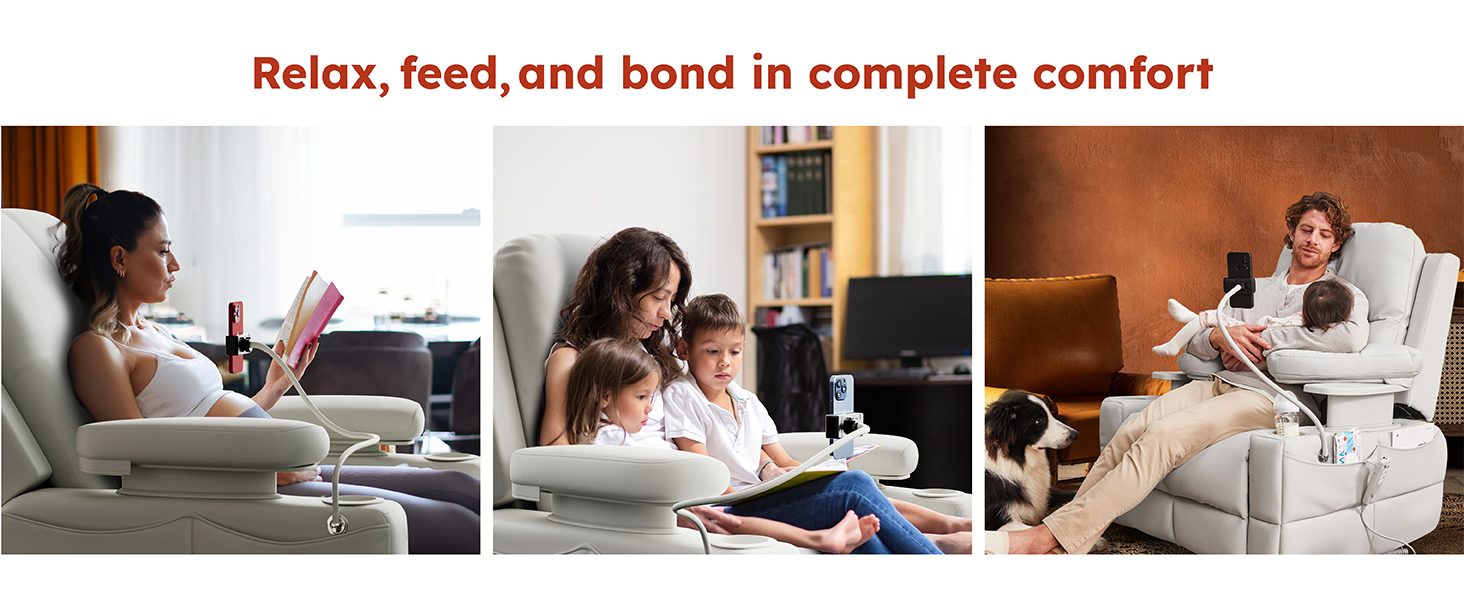
What makes the chair appealing is not just one headline feature. It is the full combination of powered recline, rocking motion, swivel movement, broad arm support, built-in storage, and wipe-clean materials. Each individual feature sounds incremental, but together they reduce the friction that tends to pile up in daily nursery use.
At the same time, this is not the right answer for every room or every routine. If you have a very tight nursery, strongly prefer a visually lighter chair, or want the simplest possible rocker, a more compact glider may still make more sense. The Mamazing chair is strongest when you want one seat to carry a lot of your daily workload.
That is why I would frame it less as a “luxury nursery chair” and more as a useful infrastructure purchase. If the chair helps you feed more comfortably, recover faster between sessions, and spend fewer tired minutes struggling with awkward positions, its value becomes obvious very quickly.
Why the Mamazing chair works well for feeding and long holding sessions
One of the biggest reasons people search for a Mamazing nursery chair or Mamazing nursing chair is feeding comfort. A nursery chair earns its place when it helps you stay in a sustainable position long enough that your shoulders, arms, and lower back are not doing extra work the whole time.
Arm support matters more than you think
This is where the chair starts to separate itself from prettier but less functional nursery seating. When you feed often, tiny posture issues become bigger problems: shoulders creeping upward, forearms working too hard, and a constant lean forward because the chair does not support your setup well enough. The MedlinePlus breastfeeding-position guide and the Office on Women's Health breastfeeding basics both point back to the same principle: comfortable support matters, and pillows or arm support can make a real difference.
The Mamazing recliner helps because it gives you more ways to settle into a position that feels sustainable instead of merely tolerable. The arm support, seat depth, and overall stability make it easier to hold a baby close without rounding forward the entire time. That matters whether you are breastfeeding, bottle feeding, burping, or simply sitting through a long sleepy stretch after a feed.
It also matters if more than one caregiver uses the chair. A rigid nursery rocker may feel fine for one person and awkward for another, but a more adjustable chair has a better chance of working across different heights, feeding styles, and comfort preferences. That flexibility is part of why the Mamazing recliner feels more like a working nursery tool than a one-size-fits-all seat.

Recline and swivel help during nighttime resets
The chair also earns its keep after the feeding itself. Many nursery chairs are acceptable during the feed but less helpful for the in-between moments: waiting for a burp, letting a baby settle, catching your breath, or trying to stay calm before one more transfer. That is where powered recline and swivel movement feel more useful in real life than they do on a spec sheet.
With a manual chair, you often need to shift your weight or force a movement while already holding a sleepy baby. With a power recliner, the transition tends to be smoother and easier to control. That does not simply make the chair feel more premium. It makes the entire feeding-and-reset process more predictable when you are tired and only half coordinated.
The rocking function also changes the chair's personality. A static recliner may be comfortable but not particularly soothing. A basic rocker may soothe well but still leave your body asking for more support. The Mamazing rocking chair succeeds because it combines motion and structure in the same seat.
If you are trying to create one dependable nursery spot for feeds, cuddles, quiet rocking, and short recovery moments, this is where the chair makes the strongest case for itself.
What stands out in daily use
The best reason to buy the Mamazing chair is not that it photographs well. It is that its design choices remove friction from care routines that repeat every day. That is what makes a chair feel worthwhile after the initial excitement wears off.
Power recline feels easier when one hand is busy
A powered nursery recliner becomes more convincing the moment your hands are not fully available. If you are holding a baby, reaching for a cloth, trying not to wake someone, or easing yourself up at the end of a long session, powered movement is not just a convenience feature. It is a friction-reduction feature.
This is particularly useful during recovery-heavy weeks or any season where you are sitting down and standing up dozens of times a day. The power function helps the chair adapt to your energy level instead of asking your body to do all the adaptation. That is why a power recliner often feels more practical than people expect once they actually use one in a nursery.
The swivel feature is similarly understated in theory and helpful in practice. In a real nursery, you rarely want to face only one direction. You may need to turn toward the crib, side table, sound machine, or door without doing a full awkward reposition. Small directional flexibility becomes surprisingly valuable when you are holding a baby and trying to stay calm.

Storage and wipe-clean surfaces reduce friction
Parenting almost always goes more smoothly when the basics stay within reach. Cup holders, side storage, and easy access to small essentials are not flashy features, but they do change whether a chair feels like a convenience or a command center.
Cleanup matters just as much. A nursery chair will eventually collect milk drips, spit-up, lotion transfer, crumbs, and whatever other chaos your house adds to the mix. A wipe-clean surface keeps the chair usable without making every mess feel like a chore. That matters more than most product descriptions admit.
The upholstery detail is worth calling out because it changes the stress level of ownership. You are more likely to use a chair confidently when you are not constantly worried about ruining it. If your nursery chair needs to survive newborn mess, toddler energy, and the occasional distracted parent coffee moment, easy maintenance is part of the value, not a side benefit.

This is also where the Mamazing chair feels intentionally parent-focused rather than simply repurposed from another room category. The good nursery products are usually the ones that think through what happens when you are tired, one-handed, and trying to do three things at once.
What to check before you buy
The Mamazing recliner can be a great fit without being the right fit for everyone. Before you buy, look beyond the marketing copy and focus on the practical points that will determine whether you still love it after the first week: room size, clearance, and how central the chair will be to your routine.
Room size and wall clearance
A powered recliner usually asks for more room than a slim nursery glider. That does not make it oversized by default, but it does mean you need to think beyond a simple footprint measurement. What matters is how the chair lives in the room when you are actually using it.
| What to measure |
Why it matters |
What to watch for |
| Chair footprint |
Tells you how much floor it owns even when upright |
Can it sit comfortably without crowding the crib or dresser? |
| Recline clearance |
Determines whether the chair feels usable or cramped |
Will it hit the wall, curtain, or side table when extended? |
| Walking path |
Affects nighttime movement when you are tired |
Can you move around the chair without clipping furniture? |
| Reach to essentials |
Changes how useful the seat is in real life |
Can you access water, cloths, and controls without standing? |
This is one reason `mamazing nursery chair` is such a useful query cluster. People are not only asking whether the chair is comfortable. They are asking whether it fits the nursery they actually have. That is a different question, and it deserves a practical answer.
Your routine matters more than the spec sheet
If your chair will mostly be used for occasional daytime feeds, you may not need a powered recliner at all. But if your daily routine includes cluster feeds, long rocking windows, repetitive sit-stand transitions, and a lot of one-handed adjustments, the Mamazing recliner becomes much easier to justify.
Ask yourself a few direct questions. Will you feed in the nursery most of the time? Do you want one chair to handle feeding, reading, rocking, and quiet recovery moments? Do you need surfaces that tolerate spills well? Are you trying to buy one nursery chair that still feels useful after the newborn phase? Those answers matter more than whether a feature list sounds premium.
Longevity is part of the value too. A chair that still works for bedtime stories, quiet rocking, or decompressing with a toddler has a much stronger long-term case than one that only shines during the first intense newborn months.

Mamazing chair pros, trade-offs, and who may want something else
If you are searching for Mamazing chair reviews, what you probably want most is balance. So here is the clearest summary: this chair has a strong case if you value support, powered ease, and multi-use nursery practicality more than minimal size or minimal visual weight.
-
Biggest strengths: supportive feeding posture, easier sit-stand transitions, soothing movement, and low-stress cleanup.
-
Best for: parents who expect long feeding sessions, want one primary nursery chair, and appreciate powered adjustments.
-
Less ideal for: very small rooms, minimal setups, or shoppers who want the lightest and simplest nursery rocker possible.
-
Value case: strongest when the chair becomes part of your daily routine rather than an occasional backup seat.
The chair's biggest strength is that it can absorb multiple jobs. It can be your feeding station, rocking chair, recovery chair, reading chair, and night-reset chair without feeling like it is trying to do too many things poorly. That is why it feels more compelling than a generic recliner dropped into a nursery.
The main trade-off is that a feature-rich chair asks for more room and more commitment. If your nursery is extremely compact or you know you prefer a simple upright glider, the Mamazing recliner may feel like more chair than you need. That is not a flaw so much as a fit issue.
That is also why the current framing works better than the old “perfect companion” angle. A useful review should help you self-select, not just flatter the product. In that sense, the Mamazing chair is easiest to recommend when your daily rhythm is demanding enough to benefit from its extra support and functions.

If you are still comparing broader chair categories, Mamazing's guide to a rocking recliner chair is the natural next read because it helps place this chair inside the larger nursery decision instead of treating it as a one-off product page.
A quick safety note for late-night feeding
A recliner can be a much better place to feed, hold, and soothe your baby than the edge of a bed or a poorly supported sofa corner. But it should not be treated as a baby sleep surface. The CPSC safe-sleep guidance is clear that babies should sleep on a firm, flat surface designed for infant sleep, not on couches, recliners, or armchairs.
That does not weaken the case for a nursery recliner. It simply clarifies the job. This chair is for feeding, settling, rocking, holding, and making your own posture more sustainable. If your baby falls asleep on you in the chair, the safer plan is still to transfer them to an approved sleep surface once you can do so safely.
In fact, that safety boundary can make a good recliner more useful, not less. It gives you a reliable caregiving station without confusing it for something it is not. The chair supports the work around sleep; it does not replace the baby's sleep space.
FAQ
Is the Mamazing recliner good for breastfeeding?
Yes, especially if you want stronger arm support, a more stable seat, and easier position changes during long feeds. It is most useful when you regularly spend enough time feeding or holding your baby that posture and support start to matter.
How much space do you need for a Mamazing nursery chair?
You need enough room for the chair's upright footprint, its recline movement, and a clear walking path around it. The exact amount depends on the model and your room layout, but you should always measure for clearance, not just the base dimensions.
Is a power recliner worth it for new moms?
It can be, especially if you expect frequent feeds, recovery-sensitive sit-stand transitions, or one-handed adjustments while holding a baby. The value is less about luxury and more about reducing physical friction across repetitive care tasks.
Can a baby sleep in a recliner chair?
No. A recliner is useful for feeding and soothing, but it is not a safe infant sleep surface. If your baby falls asleep on you in the chair, move them to a firm, flat approved sleep space when you can do so safely.
What makes the Mamazing chair different from a standard glider?
The biggest difference is the combination of power recline, rocking, swivel movement, built-in convenience features, and easier cleanup. A standard glider can still be a great choice, but the Mamazing chair is better suited to parents who want more support and more functions in one nursery seat.
Should you buy the Mamazing chair?
If you want a nursery chair that feels built around the real rhythm of feeding, rocking, resting, and cleaning up after all of it, the Mamazing recliner makes a strong case. It is not simply selling softness. It is selling less friction in the parts of parenting that repeat every single day.
The best fit is a parent who wants one chair to do a lot, values support over minimalism, and has enough room to let the chair work properly. If that sounds like you, the Mamazing chair is more than a stylish nursery add-on. It is the kind of purchase that can make the whole room easier to use.
If you are still comparing options, keep reading across Mamazing's nursery-chair cluster. But if this chair is already on your shortlist, the clearest takeaway is simple: buy it for how well it supports your routine, not just for the feature list. That is where its value shows up fastest.



History of Strollers: When They Were Invented and How Travel Strollers Evolved
Travel Stroller Safety Features: Dangerous Mistakes to Avoid and How to Prevent Failures