Lightweight Stroller for Travel: What Matters Most and Which Mamazing Model Fits Best
by FangRussell
Alightweight stroller for travel can make airport transfers, hotel check-ins, quick city walks, and day trips feel much easier, but only if it is light in the ways that actually matter. Parents are usually not just looking for the lowest number on a product page. They want a stroller that is easy to lift, fast to fold, compact enough for crowded travel moments, comfortable enough for a toddler who still needs breaks, and sturdy enough that the convenience does not disappear after a few real trips.
That is the real promise this page needs to keep. If you are searching for the best lightweight stroller for travel, you are probably trying to decide whether a lighter stroller is worth buying, what features matter most for flights and vacations, and whether a Mamazing model like the Ultra Air is actually the right fit for your routine. The answer depends less on marketing labels and more on how you travel, how old your child is, and whether you want a pure travel stroller or a stroller that can also cover more of everyday life.
For many families, a lightweight travel stroller is worth it because it removes the friction that makes travel with a baby or toddler feel harder than it needs to be. You carry it more easily, fold it faster, fit it into tighter spaces, and think less about whether the stroller is slowing the whole trip down. But not every lightweight stroller is equally useful, and not every family needs the same type of travel setup.
What makes a lightweight stroller for travel actually useful?
A stroller deserves the word travel only when it makes travel logistics easier in real life, not just in product photography. The best lightweight stroller for travel usually combines low carry weight, a compact fold, quick handling, enough comfort for a tired child, and a frame that still feels trustworthy after repeated lifting, gate checks, taxis, and uneven sidewalks.
That means parents should compare more than just weight. A stroller can be light but awkward to fold. It can fold small but feel flimsy over a long vacation. It can look compact online but still become annoying in rideshares, elevators, airport security lines, or theme-park queues. A genuinely helpful travel stroller usually gets the basics right all at once: carry convenience, fold speed, steering, seat comfort, and sane storage for the things parents actually bring.
What to compare
Why it matters for travel
Good sign
Carry weight
You lift it into cars, up steps, and through airports
Easy enough to carry one-handed for short stretches
Fold speed
Important when boarding, loading, and moving quickly
Fast fold without a complicated sequence
Fold size
Affects trunks, hotel rooms, taxis, and storage
Compact enough for tight travel spaces
Ride quality
Trips still involve curbs, sidewalks, and long walks
Steers smoothly without feeling jittery
Seat comfort
A tired toddler still needs a usable seat
Supportive seat and secure harness
Travel boundaries
Not every light stroller is newborn-ready or overhead-bin ready
Clear age use and realistic airline expectations
If you only compare headline weight, you miss the bigger question: does the stroller reduce friction on the kinds of trips you actually take? That is the standard that matters most.
When a lightweight travel stroller is better than a full-size stroller
A lightweight travel stroller shines when the hardest part of your day is carrying, folding, storing, or moving quickly through public places. That is why parents often buy one for flights, frequent rideshares, grandparents, city errands, vacation walking, or outings where a heavier stroller feels like too much gear for the job.
A full-size stroller can still be the better choice when you need newborn compatibility, a more substantial seat setup, bigger wheels, deeper storage, or a stroller that covers nearly every daily use case. The key is not assuming one stroller has to do everything equally well. Many families are happier when they stop expecting a lightweight travel stroller to replace every feature of a more capable everyday stroller.
Feature
Lightweight travel stroller
Full-size stroller
Carry feel
Much easier for stairs, airports, and quick lifting
Heavier but often more all-purpose
Fold and storage
Faster and easier to fit into tight spaces
Bulkier but often roomier when open
Travel convenience
Usually the better fit
Usable, but more cumbersome
Everyday range
Best when you value portability first
Best when you want broader versatility
If your family travels only a few times a year and mostly walks locally with a younger baby, a full-size model may still make more sense. But if you repeatedly find yourself wishing your stroller were easier to lift, fold, and pack, then a lightweight stroller for travel is often worth the extra slot in your gear lineup.
Best Mamazing lightweight stroller picks for different travel routines
This is where the generic guide intent and the Mamazing brand interest meet. Searchers who land here often want broad travel-stroller advice first, but some are also comparing Mamazing options. The useful way to answer that is not to pretend one model fits every family. It is to show which Mamazing stroller fits which kind of travel routine.
Mamazing model
Best for
Why parents look at it
Ultra Air
Pure travel convenience with a toddler
Very light carry weight, quick fold, easy handling
Air Lux
Families who want more everyday versatility
Better fit when reversible-seat flexibility matters more than being the lightest
Ultra Air X
Parents prioritizing compact carry and travel-first simplicity
Worth comparing if low carry weight and portability top your list
That table matters because it prevents the most common mismatch: parents shopping for a lightweight stroller for travel, then accidentally choosing only by hype. If you mainly fly with a toddler and want the easiest carry, Ultra Air is the most obvious Mamazing match. If you need a stroller to cover more everyday life and not just travel convenience, Air Lux may be the more realistic direction. If you want to compare more packable travel-first options inside the same family, Ultra Air X is part of the conversation too.
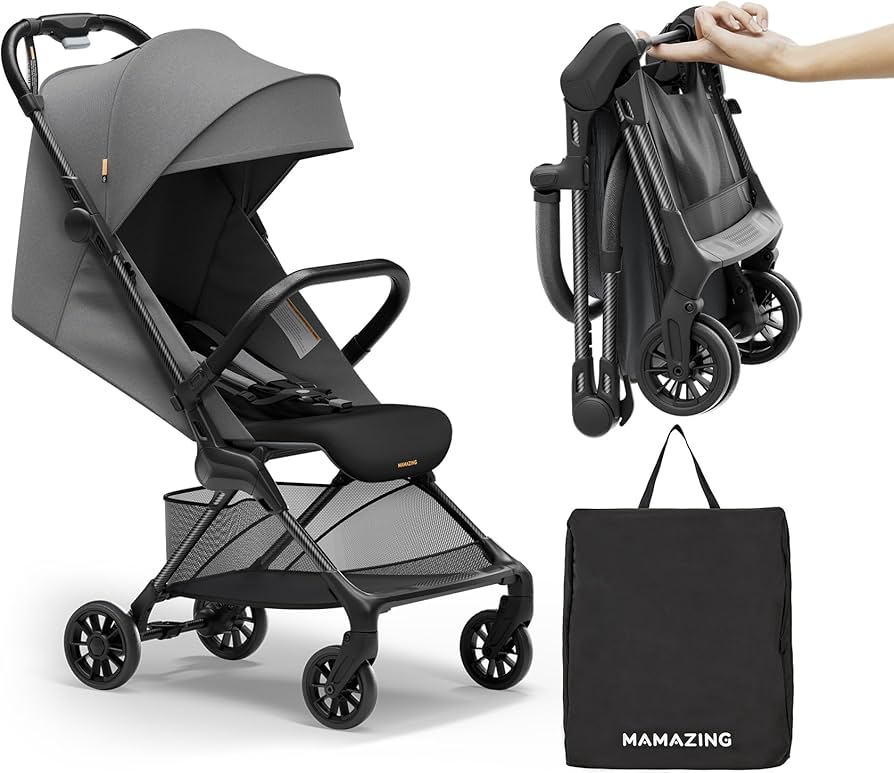
The current page already leans heavily toward Ultra Air, and there is a reason that instinct exists. For parents who want a lightweight stroller for travel mainly because they are tired of carrying something bulky, the Ultra Air sits close to the center of what they are really asking for: very low carry weight, a compact travel-friendly fold, easy steering, and a toddler-focused setup that does not feel overbuilt for simple trips.
At 11.6 lbs, the Ultra Air is light enough to feel meaningfully different from many heavier strollers during real travel moments. That matters when you are moving through airport lines, folding with one hand before getting into a car, carrying a stroller up a short staircase, or handing it off at the gate while also managing a child and a bag. The value of a lightweight stroller often becomes clearest in these small transitions, not just in long scenic walks.
Its strongest use case is not “every family should buy this no matter what.” Its strongest use case is “I want a stroller that makes toddler travel less annoying.” That is a much more believable claim, and it helps the right families self-select faster.
Where Ultra Air fits best
Ultra Air is usually most appealing to parents with a child in the 6-to-36-month stage who want travel convenience first. It makes sense for airport-heavy trips, short vacations, grandparents who do not want to lift a heavy stroller, day trips where speed matters, and urban movement where carrying and folding happen often. It also works well for families who already have a more substantial stroller at home and want a lighter second option for outings that do not need the full-size setup.
Where Ultra Air is not the best fit
This is the boundary many product-led pages skip. Ultra Air is not the right answer if you specifically need newborn readiness, if you want a stroller to replace a more versatile everyday system from day one, or if you are assuming every airline will let you store it in the overhead bin. Travel-friendly does not automatically mean overhead-bin guaranteed, and lightweight does not automatically mean newborn-safe. Parents make better decisions when those limits are said clearly.
If newborn use or a different seat setup matters more than raw portability, a stroller like the Air Lux may be closer to what you actually need.
How to choose the best lightweight stroller for your trips
The easiest way to choose a lightweight stroller for travel is to start with your most annoying travel moment. Are you frustrated by lifting? By folding in crowded places? By trunk space? By a toddler who gets uncomfortable too quickly? Different frustrations point to different priorities.
If lifting is the biggest pain point, make carry weight your first screen.
If taxis, elevators, and hotel rooms are the problem, fold size matters almost as much as weight.
If long walks are common, do not sacrifice steering and seat comfort just to save a little extra weight.
If you travel only occasionally, you may want a stroller that still feels useful for local errands.
If your child is still very young, age readiness matters more than almost any travel label.
It also helps to shop with realistic expectations. Many parents say they want the lightest stroller possible, but what they really want is the easiest stroller to live with during travel. Those two things often overlap, but not always. The best lightweight stroller for travel is usually the one with the fewest annoying tradeoffs for your actual routine.
Travel situations that reveal whether a stroller is truly lightweight
Parents often do not discover what they really need from a travel stroller until they are already in motion. An airport security line, a crowded train platform, a narrow hotel elevator, a quick museum stop, or a long theme-park afternoon can expose a stroller's weak points much faster than a showroom test. That is why travel context matters so much when you compare models.
If you fly often, focus on fold speed, carry confidence, and how calmly you can manage the stroller while also holding documents, snacks, or a child's hand. If you rely more on road trips, trunk fit and fast loading may matter more than the absolute lightest number. If grandparents will use the stroller too, the question often becomes less about features and more about whether the stroller feels easy and unintimidating to handle.
City breaks add another layer. Parents who travel through subways, sidewalks, cobblestones, elevators, and busy crossings usually need a stroller that still feels agile when spaces get tight. A stroller can be very light on paper but still become frustrating if it feels twitchy, awkward to steer, or difficult to control one-handed around other people.
Thinking in these real scenarios can save families from buying the wrong kind of lightweight stroller. Instead of asking only, “Is this stroller light?”, ask, “Will this stroller make my hardest travel moment easier?” That is the question that usually leads to the best choice.
Common mistakes parents make when buying a travel stroller
A lot of travel stroller disappointment comes from mismatched expectations rather than a completely bad product. Parents often buy too fast because the promise of “lightweight” sounds universally good. It is helpful, but it is not the only thing that matters.
Buying only by weight. A lighter stroller can still be awkward if the fold is frustrating or the seat is not comfortable enough.
Assuming airline overhead-bin storage. Some compact strollers may fit, but airline rules vary and should always be checked directly.
Expecting a travel stroller to do every job. A lightweight model often works best when used for its strongest scenario, not every possible one.
Ignoring age and setup boundaries. Not every stroller marketed for travel is the right fit for newborns.
Forgetting how often you will carry it folded. The folded experience matters almost as much as the pushing experience.
These are small mistakes individually, but together they explain why some parents love a lightweight stroller and others feel disappointed even with a decent model.
Is a lightweight travel stroller worth it?
Yes, for the right family it usually is. A lightweight stroller for travel is worth it when travel logistics create more stress than the stroller solves in its current form. If you are regularly lifting, folding, storing, and moving quickly, then a lighter stroller often pays for itself in convenience long before you have taken many trips.
It may be less worth it if you rarely travel, strongly prefer a roomier full-size setup, or still need newborn-oriented flexibility more than portability. That is why this category works best when viewed as a fit question, not an upgrade question. Lighter is not always better. Better is better.
Frequently asked questions
What is the best lightweight stroller for travel?
The best lightweight stroller for travel is the one that balances low carry weight, compact folding, comfortable toddler use, and realistic travel convenience for your routine. For many Mamazing shoppers, Ultra Air stands out when portability is the top priority, but families who want more everyday flexibility may prefer a different fit.
Is the Mamazing Ultra Air a good lightweight travel stroller?
Yes, especially if you want a very light stroller that is easy to carry, fast to fold, and practical for toddler travel. It is most attractive for families traveling with children old enough for its use range and who want travel convenience more than newborn versatility.
Can a lightweight stroller fit in an airplane overhead bin?
Sometimes, but it depends on the stroller's folded dimensions and the airline's current rules. A travel-friendly stroller is not automatically overhead-bin guaranteed, so parents should always verify policies before flying.
Is a lightweight travel stroller enough for everyday use?
It can be, depending on your routine. Many parents use one successfully for errands, malls, quick outings, and city movement. But if you need newborn readiness, larger wheels, or broader all-day versatility, a full-size or more flexible stroller may still serve you better.
What should parents compare before buying a travel stroller?
Start with carry weight, fold size, fold speed, seat comfort, handling, age suitability, and your real travel pattern. The most useful comparison is not which stroller sounds best in general, but which one removes the most friction from your usual trips.
Final thoughts
A good lightweight stroller for travel should make travel simpler, not just sound impressive on a spec list. That usually means a mix of low weight, compact folding, practical comfort, and honest boundaries about who the stroller is for. This page works best when it keeps that broader guide identity first and then helps readers decide where Mamazing models fit inside it.
For families who want a very light, toddler-ready travel option, Ultra Air is an easy one to shortlist. For families who need more everyday versatility or a different setup, other Mamazing models may make more sense. The best result is not choosing the most hyped stroller. It is choosing the one that makes your real trips feel easier from the first fold to the last step home.



Cheap Baby Strollers: What to Look For in a Safe, Affordable Stroller for Daily Use and Travel
What Is a Good Travel Stroller? 9 Features That Matter Before You Buy