
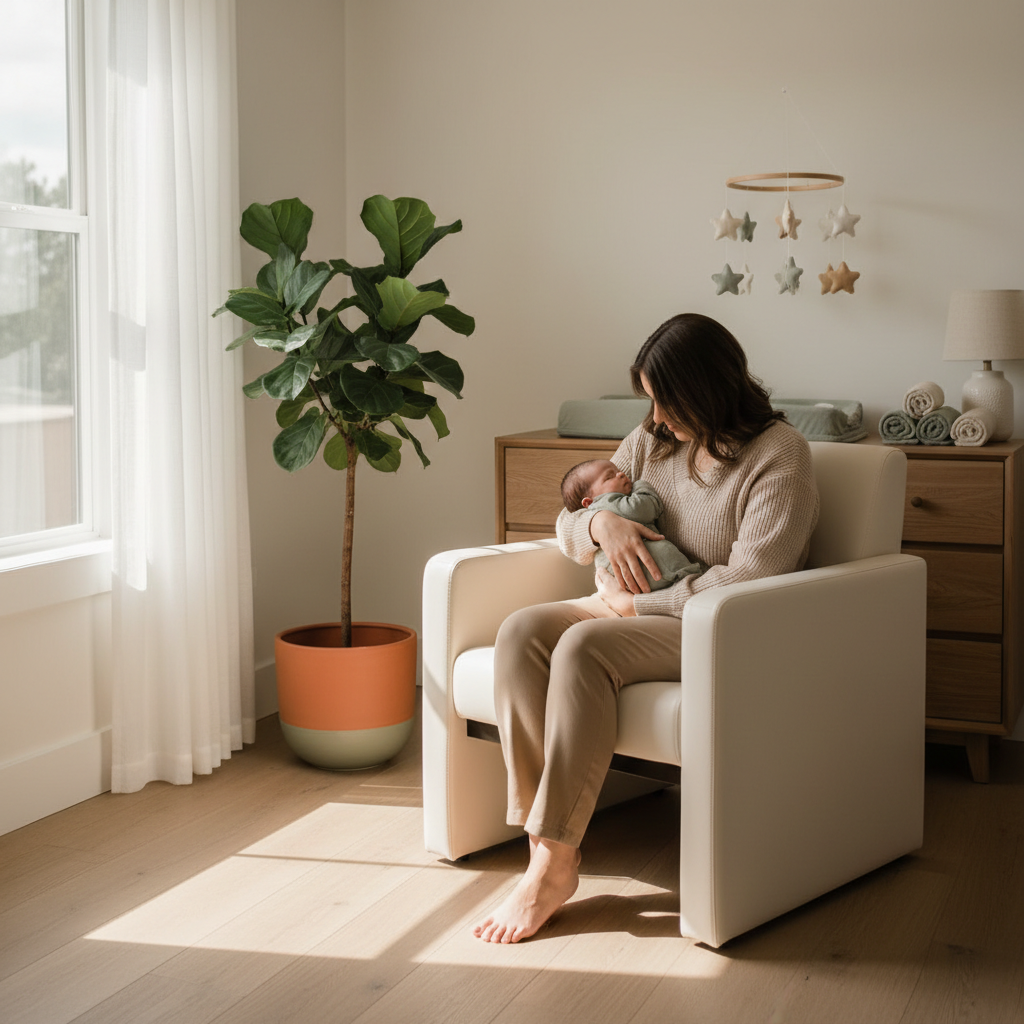
Hypoallergenic Nursing Chair: Best Materials for Sensitive Babies
- by WengGracy
When I was setting up our nursery, I bought a beautifully soft glider that came with a glowing low-VOC certification. Two weeks in, our daughter's eczema flared every single feeding. That experience taught me something most parenting blogs skip: a "non-toxic" nursing chair and a truly hypoallergenic nursing chair are not the same thing. If you're a parent of an allergy-prone newborn — or you're stocking a baby registry with one eye on the family eczema history — this guide from Mamazing walks you through exactly which fabrics, foams, and certifications actually protect sensitive skin, and which trendy materials silently trap allergens.
You'll learn how to read the labels, compare the materials, and avoid the most common buying mistakes parents make when shopping for a low odor glider nursery upgrade or sensitive skin baby room furniture.

Walk into any nursery showroom and you'll see "non-toxic" and "hypoallergenic" used as if they were interchangeable. They're not — and the difference matters a lot when your baby has sensitive skin.
"Non-toxic" addresses chemical safety: low or zero volatile organic compounds (VOCs), no chemical flame retardants, no formaldehyde. "Hypoallergenic" addresses something different — whether the materials trap or trigger allergens like dust mites, pet dander, latex proteins, or contact irritants. A GREENGUARD Gold certified glider can still harbor dust mites in a fluffy bouclé fabric. A chair marketed as "natural" can still send a latex-sensitized baby into hives.
Here's the part the marketing rarely makes clear:
The rest of this guide shows you how to do that — material by material, certification by certification.
The fabric your baby touches during every feeding is the single biggest hypoallergenic decision you'll make. Here's how the five most common nursing chair upholstery types compare on allergen accumulation, ease of cleaning, and chemical treatment risk.
Silicone leather has a non-porous surface, which means dust mites, pet dander, and pollen physically cannot penetrate the material. A 30-second wipe after each feeding session is the entire cleaning routine. There are no fiber gaps for allergens to settle into. The trade-off is breathability — silicone leather is less breathable than woven fabrics, so pair it with light cotton clothing in warm rooms. Always confirm the formulation is BPA-free and phthalate-free, and ask the brand for lab test documentation.
A tight-weave performance fabric carrying OEKO-TEX Standard 100 certification is tested against more than 1,000 harmful substances, including allergenic dyes and formaldehyde finishes. Removable covers that can be machine-washed at 60°C (140°F) are essential — the AAFA recommends hot-water washes to kill dust mites. This combination gives you a soft fabric feel with a manageable allergen profile.
Bouclé's looped open-weave construction traps dust mites, dander, and hair far more readily than tight-weave fabrics. It is not categorically unsafe, but it demands weekly HEPA vacuuming and should always carry OEKO-TEX or GOTS certification for dye and treatment safety. For a baby with diagnosed eczema or dust mite allergy, it's a high-maintenance pick.
Both have a raised-pile texture that holds onto allergens and resists thorough cleaning. Velvet in particular is hard to HEPA vacuum effectively. Choose these only if the fabric is OEKO-TEX-certified and the cover is removable and hot-washable.
A GOTS-certified organic cotton cover guarantees no pesticide residues, no chlorine bleach, and no allergenic synthetic dyes. A flat-weave or canvas style traps fewer allergens than a pile fabric, and machine-washable covers handle the hygiene side. For most sensitive-baby households, this combination wins on both chemical safety and cleanability.
The fabric gets all the attention, but the cushion underneath is doing just as much chemistry. Standard polyurethane foam can contain chemical flame retardants, formaldehyde residues from adhesives, and VOC-emitting plasticizers — none of which manufacturers are required to disclose to you at point of sale.
CertiPUR-US certification tests polyurethane foam to confirm it is made without PBDE or Tris flame retardants, formaldehyde, regulated heavy metals, or restricted phthalates, with total VOC emissions held below 0.5 parts per million. For a sensitive-baby nursery, this is the minimum bar for any foam-cushioned chair.
The latex paradox. Natural latex foam is widely marketed as the premium non-toxic upgrade. For most families it's a sound choice. But natural latex contains Hevea brasiliensis proteins, which the AAAAI classifies as both contact and airborne allergens for latex-sensitized individuals. If anyone in your family has a known latex allergy — or your child has tested positive for sensitization — choose CertiPUR-US certified polyurethane foam over natural latex.
Two more clarifications worth filing away:
The frame is the easiest part of the chair to ignore — and it is also the largest surface area emitting VOCs into your nursery air. Composite wood frames (plywood, MDF, particle board) that lack third-party certification can release formaldehyde from the urea-formaldehyde adhesives binding them together. TSCA Title VI compliance is the legal floor in the US. GREENGUARD Gold is the voluntary high standard.
Solid hardwood frames with water-based, zero-VOC finishes emit negligible formaldehyde and dissipate residual smell within days rather than months. FSC certification (Forest Stewardship Council) confirms the wood was harvested under verifiable chain-of-custody oversight. While FSC does not directly certify the chemistry of the finish, brands that invest in FSC sourcing tend to apply the same transparency to adhesives and topcoats.
Practical tip regardless of certifications: unwrap and air out any new piece of nursery furniture in a well-ventilated room for 48 to 72 hours before moving it into your baby's room. Even a fully certified chair benefits from this simple step.
By now you've seen the same handful of labels mentioned again and again. Here's what each one concretely tests — and just as importantly, what it does not test.
OEKO-TEX Standard 100 Class I. Tests the finished textile — fabric, thread, dyes, finishing treatments — against more than 100 substance categories at an independent accredited institute. Class I is the most stringent classification, reserved for products designed for direct skin contact with babies under 36 months. It does not cover foam or the frame. Verify any certification by entering the label number at oeko-tex.com.
GREENGUARD Gold. Tests the complete finished product in a controlled chamber for VOCs, formaldehyde, and more than 10,000 chemical parameters. UL notes the Gold tier applies stricter emission limits specifically for environments housing sensitive populations including schools, hospitals, and nurseries. It does not test for allergen accumulation, dust mites, or latex proteins.
CertiPUR-US. Applies only to polyurethane foam. Tests for no PBDE or Tris flame retardants, no formaldehyde, no regulated phthalates, no mercury or lead, and total VOC emissions of 0.5 ppm or less. It does not cover the frame or fabric.
GOTS (Global Organic Textile Standard). Certifies a textile is at least 70% organic natural fiber AND that the entire processing chain excluded prohibited synthetic chemical inputs — including chlorine bleaches and formaldehyde-based finishes. Stronger than an uncertified "organic cotton" claim.
FSC (Forest Stewardship Council). Verifies wood was sourced from responsibly managed forests with chain-of-custody tracking. A provenance and supply chain transparency signal rather than a direct chemical safety certification.
| Certification | What It Covers | What It Does NOT Cover |
|---|---|---|
| OEKO-TEX Class I | Fabric chemical safety for skin contact | Foam, frame, whole-chair VOCs |
| GREENGUARD Gold | Whole-product VOC and chemical emissions | Allergen accumulation, fabric chemistry |
| CertiPUR-US | Polyurethane foam chemistry | Frame, fabric, allergens |
| GOTS | Organic fiber and clean processing | Foam, frame, finished-product emissions |
| FSC | Wood provenance and forestry chain-of-custody | Chemical content of finishes |
No single certification covers every dimension of safety for a sensitive baby. A layered approach — fabric verified by OEKO-TEX, foam verified by CertiPUR-US, frame supported by FSC, and the whole product backed by GREENGUARD Gold — is the only way to truly cover both chemical and allergen risk.
If you'd like to see a curated set of nursing chairs designed against this checklist, the Mamazing collection below highlights options that meet the OEKO-TEX Standard 100 and CertiPUR-US benchmarks discussed above.

Even the most carefully chosen chair sits inside a larger nursery environment. A few small habits make a big difference for allergy-prone and eczema-prone babies.
Pair the nursing chair with a HEPA air purifier positioned near your feeding corner, especially during the first few weeks when any new-furniture VOC off-gassing is at its highest. If pet dander is a known trigger, keep cats and dogs out of the nursery — upholstered furniture holds onto pet allergens for months even with regular cleaning. Combining these habits with breastfeeding positions that reduce strain on your wrists and lower back makes those long feeding stretches sustainable for both of you.
Silicone leather (non-porous, wipe-clean) and OEKO-TEX-certified tight-weave performance fabric are the two safest choices. Silicone leather has zero fiber for allergens to penetrate. Certified performance fabric, with removable covers washed at 60°C, eliminates dust mites. Avoid bouclé, velvet, and sherpa unless you commit to weekly HEPA vacuuming.
Yes — new furniture can emit VOCs from foam, adhesives, and fabric treatments for weeks to months. GREENGUARD Gold certification tests the whole chair for emissions and is the most reliable third-party screen. Regardless of certification, air the chair out in a ventilated room for 48 to 72 hours before placing it in the nursery.
GREENGUARD Gold tests the complete chair — foam, frame, fabric together — for VOC and chemical emissions into room air. OEKO-TEX Standard 100 Class I tests the fabric textile alone for 1,000+ harmful substances at skin-contact level. The ideal chair holds both: OEKO-TEX for fabric safety, GREENGUARD Gold for whole-product air quality.
Bouclé's looped texture traps dust mites and pet dander more readily than smooth fabrics. It is not inherently unsafe, but it requires weekly HEPA vacuuming and should carry OEKO-TEX certification for dye safety. For babies with diagnosed dust mite allergy or eczema, silicone leather or tight-weave performance fabric is a lower-maintenance, lower-risk choice.
No. Natural latex contains Hevea brasiliensis proteins classified as allergens for latex-sensitized individuals. If your family has a known latex allergy, choose CertiPUR-US certified polyurethane foam instead. Natural latex is a reasonable non-toxic choice for non-sensitized families, but it is not a hypoallergenic foam option for those at risk.
It can contribute to flares through three routes: VOC off-gassing from new furniture, allergen accumulation (dust mites, pet dander, detergent residue) in uncleaned upholstery, and fabric friction during contact. A chair with OEKO-TEX-certified fabric, removable hot-washable covers, and GREENGUARD Gold certification significantly reduces all three risks.
The main verified alternative to standard foam is CertiPUR-US certified polyurethane foam — still polyurethane, but independently tested to exclude chemical flame retardants, formaldehyde, and heavy metals. Natural latex is an option for non-latex-sensitive families. Coconut coir and steel spring systems exist in a small number of chairs and are genuinely foam-free.
Look for four: OEKO-TEX Standard 100 Class I (fabric chemical safety), GREENGUARD Gold (whole-product VOC emissions), CertiPUR-US (foam without flame retardants or formaldehyde), and FSC (responsible wood sourcing). GOTS is a bonus if organic fiber is a priority. No single certification covers every dimension — a layered approach is the most protective.
Print this, save it on your phone, or screenshot it for your registry shopping list. If a chair meets every must-have item below, you've cleared both the chemical-safety and allergen-management bars. For a feature-by-feature breakdown beyond allergy-specific concerns, our comprehensive guide to choosing the best nursing chair covers ergonomics, motion type, and budget tradeoffs.
Fabric
Foam and Fill
Frame and Finish
Whole-Product
Nice to Have
Choosing the best nursing chair materials for sensitive babies is not about chasing one perfect product — it's about stacking the right certifications, picking the right fabric texture for your family's allergen load, and building a few small cleaning habits around it. The hypoallergenic nursing chair you'll feed your baby in for hundreds of hours deserves every one of those checks. At Mamazing, our Lullapod nursing chair — covered in detail in our full Mamazing recliner review — is built around the same OEKO-TEX Standard 100 and FSC-certified standards described above, so you can settle in for that quiet 3 a.m. feeding knowing exactly what your baby is touching, breathing, and resting against.
Featured Products


Built-In Footrest vs Ottoman for a Nursing Chair: Which One Is Right for You?
Late-Night Feeding Chair Tips: Comfort, Company and Calm