
How Stroller Weight Affects Your Daily Life: The Real Parent Test
- by WengGracy
A lightweight stroller sounds like an obvious win until you start comparing real life instead of product specs. Three extra pounds may not matter on a smooth showroom floor. They can feel very different when you are holding a diaper bag, opening a car trunk, calming a tired toddler, and trying not to block the apartment hallway.
That is the real stroller weight importance: not whether a stroller looks light on paper, but whether you can repeat your normal day without dreading the lift, fold, carry, and store moments. This guide gives you a practical parent test for heavy vs light stroller decisions, plus a clear stroller weight comparison framework you can use before you buy.
Stroller weight matters most when you lift the stroller often. If your stroller lives unfolded in a garage and rolls straight onto wide sidewalks, a few pounds may be a small tradeoff for bigger wheels, more storage, and a roomier seat. If you live upstairs, drive a compact car, use public transit, or fold the stroller several times a day, weight quickly becomes part of your daily energy budget.
The right question is not "What is the lightest stroller?" It is "How often will I lift this stroller, and what else will I be holding when I do it?" A stroller can be light but awkward. A heavier stroller can feel manageable if it folds cleanly, locks securely, and has a balanced carry handle. The listed weight is the start of the decision, not the whole decision.
Use this simple rule: the more transitions in your day, the more a lightweight stroller matters. Transitions include stairs, curbs, taxis, buses, car trunks, security lines, elevators, narrow entryways, and storage closets. Rolling weight is different from carrying weight, and daily parenting is full of both.
Before you compare features, run the stroller through the routine your body will actually repeat. This test works in a store, at home after delivery, or while comparing product dimensions online. It is especially useful because a stroller that feels fine for ten seconds may feel very different after a week of errands.

Give each move a green, yellow, or red score. Green means you would repeat it without thinking. Yellow means you can do it, but you notice the effort. Red means you already feel annoyed, strained, or unsure. One red score does not always rule out a stroller, but two or more red scores usually mean the stroller is fighting your daily life.
This is where many parents discover that the best lightweight stroller is not always the absolute lightest option. The winner is the stroller you can fold, carry, lift, and store without adding friction to the parts of parenting that are already busy.
A fair heavy vs light stroller comparison should look at tradeoffs, not labels. Lightweight designs often shine in apartments, travel, quick errands, daycare pickup, and public transit. Heavier full-size strollers may offer larger wheels, bigger baskets, plush seats, stronger suspension, or more accessory flexibility. Neither category is automatically better.
| Decision Point | Light Stroller Advantage | Heavier Stroller Advantage | Parent Test |
|---|---|---|---|
| Car errands | Easier trunk lifts | Often more storage | Lift twice in a row |
| City routes | Better for stairs and transit | May roll smoother | Carry folded for 30 seconds |
| Long walks | Less tiring at transitions | Often more comfort | Push over your usual surface |
| Small homes | Simpler storage | May stand sturdier | Test the real storage spot |
If you are choosing between categories, Mamazing's lightweight vs full-feature stroller comparison can help you think through broader feature differences. This article narrows the decision to weight, carry burden, and daily fit.
The same stroller can feel perfect in one routine and frustrating in another. Use your actual week as the filter. Here is where stroller weight usually shows up.

For walk-up apartments, even a beautiful stroller can become a problem if it must be carried every day. Look at the folded shape, not just the number on the spec sheet. A compact folded stroller with a secure lock and carry strap can feel more manageable than a lighter model that swings open or hits your knees.
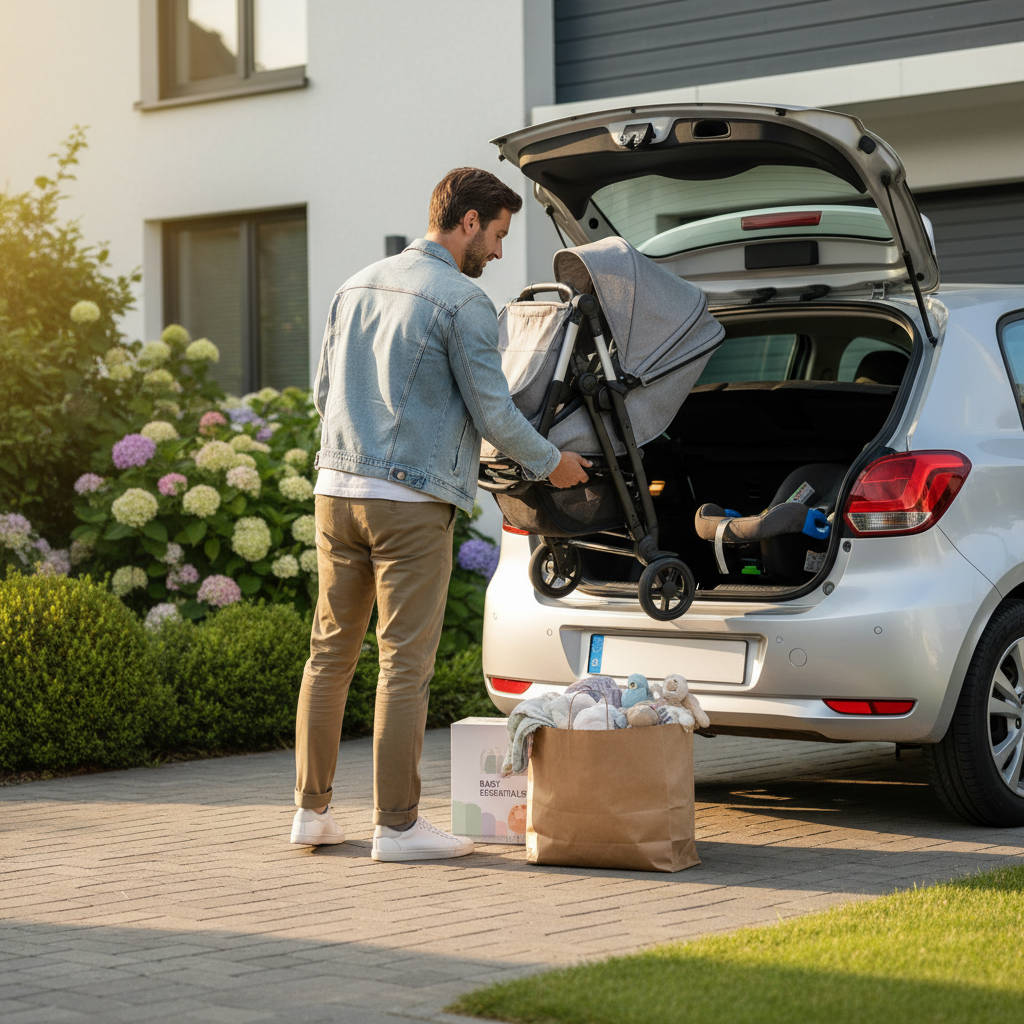
Car-based parents sometimes assume weight does not matter because the stroller mostly rolls. Then the trunk lift becomes the daily pain point. Try lifting the stroller into a trunk-height position while imagining a child waiting beside you. If you need to twist your torso or use an awkward grip, that weight will feel heavier over time.
For buses, subway stairs, narrow shop aisles, and quick coffee stops, a lightweight stroller can change your whole mood. The goal is not just less weight; it is faster transitions. You want a stroller that folds before the bus arrives, carries without banging into everyone, and reopens without a small engineering ceremony.
Travel adds its own friction. The TSA says strollers and umbrella strollers must be screened by X-ray, and items that do not fit through the X-ray machine may need visual or physical inspection; children must be removed from strollers during screening according to TSA traveling-with-children guidance. FAA baggage advice also notes that most airlines use 45 linear inches as the maximum for carry-on bags, while reminding travelers to check airline rules.
That does not mean every travel stroller must fit overhead. It means a travel day rewards a stroller that is light, quick to fold, and easy to move through screening and boarding. If travel is a big part of your life, compare a lightweight stroller collection with your airport routine in mind.
Listed stroller weight is measured under controlled conditions. You will experience it in motion, usually while doing something else. That is why folded weight can matter more than the product number.
Ask these questions:
This is also where one-hand fold claims deserve a real test. One-hand fold is helpful only if the folded stroller is easy to control afterward. If the stroller collapses nicely but lands in an awkward long shape, it may still be hard to load, carry, or store.
Parents deciding between daily and travel designs may also want to read Mamazing's guide to travel stroller vs everyday stroller. It helps separate category fit from weight alone.
A lighter stroller should still feel stable, secure, and appropriate for your child. The American Academy of Pediatrics' HealthyChildren guidance tells parents to choose a stroller that is convenient, comfortable, and safe, and it recommends safety basics such as a wide base, brakes, and a five-point harness. It also warns parents not to hang bags from stroller handles because that can cause tipping.
In the U.S., strollers are also covered by federal safety requirements. CPSC business guidance for carriages and strollers describes requirement areas such as latching and locking mechanisms, parking brakes, stability, restraint systems, wheel and swivel assembly detachment, and labeling. A lightweight frame is not a shortcut around those fundamentals.
So when you compare stroller weight, do not reward lightness if the stroller feels wobbly, has a weak brake, uses a harness that is hard to adjust, or does not suit your child's age and size. Weight should make daily life easier without making everyday safety checks harder.
Your route is the best shopping filter. A parent who parks in a driveway has a different weight problem than a parent who climbs stairs to a third-floor apartment. Use the route below that sounds most like your week.
Prioritize a light folded carry, a reliable lock, compact storage, and easy steering in tight spaces. Basket size still matters, but do not let a giant basket tempt you into a stroller you hate carrying upstairs.
Test trunk height, folded length, and whether the stroller leaves room for groceries. A slightly heavier stroller can work if the lift is clean and the fold is compact. If the folded frame catches on the trunk opening, the listed weight will not save you.
Look at weight, folded size, carry strap, and how fast the stroller folds under pressure. Your best option is often the one that reduces steps, not the one with the longest feature list.
Choose for the person who will struggle most, not the strongest adult in the house. A stroller used by grandparents, babysitters, or postpartum parents should pass the lift and fold test for them too.
When you are ready to compare models, use this stroller weight comparison mindset across different baby stroller collections: lift, fold, carry, store, repeat. The best choice is the stroller that fits your real route, not just the one with the most impressive spec line.
Stroller weight is only the empty starting point. Daily weight includes your child, diaper bag, snacks, water bottle, blanket, rain cover, toys, and whatever you grab during errands. A light stroller with a small basket may push you toward hanging bags on the handle, which HealthyChildren specifically warns against because it can make the stroller tip. A heavier stroller with better storage may feel calmer for grocery walks, as long as you do not need to carry it often.
This is the part of the decision that spec charts miss. A stroller is not a dumb frame; it is the rolling center of your parent workflow. If a lighter stroller makes you carry more on your shoulder, it may not actually reduce your daily load. If a heavier stroller lets you keep bags low and organized but never needs to be lifted, it may feel easier than expected.
The sweet spot is usually a stroller light enough for your transitions and capable enough for your cargo. Do not buy weight in isolation. Buy the daily setup.
A lightweight stroller is not a moral victory. Sometimes the better parent choice is a stroller with more structure. If your daily walk includes broken sidewalks, gravel paths, long park loops, or a child who naps in the stroller for long stretches, comfort and stability may matter more than shaving off every pound.
Heavier strollers often earn their place when they solve problems you truly have. A deeper recline can help with rest. Larger wheels can make rough surfaces less frustrating. A bigger basket can keep bags low instead of hanging from the handle. A roomier seat can be useful if your child is tall, bundled in winter layers, or close to the upper end of a compact stroller's comfort range.
The key is to separate useful weight from accidental weight. Useful weight gives you something back: smoother steering, better storage, a stronger-feeling fold, or a seat your child can use longer. Accidental weight just makes every lift harder without improving your route. During your stroller weight comparison, write down what each extra feature actually does for your day. If you cannot name the daily benefit, you may not want to carry it.
Some families eventually use two strollers: a fuller everyday stroller for long neighborhood walks and a lightweight stroller for travel, car errands, grandparents, or public transit. That is not always necessary, and it is not the budget-friendly answer for everyone. But it can be realistic when one stroller is being asked to solve opposite jobs.
If you want one stroller only, choose based on the most annoying part of your week. If stairs are the pain point, prioritize weight and carry. If long walks are the pain point, prioritize push feel and child comfort. If car errands are the pain point, prioritize trunk fit and folded handling. The "best" stroller is usually the one that removes the problem you repeat most often.
Yes, a lightweight stroller is often worth it if you fold, lift, carry, or store your stroller often. It is especially helpful for apartments, public transit, small cars, daycare pickup, and travel. If your stroller mostly stays unfolded and rolls on smooth paths, a heavier model may still make sense.
There is no single official cutoff. In shopping language, lightweight usually means a stroller that is noticeably easier to lift and carry than a full-size model. Instead of chasing one number, run the lift, fold, carry, and store test with your real routine.
Not automatically. Safety depends on the stroller's stability, brakes, harness, locking mechanisms, correct assembly, and correct use. A lightweight stroller can be safe when it is well-designed and used according to the manual.
Compare listed weight, folded shape, carry handle, fold lock, trunk fit, storage location, and who will lift it. The best stroller weight comparison is a real-life movement test, not just a spec chart.
It can matter in both. Travel makes weight obvious at security, boarding, taxis, and hotels. Daily errands make weight obvious through repetition: lifting into the trunk, climbing stairs, squeezing into elevators, and storing the stroller at home.
Look at safety, stability, brakes, harness comfort, fold quality, wheel size, seat support, canopy coverage, basket access, folded dimensions, and whether the stroller fits your child's age and size. Weight helps only if the rest of the stroller works for your life.
Yes, a lightweight stroller is often worth it if you fold, lift, carry, or store your stroller often. It is especially helpful for apartments, public transit, small cars, daycare pickup, and travel. If your stroller mostly stays unfolded and rolls on smooth paths, a heavier model may still make sense.
There is no single official cutoff. In shopping language, lightweight usually means a stroller that is noticeably easier to lift and carry than a full-size model. Instead of chasing one number, run the lift, fold, carry, and store test with your real routine.
Not automatically. Safety depends on the stroller's stability, brakes, harness, locking mechanisms, correct assembly, and correct use. A lightweight stroller can be safe when it is well-designed and used according to the manual.
Compare listed weight, folded shape, carry handle, fold lock, trunk fit, storage location, and who will lift it. The best stroller weight comparison is a real-life movement test, not just a spec chart.
It can matter in both. Travel makes weight obvious at security, boarding, taxis, and hotels. Daily errands make weight obvious through repetition: lifting into the trunk, climbing stairs, squeezing into elevators, and storing the stroller at home.
Look at safety, stability, brakes, harness comfort, fold quality, wheel size, seat support, canopy coverage, basket access, folded dimensions, and whether the stroller fits your child's age and size. Weight helps only if the rest of the stroller works for your life.
Featured Products


Stroller Frame Materials Guide: Aluminum vs Steel vs Carbon Fiber
What Is a Glider Chair? Everything New Parents Need to Know