Quick answer: If you want to avoid a travel stroller failure, focus less on story-driven fear and more on a repeatable safety check. The U.S. Consumer Product Safety Commission explains in
Carriages and Strollers that modern stroller standards cover stability, parking brakes, restraint systems, latches, folding mechanisms, and wheel attachment, while the agency's stroller hazard summary in
CPSC Approves Proposed Rule Aimed at Making Strollers Safer lists wheel detachment, parking-brake failures, hinge issues, and stroller collapse among the recurring danger patterns. That is why the best prevention plan is simple: check the fold lock, test the brakes, secure the harness, keep cargo within limits, and use the stroller only on surfaces it is actually built to handle.
If you searched for travel stroller safety features, dangerous stroller mistakes, or how to avoid travel stroller failures, you probably do not need another dramatic cautionary tale. You need a practical guide that tells you what to inspect before a trip, what misuse causes avoidable failures, and what warning signs mean the stroller should be repaired, replaced, or retired from travel use. That is the job of this page.
The original article leaned heavily on anecdotal stories. Stories can be memorable, but they are not the strongest answer for the intent now showing up in Google Search Console. Parents searching this topic usually want a checklist: what makes a stroller safer, what can make it fail, and what to do before a small issue becomes a travel-day problem. So this rewrite keeps the failure-prevention theme, but it reframes the article around high-value decisions you can actually use at the airport, on a city trip, or during everyday errands.
Travel Stroller Safety Features to Look For Before You Travel
A good travel stroller is not just the lightest model you can fold with one hand. It is the one that stays predictable when you are tired, carrying bags, navigating curbs, or moving through a crowded gate. The American Academy of Pediatrics notes in How to Choose a Safe Baby Stroller that easy-to-use brakes, a wide base, a secure fold, and a five-point harness are core safety considerations, not optional extras. The CPSC also groups stroller safety around the same themes: braking, stability, restraint, wheel attachment, and latching performance.
That matters because many stroller disappointments begin with a shopping mistake. Parents often compare cup holders, fold size, or color first, then assume safety and structural reliability are built in. In reality, the most expensive-looking feature may have far less impact on safety than the least glamorous one. A stroller with beautiful fabric but weak wheel tracking is still a bad travel partner. A stroller that folds tiny but never feels fully locked open is still a risk. When you evaluate a travel stroller, ask whether it inspires confidence during ordinary stress, not just whether it looks good in a product photo.
These are the features worth prioritizing before any trip:
-
A fold lock that engages clearly: You should not have to guess whether the stroller is fully open. If the locking point feels vague, sticky, or inconsistent, that is a meaningful concern.
-
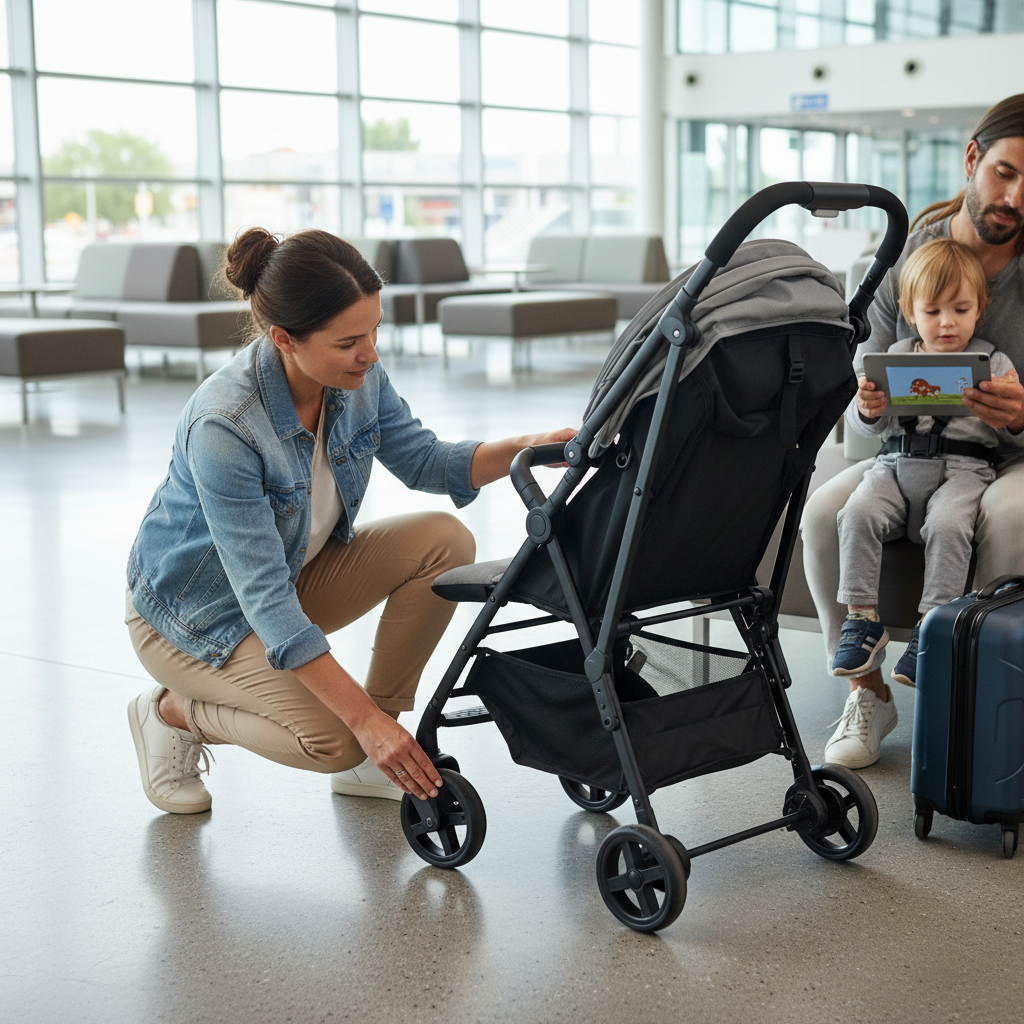
Brakes you can test quickly: Parking brakes should engage and hold without a fight. If you stop on a slight slope, the stroller should stay put.
-
A true five-point harness: Parents often think of the harness mainly for wriggly toddlers, but consistent restraint matters for preventing falls during sudden stops or curb transitions.
-
Stable wheel and steering behavior: The stroller should track straight, turn cleanly, and avoid wheel wobble when loaded the way you will actually use it.
-
A frame that stays rigid under normal pressure: Some flex is normal in lightweight gear, but obvious twisting, rattling, or side-to-side looseness is not something to ignore.
-
Storage that does not destabilize the stroller: A basket is helpful only when it works within the stroller's balance and weight limits.
-
Weather coverage that fits your destination: Shade, rain protection, and breathable fabric do not fix a bad stroller, but they do prevent smaller discomfort issues from turning into travel-day chaos.
One of the easiest ways to misjudge stroller quality is to test it empty. An empty stroller almost always feels smoother than a loaded one. Before travel, test the stroller with your child and with the typical gear you will carry. Roll it over thresholds, corners, elevator gaps, and rough patches. That short real-world test tells you much more than a showroom fold demo.

Dangerous Stroller Mistakes That Can Lead to Travel Failures
Some stroller failures really do come down to a bad product. But many happen when a decent stroller is used in ways that push past its design limits. That is why the phrase dangerous stroller mistakes deserves a visible section of its own. Parents usually do not need perfection; they need to know which habits quietly increase risk.
The first common mistake is treating a travel stroller like a universal stroller. Lightweight travel strollers are often built for portability and smooth-surface convenience. They are great at airports, malls, sidewalks, and short city outings. They are not automatically built for cobblestones, gravel paths, repeated curb drops, amusement parks, or daily heavy-duty neighborhood use. When the stroller and the terrain do not match, steering, wheels, brakes, and the frame all absorb extra stress.
The second mistake is overloading the stroller in ways that feel harmless. HealthyChildren specifically warns in How to Choose a Safe Baby Stroller not to hang bags from stroller handles because doing so can make the stroller tip backward. The same article also advises parents to keep cargo low and within the stroller's intended storage area. In practice, that means the diaper bag on the handle, a shopping bag on one side, and souvenirs stuffed in the basket can turn a stable stroller into an unpredictable one.
The third mistake is ignoring small warning signs because the stroller still technically moves. Many parents notice a new rattle, a sticky brake, a wheel that drifts, or a fold that needs a harder shove to lock. Then they keep using the stroller because the problem is not dramatic yet. But the CPSC's incident review in its stroller hazard report shows that wheel detachment, brake failures, hinge issues, and collapse are not abstract ideas. They are real failure categories with real injuries attached to them.
The fourth mistake is assuming recalls only matter for obviously defective products. They also matter for products that once felt perfectly normal. Recent CPSC recall notices such as Stokke's YOYO3 stroller brake recall and Guava Family's Roam stroller recall show how brake or disengagement problems can surface even in widely used stroller models. You do not need to become a recall obsessive, but you should check recall status for any stroller that starts behaving unpredictably.
To make this more concrete, here are five mistakes worth treating as non-negotiable red flags:
-
Skipping the brake test before you leave: If you never test the brake until you need it on a slope, you are testing it at the worst possible moment.
-
Using handle-hung bags as permanent storage: It is convenient, but it changes balance fast.
-
Pushing a compact stroller on rough terrain again and again: A short patch may be fine. Repeated rough use is different.
-
Accepting a half-locked fold: If you need to kick, slam, or re-open the stroller multiple times before it feels stable, that is not normal travel friction.
-
Continuing to use the stroller after a wheel, brake, or frame problem appears: Travel is exactly when an unresolved issue is most likely to get worse.
Notice that none of these mistakes depend on a dramatic backstory. They are ordinary habits. That is good news, because ordinary habits are easier to change than luck.
Pre-Trip Travel Stroller Safety Checklist
The fastest way to prevent a failure is to run a short inspection before each trip. This does not need to become a thirty-minute ritual. The point is to catch the predictable problems when they are still small.
-
Open and lock the stroller twice. Confirm that the frame opens fully and the locking point feels secure each time.
-
Set the brakes and push lightly. Make sure the stroller does not creep forward or backward.
-
Spin or roll the wheels. Listen for scraping, feel for wobble, and check whether both sides track evenly.
-
Inspect the harness. Look for twisted straps, broken buckles, or worn webbing.
-
Check visible fasteners and joints. Loose screws, widening gaps, or new frame movement are worth attention.
-
Review your cargo plan. Keep heavy items off the handle and stay within basket limits.
-
Match the stroller to the trip. Ask whether the real route includes stairs, cobblestones, beach access, long sidewalks, rough pavement, or heavy all-day use.
Most parents benefit from turning this into a mental script: lock, brake, wheels, harness, cargo, terrain. Short checklists work because they are easy to repeat when you are rushing.
It can also help to split problems into two buckets. The first bucket is annoying but manageable: a squeak, light dirt in the wheel housing, a cup holder that rattles, or fabric that needs cleaning. The second bucket is safety critical: a brake that slips, a latch that does not hold, a wheel that wobbles after tightening, or a frame that feels unstable with your child inside. The first bucket may be inconvenient. The second bucket should change your plan immediately.
If you share stroller duty with a partner, grandparent, or babysitter, make the checklist visible. A stroller is not safer just because one person knows its quirks. Travel stress usually appears when someone else folds it, loads it differently, or uses it in a new setting without the same background knowledge.
When to Repair, Replace, or Stop Using a Stroller
This is the section many parents search for without using those exact words. Queries such as stroller repair near me, stroller mechanic, or parts of stroller often signal the same underlying question: is this still safe enough to use with my child, or am I trying to rescue gear that should be retired?
Start with the simplest rule: if a problem affects braking, restraint, folding, wheel security, or structural stability, treat it as a safety issue first and a convenience issue second. Cosmetic wear is annoying. A brake that disengages on its own is a hard stop. A canopy that sticks is inconvenient. A fold lock that no longer clicks into place is a travel-ending problem.
Use this framework:
-
Repair may be reasonable when: the issue is minor, repeatable, and clearly limited to maintenance, such as dirt in a joint, a loose but intact fastener, or routine wheel wear addressed by the manufacturer.
-
Pause use and inspect before the next outing when: the stroller pulls to one side, the brakes feel inconsistent, the wheel wobble is new, or the frame starts rattling under normal load.
-
Stop using it immediately when: the stroller collapses, the lock slips, a wheel detaches, the brake will not hold, the harness buckle fails, or the frame shows cracking or major deformation.
Parents sometimes resist replacing a stroller because the failure happened only once. But single-event safety failures matter. A brake that unexpectedly disengages one time has already told you something important. A stroller that nearly folds during use has already crossed the line from inconvenient to unsafe. If you would not trust that mechanism during a rushed airport transfer or curb crossing, that is your answer.
Also remember that repairability is part of safety. If replacement parts are hard to verify, if the manufacturer cannot clearly support the repair path, or if the fix still leaves you second-guessing the stroller, replacement may be the more realistic safety decision. There is no prize for squeezing one more trip out of gear you no longer trust.
Can a Travel Stroller Be Used Every Day or on Rough Terrain?
This is where many parents accidentally create their own failure story. A stroller can perform beautifully for travel and still be the wrong tool for daily life. Compact travel strollers are usually optimized around portability: lighter weight, smaller fold, easier carry, quicker airport handling. Those are real strengths. But those strengths often require tradeoffs in wheel size, suspension feel, frame rigidity, and cargo capacity.
If your daily reality looks like smooth sidewalks, errands, daycare drop-off, public transit, and occasional trips, a quality travel stroller may be enough for both travel and everyday use. If your reality includes rough pavement, gravel, repeated curbs, long walks, heavy storage, or a child who still needs lots of padding and support, the same stroller may wear out faster or feel unstable sooner.
That is why this question should be framed less as “Can I?” and more as “Under what conditions does it still stay predictable?” For a deeper comparison, see our travel stroller vs everyday stroller guide, which breaks down where compact convenience makes sense and where an everyday frame may be the better fit.
Rough terrain deserves special caution. Even without a dramatic failure, repeated bumps and vibration can reveal weaknesses over time. If you know your trip includes cobblestones, broken sidewalks, park paths, or long stretches of uneven ground, shop and pack accordingly. Our guides to what makes a good travel stroller, lightweight strollers for travel, and how to choose the perfect stroller for your next adventure can help you match stroller type to destination more realistically.
The key idea is not that travel strollers are fragile. Many are excellent. The key idea is that they are purpose-built. And purpose-built gear works best when parents respect the purpose.
A Safer Way to Think About Travel Stroller Shopping
Parents often ask for the best travel stroller as if there is one universal answer. Usually there is not. The smarter question is: what is the safest travel stroller for my trip pattern, cargo load, and everyday routine?
If you fly often and need something you can fold quickly with one hand, convenience may deserve more weight. If you mostly walk in older cities, wheel behavior and frame confidence may matter more. If you expect to use the stroller every day after the trip, durability deserves extra priority. And if you know you regularly overload storage or rely on the stroller to carry too much gear, it is better to plan around that honestly than to hope balance issues will not matter.
A useful buying filter looks like this:
| Question |
Why it matters |
| Does the fold lock feel secure every time? |
A vague lock is one of the clearest confidence-killers in travel use. |
| Do the brakes hold on a slight incline? |
That is a fast real-world safety check, not a showroom nicety. |
| Can the wheels handle your actual route? |
Smooth-store flooring tells you very little about real travel surfaces. |
| Does the stroller stay stable with normal cargo? |
Balance problems often show up only after bags and a child are added. |
| Would you trust it for both travel and everyday use? |
If not, plan for its limits instead of asking it to do everything. |
That framework may feel less exciting than a roundup of dramatic stroller mishaps. But it is much more useful. The goal is not to scare parents away from travel strollers. The goal is to help them choose one they can trust and use it in ways that keep small weaknesses from turning into bigger failures.
Frequently Asked Questions
What travel stroller safety features matter most before a trip?
Start with the basics that reduce the most common failure points: a secure folding lock, easy-to-use parking brakes, a five-point harness, stable wheel attachment, and a frame that does not wobble under load. A stroller can feel light and convenient, but it still needs predictable brakes, reliable latches, and enough stability for the surfaces you actually plan to use.
What are the most dangerous stroller mistakes parents make while traveling?
The biggest mistakes are skipping a pre-trip brake and wheel check, hanging heavy bags from the handle, overloading the basket, using the stroller on terrain it was not built for, and continuing to use it after a locking or steering problem shows up. Most travel stroller failures are not truly random; they usually follow a warning sign or a mismatch between the stroller and the trip.
When should I stop using a stroller and get it repaired or replaced?
Stop using the stroller right away if the frame cracks, the fold lock does not stay engaged, a brake will not hold, a wheel detaches or wobbles after tightening, or the stroller pulls sharply to one side. Those are safety issues, not convenience issues. Minor cosmetic wear can wait, but any failure involving restraint, brakes, folding, or structural integrity should move the stroller out of travel duty until it is professionally repaired or replaced.
Can a travel stroller be used every day?
Sometimes, yes, but only if its frame strength, wheel quality, brake performance, and storage limits fit your normal routine. A compact travel stroller can work well for airports, errands, and smooth sidewalks, but frequent rough terrain, heavy cargo, or all-day neighborhood use may call for a sturdier everyday stroller.
Is a lightweight travel stroller safe on rough terrain?
Not automatically. Lightweight travel strollers are usually designed for portability first, so rough pavement, cobblestones, gravel, curbs, and repeated shocks can expose weaknesses in steering, wheel tracking, and frame stability. If rough terrain is part of your real life, choose a stroller specifically built for that use instead of assuming every compact stroller can handle it.
What should I check if my stroller wheels or folding mechanism start to fail?
Check for loose fasteners, uneven wheel wear, axle play, dragging brakes, dirt in the folding joints, and any latch that only partially clicks into place. If the problem returns after basic cleaning and tightening, or if the stroller collapses, rolls unexpectedly, or feels unstable with your child inside, stop using it and contact the manufacturer or a qualified repair source before the next outing.
Final Takeaway
The best way to avoid travel stroller failures is not to memorize scary stories. It is to build a better filter: buy for braking, locking, wheel stability, harness security, and terrain fit; use the stroller within its real limits; and treat new safety issues as action signals, not annoyances. If you do that, you give yourself a better chance of having the kind of travel stroller experience parents actually want - calm, predictable, and forgettable in the best possible way.




Mamazing Recliner Review: A Nursery Chair for Feeding, Rocking, and Late-Night Resets
From First-Time Mom to Pro: My Journey with Mamazing Gear