
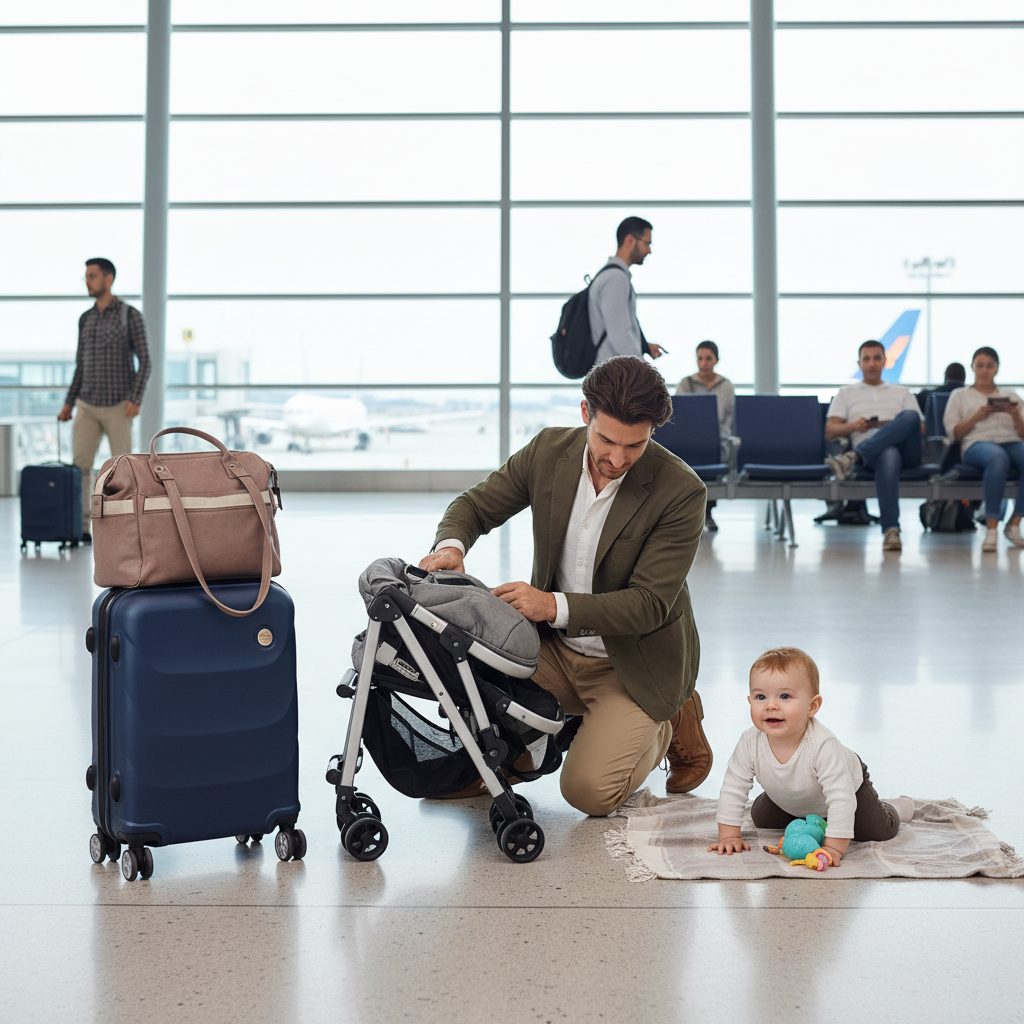
If you are wondering can I bring a stroller on a plane, the short answer is usually yes. The better answer is: yes, but how it travels depends on the stroller’s size, your airline’s rules, and whether you plan to check it at the counter, gate-check it, or try to carry it onboard.
That distinction matters more than parents expect. Most travel stress does not come from the word “yes.” It comes from the messy second question: will your stroller be free to check, can you use it right up to the plane door, and what happens if you are hoping it will fit in the overhead bin but the airline says no at boarding?
At Mamazing, we think this topic is easiest when you stop treating “stroller on a plane” like a single rule and start treating it like a travel decision tree. This guide walks you through the practical version: what TSA screening looks like, what major airline examples say, when gate check is the smarter move, and how to avoid common mistakes before you leave home.
Quick Answer: Can You Bring a Stroller on a Plane?
Yes, you can usually bring a stroller on a plane trip, but that does not always mean you can wheel it into the cabin and place it in an overhead bin. In real travel, there are three common outcomes:
- You check it at the ticket counter before security with your larger bags.
- You gate-check it, which means you use it through the airport and leave it at the jet bridge before boarding.
- You carry it onboard only if it is compact enough, the crew allows it, and there is space in the cabin.
If you want the most realistic mental model, think “allowed to travel” first and “allowed in the cabin” second. That one shift saves a lot of last-minute disappointment.
It also helps to remember that stroller rules are rarely identical across every carrier and route. Some airlines are generous about free checked stroller handling. Some are more specific about non-collapsible models, stroller wagons, or full-size gear. And even when a stroller can fit overhead, the real boarding situation may still turn it into a gate-check day.
The 3 Most Common Ways a Stroller Travels
The easiest way to reduce airport stress is to decide before you leave home how you want your stroller to travel. Each option solves a different problem, and none of them is universally best.
1. Check it at the ticket counter
This is the simplest option if you already plan to use a baby carrier in the terminal, your stroller is bulky, or you are traveling with a full-size model that is clearly not a cabin candidate. Counter check can be the calmest choice when you know your stroller is going to end up in the hold anyway.
The tradeoff is obvious: once you hand it over, it is gone until you land. If you have a long walk to the gate, a layover, or a toddler who melts down the minute they have to walk farther than expected, that can feel harder than it sounds on paper.
2. Gate-check it
Gate check is often the best middle ground for families. You keep the stroller through check-in, security, and the terminal, then hand it over right before boarding. For many parents, that means less carrying, easier naps, and more control during the most chaotic part of the trip.
This is also why gate check is so popular with infants and toddlers. You can use the stroller as your airport base until the last practical moment, then pick it up again after landing. It is not perfect, because gate-checked gear can still get banged around, but it is usually far more convenient than checking a stroller at the counter if you have a child small enough to need wheels all the way to boarding.
3. Carry it into the cabin if it is truly compact
This is the option parents dream about, and sometimes it works beautifully. If your stroller folds small enough and the crew accepts it as an onboard item, you may be able to place it in an overhead bin and skip the whole gate-check process.
But this is where families get tripped up by marketing language. “Travel stroller” does not automatically mean “guaranteed cabin stroller.” Even if a stroller is compact enough on paper, the final call still depends on airline size rules, aircraft type, bin space, and boarding-day reality. That is why overhead-bin friendly is a better phrase than overhead-bin guaranteed.
What TSA and Airlines Usually Require
You do not have to guess your way through airport security with a stroller. The TSA says children’s gear such as strollers, umbrella strollers, baby carriers, car seats, and booster seats must be screened, and any stroller that does not fit through the X-ray machine gets a visual or physical inspection instead. TSA also notes that you should remove children from strollers and car seats before screening and carry them through the metal detector yourself. You can review that guidance on the TSA’s Traveling with Children page.
That means the checkpoint question is usually not “are strollers allowed?” but “how smoothly can you collapse yours, empty the basket, and get through screening without creating a traffic jam around yourself?” A stroller that folds quickly and one-handed is not just convenient in marketing photos. It genuinely changes your airport experience.
Airline rules are the next layer. Delta’s official children and infant baggage guidance says strollers and child-restraint seats can be checked for free and do not count toward the standard baggage allowance. Delta also says these items can usually be checked at the curb, ticket counter, or gate, depending on the situation. You can see that in Delta’s Children & Infant Baggage guidance.
American Airlines takes a similarly family-friendly approach, but with useful extra detail. In American’s official Traveling with children guidance, each ticketed customer traveling with a child may check one stroller and one car seat free of charge. American also distinguishes between non-collapsible strollers, which must be checked at the ticket counter, and most other strollers, which should be checked at the gate before boarding.
The practical takeaway is simple: most airlines will let your stroller travel, often at no extra charge, but the size and collapsibility of the stroller still shape where and how it travels. That is the part many short articles skip, and it is the part that matters most on an actual travel day.
Which Strollers Are Easiest to Fly With?
Not every stroller is equally good for air travel, even if every stroller technically works somewhere in the process. If your goal is the least friction possible, the easiest travel strollers usually share a few traits: a compact fold, manageable weight, quick collapse, and a shape that is easy to carry with one hand while you are also handling a diaper bag or a toddler.

Full-size strollers can absolutely still fly, but they are usually better candidates for counter check or gate check than for cabin carry-on. If you already know your stroller is large, do not waste energy trying to force an overhead-bin fantasy. Put your attention on protecting it, removing accessories, and making handoff smoother.
Compact and foldable travel strollers are where things get easier. They are usually faster through security, easier to wheel through crowded terminals, and more realistic for gate-checking without drama. And if you care about the possibility of bringing a stroller onboard, compact folded dimensions matter far more than generic “travel stroller” branding.
If you are specifically comparing options for overhead-bin potential, our guide to the best travel stroller for airplane overhead-bin use goes deeper into what really matters on flight day. The short version is this: the smaller and faster-folding your stroller is, the more choices you keep open.
How to Decide Between Gate Check and Carry-On
This decision is easier when you stop asking what sounds nicest and start asking what will actually reduce friction for your family. Carry-on sounds ideal because nobody wants to wait for a stroller or worry about rough handling. But a true cabin strategy only works if your stroller folds small enough, you can carry it easily, and you are comfortable with the possibility that staff may still ask you to gate-check it.
| Option | Best for | Main downside |
|---|---|---|
| Ticket-counter check | Large strollers, baby-wearing families, or trips where you do not need stroller help in the terminal | You lose the stroller before security and do not get it back until arrival |
| Gate check | Most families with infants or toddlers who want the stroller through the airport | The stroller still goes into aircraft handling flow and may need basic protection |
| Cabin carry-on | Families with a truly compact fold and a strong preference to avoid handoff | Never fully guaranteed because airline rules, aircraft type, and overhead space can change the outcome |
For many families, gate check is the sweet spot. You get the airport convenience without betting the whole day on bin space. Carry-on becomes more attractive if you travel often, hate waiting at arrival, and already own a stroller that folds into a genuinely compact package.
If your main question is whether a stroller can count as a carry-on, treat the answer as “sometimes.” American’s conditions of carriage, for example, say a fully collapsible stroller may be carried on if it is under 20 pounds and fits in an overhead bin, but that is still subject to airline suitability and storage availability. In other words, the folded stroller matters, but cabin reality matters too.
How to Prepare a Stroller for Air Travel Without Regret
The biggest stroller mistakes happen before boarding, not during the flight. Families either assume the stroller will be handled gently no matter what, or they leave too many accessories attached and end up annoyed when something goes missing, gets bent, or catches on other baggage.

If you are checking or gate-checking your stroller, do these things before you get close to the handoff point:
- Empty the basket and pockets. TSA already requires loose items to be screened, and airlines are not responsible for random toys, bottles, or chargers left stuffed underneath.
- Remove add-ons that snag easily. Cup holders, hooks, phone clips, and universal organizers are exactly the kind of accessories that disappear or break first.
- Take a quick photo. It sounds fussy, but it is useful if you ever need to document damage after a flight.
- Use a stroller bag if your setup needs one. Not every family needs this, but it can make sense for pricier gear, awkward shapes, or repeated air travel.
- Attach an ID tag. Airport gear starts to look weirdly identical when several families are waiting in the same gate-check area.
Do you need a stroller bag for a flight? Not always. If you are gate-checking a compact stroller and the trip is straightforward, many parents skip it. But if your stroller has exposed parts, you are using connections, or you know you will be checking it earlier rather than at the gate, a simple protective bag may be worth the effort.
This is also where a compact fold helps again. It is not only about possible overhead storage. It is about making every single transfer point less annoying: security, boarding, jet bridge handoff, baggage return, and ground transport after landing.
Flying With a Newborn: Stroller, Car Seat, and Airport Reality
Travel with a newborn changes the equation because the stroller is rarely the only gear question. Parents also need to decide whether to bring a car seat onboard, whether to use a travel system, and how much airport setup complexity they can tolerate.
If you bought your baby a seat and plan to use a child restraint onboard, the FAA strongly recommends that children under age 2 be secured in an approved child restraint system instead of riding as a lap infant. That guidance matters if your travel plan includes clicking a car seat into a stroller frame at the airport and then installing the seat on the aircraft. The FAA explains that position in its official Flying with Children guidance.
In real life, the newborn-friendly setup often comes down to two workable patterns:
- Travel system strategy: bring the infant car seat and a compatible stroller or frame so airport transfers feel easier.
- Carrier-plus-stroller strategy: use a baby carrier in the airport, then either gate-check or counter-check the stroller depending on your trip.
Neither is universally better. A travel system can feel wonderfully smooth after landing, but it also adds parts to manage. A carrier-plus-stroller setup feels lighter in some airports but harder in others. The right answer is usually the one that reduces the number of awkward transitions for your child, not the one that sounds most efficient online.
If your child is older and your goal is simply easier airport movement, a lightweight compact stroller becomes more appealing than a full travel system. That is where products built for folding speed and smaller travel footprints start to make a real difference.
Frequently Asked Questions About Bringing a Stroller on a Plane
Can you bring a stroller on a plane for free?
Usually, yes. Many airlines let you check a stroller free of charge, but the exact rule depends on the carrier. Delta says strollers and child safety seats can be checked for free, and American says one stroller and one car seat can be checked free for each ticketed customer traveling with a child. Always check your airline before travel because route and policy details can still vary.
Can you use a stroller until the gate?
Often, yes. That is what gate-checking is for. You use the stroller through the terminal, then leave it at the jet bridge before boarding. Some airlines expect most collapsible strollers to be checked this way, especially if they are not true cabin-size models.
Can a stroller count as a carry-on?
Sometimes, but only if it is fully collapsible, small enough for the overhead bin, and accepted by the airline on that specific flight. Think of cabin stroller travel as a possibility, not a guarantee. If overhead bins are full or the aircraft is smaller than expected, you may still be asked to gate-check it.
Do you need a stroller bag for a flight?
No, not always. A stroller bag is optional for many families, especially when gate-checking a compact stroller on a simple trip. It becomes more useful if your stroller has exposed parts, you are checking it earlier than the gate, or you want extra protection against scuffs and snagging.
Are stroller rules different on international flights?
They can be. International routes may involve different baggage allowances, aircraft types, and partner carriers, even when your ticket was bought from a familiar airline. If part of your trip is operated by another carrier, check the operating airline’s stroller and child baggage rules instead of assuming the first airline’s policy controls the whole trip.
Should you bring both a stroller and a car seat?
That depends on your child’s age, whether you bought a seat on the plane, and how you plan to get around after landing. If you are flying with a newborn or need a car seat at the destination, bringing both can make sense. If your child is older and you want the least gear possible, a compact travel stroller may be the easier airport choice.
Final Takeaway
So, can you bring a stroller on a plane? Yes, almost certainly. The more useful question is how you want it to travel. For most families, the smartest answer is not “whatever the airline allows.” It is “the option that makes the airport easier without creating a new problem at boarding.”
That is why gate check works so well for so many parents, why compact strollers are easier to live with on flight days, and why you should never buy a stroller based only on the hope that it will fit in an overhead bin every time. If you want more airport-specific strategy, our guide to navigating airports with a foldable stroller is a helpful next read.
If your goal is to keep travel light and realistic, a compact option such as the Mamazing Ultra Air travel stroller is worth comparing before your next trip. But whatever stroller you choose, the winning move is the same: check your airline’s current rule, decide your handoff plan before you leave home, and keep airport transitions simpler than you think you need to.


When Can Baby Sit in a Stroller? Age, Readiness Signs, and Safety Rules
When Do Babies Start Crawling? Milestones & Tips