
- by Mamazing Team
When Do Kids Stop Using Strollers Age Guidelines Development Signs and Parent Tips
- by Mamazing Team
Someone at the park gave you a look. Your four-year-old is in the stroller, they are perfectly comfortable, and a stranger has decided this is a commentary opportunity. And now you are home, googling "when do kids stop using strollers" at 11 pm, wondering if you have been doing something wrong.
You have not. The honest answer is that there is no universal stroller expiration date — and anyone who tells you otherwise is guessing. The real answer is a combination of your child, your lifestyle, and the outing. From strollers and baby gear for toddlers and growing families, the gear should serve the family, not the other way around. Here is what the actual evidence says, what to watch for, and when the stroller probably has served its time.

The most useful way to think about this is not by birthday but by how your daily life looks. Here is the typical picture, with the important caveat that every child develops differently:
|
Age |
Stage |
Typical use |
The stroller |
Key note |
|
2 years |
Toddler |
Frequently — most outings |
Probably essential |
Starting to want to walk short stretches |
|
2–3 years |
Active toddler |
Regularly — long outings and travel |
Very useful — do not rush |
First walking endurance emerging |
|
3–4 years |
Preschool stage |
Mixed — short walks no, long days yes |
Context-dependent now |
Big variation between children |
|
4–5 years |
Pre-K / school-age |
Situational — theme parks, travel, city |
Optional but still valid |
Many still use it for long outings |
|
5–7 years |
School-age |
Occasional — specific scenarios only |
Probably phased out daily |
Travel and big events are still reasonable |
|
7+ years |
Older child |
Rarely — special needs or extreme outings |
Individual family call |
No universal "too old" rule applies |
According to CDC developmental milestones for 3 to 5 year olds, walking endurance and following safety directions are the key physical skills that make stroller-free outings realistic, not a specific age. A child who cannot reliably stop at a curb is not ready to walk freely in traffic, regardless of how old they are.
|
The most honest answer to "when do kids stop using strollers?" Between 3 and 5 for most families, for daily errands and neighborhood outings. But this can extend to 6, 7, or beyond for travel, theme parks, or children with higher support needs. There is no age at which it becomes automatically inappropriate. Weight limits are the one hard rule — check your specific stroller manual. |

Age is one input. But these observable signals are much more reliable than a birthday for knowing when the transition is genuinely ready to happen:
|
Readiness signal |
What it actually means |
What it tell you |
|
Asks to walk instead of ride — consistently |
Not once in a while. If your child regularly refuses the stroller and walks without issue, that is genuine readiness. |
Strong signal — respect it |
|
Completes a 30–60 minute outing on foot |
Not just the parking lot. A full supermarket trip, a full park walk, the full school pickup route—stamina, not interest. |
Physical readiness confirmed |
|
Can follow safety—staminans reliably |
Stops at the curb. Stays close in carparks. Holds your hand when asked. This is the safety test, not the age. |
Safety readiness confirmed |
|
Pace matching — keeps up without being carried |
The stroller stops being used as transport and becomes a bag holder. Clear sign. |
Transition ready |
|
Shows embarrassment about using the stroller |
Some children genuinely feel self-conscious around same-age peers. Worth respecting. Not all do. |
Child-led signal |
|
Rarely naps on outings anymore |
If on-the-go naps are gone, one of the stroller's main functions has already dissolved. |
Practical readiness signal |
The AAP physical activity recommendations for young children recommend at least 60 minutes of active play daily for children aged 3 to 5. Walking outings contribute to that, which is a genuine developmental benefit of phasing out the stroller when a child is ready. But note that word: when. Not before.

Keeping a stroller past the typical age is not indulgence. It is usually a practical calculation about the specific outing or situation. Here is the breakdown:
|
Situation |
Why the stroller still helps |
Real-life note |
|
Long-distance walking days |
Zoos, theme parks, airports, city sightseeing — 15,000+ steps is too much for most children under 6. |
The stroller is the difference between a good day and a carried-out-meltdown day. |
|
Public safety concerns |
Busy roads, crowded train stations, high-footfall urban areas. A contained child is a safer child. |
Independence comes later. Containment in genuinely dangerous spaces is smart parenting. |
|
New sibling in the household |
An older child regressing to the stroller is common and usually temporary. Fighting it usually extends it. |
Give it a few weeks. The regression usually fades on its own. |
|
Long travel days — flights, long drives, airports |
Airports with a toddler on foot are an advanced-level parenting challenge. The stroller reduces that significantly. |
Travel is not everyday life. Bringing a stroller for travel does not undo any progress. |
|
Child has high sensory sensitivity or medical needs |
Some children genuinely need the containment and predictability of a stroller longer than their typical peers do. |
No judgment. Every child is different. |
|
Energy crashed mid-outing |
Even strong walkers hit a wall. A tired-to-carrying-weight child is heavier than a stroller—a practical calculation. |
Having the stroller available does not mean using it every time. |
|
The key distinction A stroller used strategically for long outings and travel, while the child walks independently for daily life, is perfectly healthy. A stroller used for every single outing because walking has never been required is a different pattern. The difference matters more than the age. |

There is a difference between context-appropriate stroller use and genuine over-reliance. These are the practical signals that the daily stroller is probably done:
|
Signal |
What it actually looks like |
What to do |
|
The stroller sits unused for weeks |
This one is pretty self-explanatory. |
Retire it |
|
The stroller |
||
|
The child runs ahead while it stays empty |
You are pushing an empty bag holder. They outran the stroller naturally. |
Phase it out |
|
Weight limit approaching or exceeded |
This is a safety hard stop, not a preference. Check the manual — weight limits vary. |
Must stop |
|
The child refuses it entirely and never wants it |
Some kids phase themselves out suddenly and completely. Respect that. |
Transition complete |
|
It creates more conflict than it prevents |
If the stroller is causing more battles than it is solving, the calculation has changed. |
Reassess the tool |
The weight limit row in that table is the only non-negotiable. The rest are judgment calls. And different children call it differently — some phase out naturally over months, others announce one day that they are done and never ask again.

Going cold turkey on the stroller is usually the worst approach. Here is how gradual works:
|
1 |
Start with the outings your child already loves to walk on Farmer markets, small parks, and trips to see a specific friend. When the destination is motivating, the walk feels like part of it. Do not start with the supermarket — nobody loves the supermarket. |
|
2 |
Keep the stroller in the boot for the first few months Having it available but not automatically using it gives everyone a safety net. When you get three outings in a row without touching it, you know the transition is real. |
|
3 |
Frame it for the child as their choice, not your rule Some children respond strongly to "You are getting so grown up, do you want to try walking today?" Others do not care about that framing at all. Know your kid. But when possible, making it their decision speeds up adoption considerably. |
|
4 |
Do not use the younger sibling as the reason This backfires. Consistently. If a younger sibling gets the stroller and the older child feels displaced, both regression and resentment increase. If you can, keep a separate stroller for the baby and retire the older child on its own timeline. |
|
5 |
Build distance gradually over weeks, not days The first stroller-free outing should be short, under 20 minutes. Success matters more than distance. Then 30 minutes. T under The child builds walking stamina, and you build confidence. Pushing too far too fast results in being carried, which is worse than being in the stroller. |
|
6 |
Bring the stroller on long days until the child genuinely no longer needs it. This is the last holdout for most families. And it is fine. The daily neighborhood stroller and the theme-park stroller can retire at different times. |

This is probably the scenario most parents wrestle with — and where most of the judgment comes from other people. Here is the reality:
|
Scenario |
What it involves |
Why a stroller still makes sense |
|
Theme park day |
8–10 hours, 15,000+ steps |
A stroller makes the difference between your child completing the day and you carrying a 35-pound tired person from the third hour onward. There is no age at which this is unreasonable. |
|
Airport transit |
Connections, terminals, security, gates |
Security with a toddler walking independently is genuinely difficult. Gate-to-gate with a stroller is manageable. This is practical, not developmental. |
|
City sightseeing |
Museums, galleries, shopping streets |
A day in a city covers more ground than most children can manage on foot. Having the stroller available — even if the child walks half the time — makes the whole day more realistic. |
|
Weddings and long events |
Indoor formal events with lots of sitting and waiting |
These settings are not designed for small children. A stroller becomes a contained safe space and a nap spot. Essential for events that run past bedtime. |
|
Grocery shopping (large) |
Big supermarket runs with multiple stops |
Even a capable walker can become unpredictable in a large store. The stroller provides containment when you need both hands and your full attention. |
The stroller for these occasions does not have to be the same one you used when your child was two. A compact, lightweight travel model makes far more sense — easier to fold at security, easier to push through crowds, easier to fold and store when the child wants to walk. compact lightweight strollers for active toddlers and preschoolers covers what those options look like.
And if you are building out a longer outing stroller kit — shade canopy, organizer for the snack and sunscreen haul, cup holders for the coffees you need to survive — stroller organizers and accessories for daily outings have the practical add-ons that make those days significantly easier.

When you are at the point where the stroller is for specific situations rather than every day, what you want is something that does not feel like hauling baby infrastructure every time you pull it out.
|
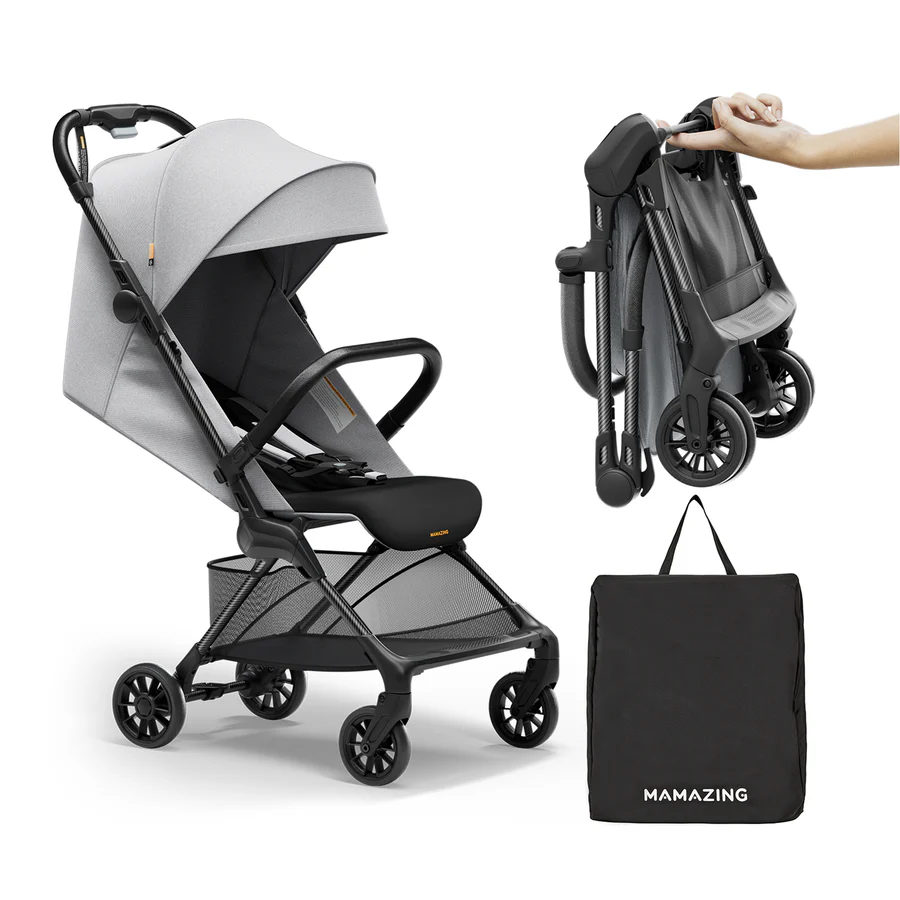
Ultra Air X — the travel and theme park stroller Under 15 lbs with a carbon fiber frame. Folds compactly enough to manage solo through airport security. Rated to 50 lbs, which covers most children through the theme-park-stroller years. One-handed fold for parents who are doing everything else with their other hand. One-handed families where the stroller has become a situational tool rather than a daily necessity — this is the stroller that earns its keep. ultra-compact travel stroller for theme parks and long day outings |
Somewhere between 3 and 5 for most families — but this is a lifestyle answer, not a developmental one. A child who lives in a walkable city and regularly takes 45-minute walks will phase out the stroller earlier than a child whose outings are mostly by car.
Most pediatricians suggest somewhere around 3 as a reasonable starting point for transitioning, but they also consistently say there is no hard upper limit for occasional or situational use. The more useful question is: what is the specific outing, and does my child genuinely need it? That answers the question better than any age chart.
Yes — in specific situations. A full day at Disney, an airport with long connections, and a day of sightseeing in a city that covers 15,000 steps. These are not everyday scenarios, and in those scenarios, a stroller preventing complete exhaustion and meltdowns is a practical tool, not a developmental failure.
It refers to the rough timing of growth spurts — babies tend to hit significant growth periods at around 3 weeks, 6 weeks, 3 months, 6 months, and 9 months. During those windows, more feeding, disrupted sleep, and general fussiness are common. Some people also extend this to developmental milestone clusters at 3, 6, and 9 months.
This one is a parenting-travel hack rather than an official Disney guideline. The version most commonly referenced goes: 3 snacks packed per child, 2 breaks built into the day, 1 stroller or wagon for longer distances. Some people define it differently — 3 rides before lunch, 2 character meets, 1 rest time.
If they exceed the manufacturer's weight limit — that is the signal to stop using it, regardless of anything else. Exceeding the weight limit compromises the stroller's structural stability, which is a safety issue, not a preference. Check your specific model, as the limit varies: some lightweight strollers cap out at 40 pounds, while others accommodate up to 65 pounds.
Featured Products


When Can Baby Sit in Stroller: Safe Age Development and Parent Guide
Best Stroller for 4-Year-Old: Comfort, Travel, and Everyday Use Guide