
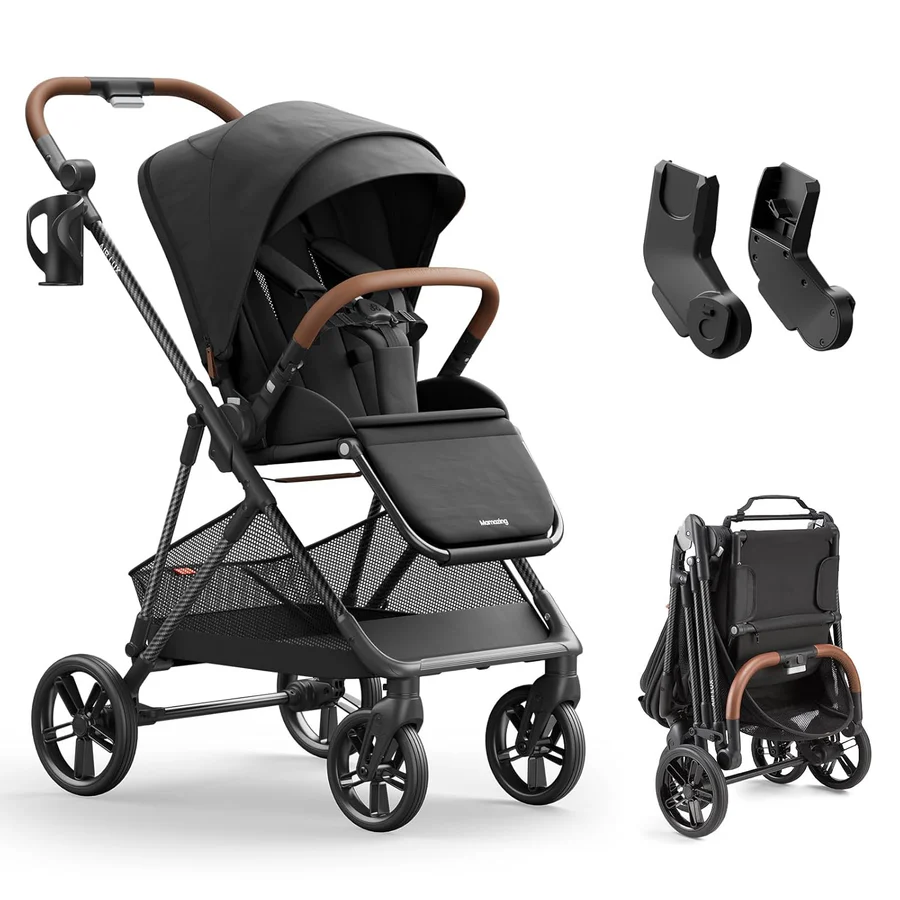
- by Mamazing Team
When Can Baby Sit in Stroller: Safe Age Development and Parent Guide
- by Mamazing Team
Six months. Your baby is pushing up on their arms, reaching for things, and trying to sit upright every time you hold them in your lap. And you're looking at the stroller seat, wondering if this is finally the moment.
It might be. But the answer to when a baby sits in a stroller is not actually about the date on the calendar. It is about two things: head control and core strength. When those two things are genuinely there — not almost there, not on good days — the stroller seat becomes safe.
Without them, even a six-month-old should stay in a reclined position. From stroller and baby gear matched to your baby's development stage, the stroller and the baby need to be in sync. This guide explains exactly how to know when that sync happens.

Here is the full picture. Every age range has a safe stroller setup, and the progression makes sense when you see it laid out:
|
Baby age |
Development |
Safe seat angle |
Best setup |
Key note |
|
Birth–8 weeks |
No head control |
Bassinet or flat-recline only |
Newborn stroller or car seat on frame |
Do not place in any stroller seat |
|
8 weeks–3 months |
Tilt and turn only |
Flat or near-flat |
Bassinet, 0–10° recline |
Head still flops — zero upright seating |
|
3–4 months |
Emerging head control |
Semi-recline OK (20–40°) |
Reclining stroller seat, supervised |
Watch for flopping in bumps |
|
4–6 months |
Steadying head, early core |
30–45° semi-recline |
Reclining seat — not fully upright yet |
Test head control before adjusting the angle |
|
6–7 months |
Solid head, early sit |
Semi to upright (45–80°) |
Standard stroller seat with harness |
First "real" stroller rides — start short |
|
8+ months |
Sitting confidently |
Fully upright (90°+) |
Any appropriate stroller seat |
Baby can handle longer outings now |
The CDC developmental milestones for head control and motor skills confirm that head steadying typically develops between 3 and 4 months for most babies, but full steadiness under movement is closer to 6 months. Those are two different things. Holding the head up in a calm room is not the same as holding it up on bumpy pavement while the stroller is in motion.

The head is disproportionately heavy relative to the body at this age — about a quarter of total body weight in early infancy. The neck muscles need to be genuinely strong enough to hold it steady while pushing a stroller. Occasional wobbles in a quiet room do not indicate whether a baby is ready for outdoor terrain.
Head control is the first thing. The second is trunk stability — the ability to hold the whole torso upright without slumping sideways or forward. These are different muscle groups that develop at different speeds. It is entirely possible for a baby to have reasonable head control yet lack the core strength to maintain a seated position in a moving stroller.
|
Why tummy time matters here Tummy time is not just a developmental activity — it is directly building the muscles your baby needs for stroller sitting. Neck, shoulder, upper back, core. Three to five minutes, several times a day, from early on. The stronger those muscles get, the smoother and earlier the stroller transition happens. Skipping tummy time because the baby protests is the main reason some babies are not ready at 6 months. |

According to KidsHealth: Infant Motor Development and SittingMilestones, physical signs of readiness are more reliable than age. These four tests give you real information:
|
Test |
How to do it |
What it means |
|
Pull-to-sit test |
Lay the baby flat on its back. Hold hands and gently pull toward sitting. Watch the head. |
Head stays aligned with the body as they come up = READY. Head lags and flops backward = not yet. |
|
Tummy time lift |
Supervised tummy time. Watch if the baby lifts its head and chest. |
Holds head at 45° or higher and looks around actively = good sign. Head stays on the floor = more time needed. |
|
Supported sit test |
Sit baby on your lap with light support at the waist only (no head support). |
Head stays centered and steady for 20+ seconds = head control established. Head wobbles or drops = not ready. |
|
Gentle nudge test |
Baby sitting with support. Very gently push their shoulder. |
Baby engages core to resist and stay centered = postural balance developing. Baby topples with no resistance = wait. |
|
A note on consistency One good performance does not confirm readiness. Tired babies fail tests they should pass. Run each test across a few different days and times. You are looking for consistent readiness, not a best-day result. |

These are the signals to watch for once you start trying the stroller seat. None of them are catastrophic if you catch them early and adjust — but ignoring them can cause strain or airway compromise.
|
Warning sign |
What it means |
What to do |
|
Head droops forward within minutes |
Chin touching the chest compresses the airway. This is not tiredness — it is not ready. |
Recline immediately. End the outing if it keeps happening. |
|
The body slumps consistently to one side. |
Core muscles cannot hold the torso centered. Not a posture issue — a strength issue. |
Reduce the seat angle. More tummy time is needed. |
|
Baby arches back against the seat. |
Often a signal of discomfort or strain, not personality. Can indicate the angle is too upright. |
Try a deeper recline. If arching persists, consult your pediatrician. |
|
Crying that starts within 10 minutes. |
New sitters fatigue quickly. What looks like fussiness is often muscle tiredness. |
Shorter rides. Recline the seat. Call it a successful first go. |
|
Head wobbles badly on bumps. |
Normal roads challenge new neck muscles. Fine on smooth paths, bad on rough. |
Stick to smooth surfaces until head control is more established. |

The AAP guidance on infant seating and safe stroller positioning, and most stroller manufacturers share the same safety fundamentals. These are not optional, depending on how short the outing is:
|
Safety rule |
What it means in practice |
Priority |
|
5-point harness — always |
Every outing, every length. Even 5 minutes. |
Non-negotiable |
|
Harness check after growth spurts |
Babies grow fast. Last week's fit is not this week's fit. |
Ongoing maintenance |
|
Start reclined, not fully upright |
Even confirmed sitters benefit from starting at a partial angle. |
First transition step |
|
Short first outings |
5 to 15 minutes. Extend as the baby builds stamina. |
For the first 2–3 weeks of upright sitting |
|
Smooth paths first |
Bumpy terrain challenges developing balance. Save it for later. |
Early sitter care |
|
Keep recline option accessible |
Mid-outing fatigue is real. Being able to recline quickly saves the walk. |
Stroller feature requirement |
|
Brakes on every stop |
Even 30 seconds — bending down for a dropped hat, checking your phone. |
Safety habit to build now |

When you are confident that your baby passes the readiness tests and the milestones are there, this is how to do the first proper upright ride without it becoming a stressful experience:
|
1 |
Start with a partial recline, not fully upright. Even babies who pass all the readiness tests benefit from starting at 45 to 60 degrees rather than 90 degrees upright. The stroller backrest does some of the work; their core is still building. Move to a more upright position over the following days, not all at once. |
|
2 |
Try parent-facing mode first if your stroller has it Baby can see your face during the first few upright rides. You can see their head position and body posture in real time. This is valuable during the early transition when you are still learning what tired-in-a-stroller looks like for your specific baby. |
|
3 |
Five to ten minutes for the first outing Not a park walk. Not an errand run. A short loop around the block. You are checking: does the head stay steady, does the body stay centered, does the baby seem comfortable or distressed? That is all the first ride needs to accomplish. |
|
4 |
Harness snug before you start moving — not after Check that the chest clip is at armpit level, and you can slide two fingers under the shoulder straps. The harness keeps a new sitter centered and prevents the forward slump that can compress the airway. Adjust before the walk, not while pushing. |
|
5 |
Smooth paths only for the first two to three weeks Bumpy terrain tests balance. New sitters lose it more on bumps and vibrations than on smooth paths. Curb transitions, gravel, cobblestones — fine later. For now, use the smooth pavement and save the park trail for when the core is stronger. |
|
6 |
Extend the outing duration based on what you observe, not time Some babies build stroller stamina in days. Others need weeks. The signal to extend is not "it has been two weeks" — it is that the baby stays centered, comfortable, and unstressed for the full duration of the current outing. Use that as your baseline. |

The products that make this developmental window easier are the ones designed to grow through it — not ones that require you to buy a second stroller when your baby reaches the sitting stage.
|
Air Lux with Bassinet — from flat newborn to upright sitter Reversible seat that starts in parent-facing mode for the early sitting weeks and flips to world-facing when your baby is ready. Mechanical recline covers the full angle range from near-flat through to fully upright. The stroller that goes through the transition with you, rather than making you start from scratch at 6 months. reversible seat stroller that grows from bassinet to upright |
|
Ultra Air Carbon Fiber — the daily driver when baby is ready to sit When your baby passes the readiness tests, and you want the daily walking stroller, this is it. Carbon fiber frame at 11.6 lbs. Appropriate for babies 6 months and up, rated to 50 lbs, with a 5-point harness and a seat that reclines to give you the partial angle option for the early sitting weeks. One-handed fold for parents who are always holding the baby with the other arm. upright-ready carbon fiber stroller for babies six months and up |
The full range, from bassinet-compatible systems to compact upright strollers, is in strollers for every stage from newborn to confident sitter. Worth filtering by the stage you are shopping for — buying for the newborn months versus buying for the confident-sitter months will point you to different configurations.
Day one, with the right setup. A stroller with a bassinet attachment or a fully reclining seat — genuinely flat, not just the deepest recline on a standard seat — is safe for a newborn from birth. A car seat mounted on a stroller frame works for the newborn months, too.
The thing to avoid is any angled position in a standard bucket-shaped stroller seat before your baby has head and neck control, because in an inclined position, a newborn's head can flop forward and compress the airway. The position matters, not the brand or price of the stroller.
Yes — in the right configuration. A two-month-old cannot go in an upright or semi-upright stroller seat. But a bassinet stroller, a fully reclining stroller seat rated for newborn use, or a car seat on a stroller frame are all appropriate.
The specific concern at two months is that the neck and core muscles are nowhere near ready for any angled position. The head flops, the chin can drop to the chest, and in that position, the airway can be partially obstructed. Flat or near-flat is the rule at this age, full stop.
Yes, same as at two months — with the right setup. A three-month-old who is showing emerging head control (can hold the head up steadily during tummy time, wobbles but recovers) might tolerate a light semi-recline of around 30 degrees, but only for short outings and only with close monitoring.
Full upright seating at three months is too early for most babies. The window during which a bassinet or car seat is the safest option extends for most babies from four to five months. If your three-month-old has unusually strong head control, it's worth getting a pediatric opinion before trying any stroller seat angle.
The general recommendation is no more than two hours at a stretch in any seated position — stroller, car seat, bouncer, or swing. The concern is the effect of a semi-inclined position on airway development over an extended period.
Fully flat in a bassinet is less restricted, but even then, the variety of positions matters for muscle development. For upright stroller sitters, the practical limit for early sitters is often less than two hours anyway because the core muscles tire. Watch your baby rather than the clock — slumping, fussiness, and head drooping are the signals to stop, not a specific time.
The physical signals are more reliable than age. Three things suggest it is time: your baby is rolling or showing strong signs of imminent rolling (shallow bassinet sides become a safety issue), the head control is steady and consistent under movement — not just in a quiet room — and the baby is actively fighting the flat position and trying to push up.
That last one is a common but frequently misread signal; lots of babies fuss in bassinets for all kinds of reasons that have nothing to do with readiness. The physical capabilities — rolling and head control — are reliable indicators. Fussiness alone is not enough.
Featured Products


Do You Need a Bassinet Stroller for Your Baby
When Do Kids Stop Using Strollers Age Guidelines Development Signs and Parent Tips