
- by Mamazing Team
How to Choose a Baby Stroller
- by Mamazing Team
AT A GLANCE
|
First question |
What does your most difficult weekly moment with a stroller look like? |
|
Safety baseline |
5-point harness, one-touch brake, and a frame that does not wobble |
|
Newborn rule |
Lie-flat only — no upright seat before the baby has real head control |
|
Weight warning |
Heavy strollers get abandoned. Lighter ones actually get used. |
|
Boot check |
Measure before buying. Not after. |
|
Skip the extras first |
Nail the basics. The snack tray can wait. |
Buying a stroller is one of those purchases that feels simple until you're actually doing it. Then suddenly you're forty minutes deep into suspension type comparisons, and you haven't even figured out if the thing fits in your car yet.
Most guides don't help. They throw fifteen features at you with roughly equal importance and leave you more confused than when you started. So here's what this one does instead: safety first, because that's non-negotiable. Then, lifestyle fit: a stroller you dread using is a stroller that stays folded in the hallway. Then, specific features, once you know which category you're even shopping in.
The AAP recommendations on infant stroller and carrier use put safety first, too — a five-point harness, a stable frame, and a reliable brake. Everything else is secondary. Cup holders, parent trays, one-hand folds — those are great features, but they belong after the basics, not before.

A stroller you hate using changes whether you leave the house. Not in a dramatic way — it just quietly stops coming with you. Too heavy to lift into the car alone, the fold requires both hands, so you can never do it while holding the baby. The basket is unreachable with the seat reclined, so you carry a separate bag anyway. Three weeks in, you stop taking it, and nobody remembers making that decision.
By that point, the return window is usually closed, which is why this choice matters more than it looks.
Give the stroller a light shake when it's assembled. Any wobble is a bad sign. Hit the brake, then lean on the handlebars the way you would if you got distracted for a moment — does it hold? Five-point harness: should clip securely without being fiddly, and definitely shouldn't pop open with a casual bump. That's the three-part test. Stability, brake, harness. If all three pass, you're working with a safe starting point.
The ASTM F833 stroller safety standard requirements are what reputable brands test against. Worth confirming the one you're looking at meets it. But — and this matters — meeting a standard and actually being reliable day-to-day are not identical, which is why you test it in person if you can.
Adjustable handlebars sound minor. They're not, if one of you is noticeably shorter or taller than the other — you'll both use this thing daily for two years. Basket depth: Some under-seat baskets look generous and hold about as much as a medium tote bag with the seat reclined. Try it in the shop before you buy, with the seat in the position you'll actually use. Fold mechanism: if it requires both hands or any kind of deliberate process, multiply that by 300 to get roughly how many times it will annoy you.
Strollers that look identical on a spec sheet can push completely differently. That gap only shows up when you're pushing one.

Safety first, convenience second, comfort third. Not because comfort doesn't matter, but because you can live with a slightly smaller canopy — you can't live with a brake that doesn't hold.
|
Feature |
What to check |
Why it matters |
|
5-point harness |
Snug at the shoulders, waist, and between the legs. Actually test the clip. |
Stops sliding and climbing — not optional on any stroller worth buying |
|
Brake |
One-foot, one-motion. Test it on a slight slope. |
Every stroller gets parked somewhere imperfect at some point |
|
Frame stability |
Light shake test when assembled. Minimal movement. |
A wobbly frame is a long-term problem that gets worse over time |
|
Full recline/bassinet |
Lies flat for newborns. Adjustable for older babies. |
Under 6 months: flat. Full stop. Upright is not safe for extended use. |
|
Fold mechanism |
How many hands? Does it stand folded? |
One-hand fold is not a luxury — it is a basic functional requirement |
|
Boot fit |
Check your actual car boot with the folded dimensions from the spec sheet. |
This is the most commonly skipped check and the most common buyer regret |
|
Wheel size and type |
Bigger wheels for rough ground. Air-filled absorbs more. |
Match to where you actually walk, not where you think you might walk |
|
Adjustable handlebars |
Check the height range and how easy it is to move. |
Two parents of different heights will both use this thing daily |
|
Under-seat basket |
How deep? Accessible with the seat reclined? |
Some baskets look generous and hold about four apples. Test it. |

Be honest with yourself about this one. Not the version of your life where you jog at sunrise. The actual version.
|
Type |
Best for |
Main advantage |
Main trade-off |
|
Full-size |
Daily errands, walks, and neighborhood use |
Storage, longevity, all-round features |
A heavier, bulkier fold may not fit small boots |
|
Lightweight / travel |
City life, public transit, flights |
Easy to carry solo, compact fold |
Less storage, smaller canopy, not for rough terrain |
|
Jogging stroller |
Running, outdoor adventures, mixed terrain |
Air-filled tires, suspension, handles bumps well |
Bulky fold, heavy, struggles in tight indoor spaces |
|
Travel system |
Newborn phase, car-heavy families |
Infant car seat clicks straight in — baby stays asleep |
It can feel like a lot of gear; bigger and heavier overall |
|
Double stroller |
Twins or two young children |
Seat both kids at once |
Much wider, harder to store, tiring to push when loaded |

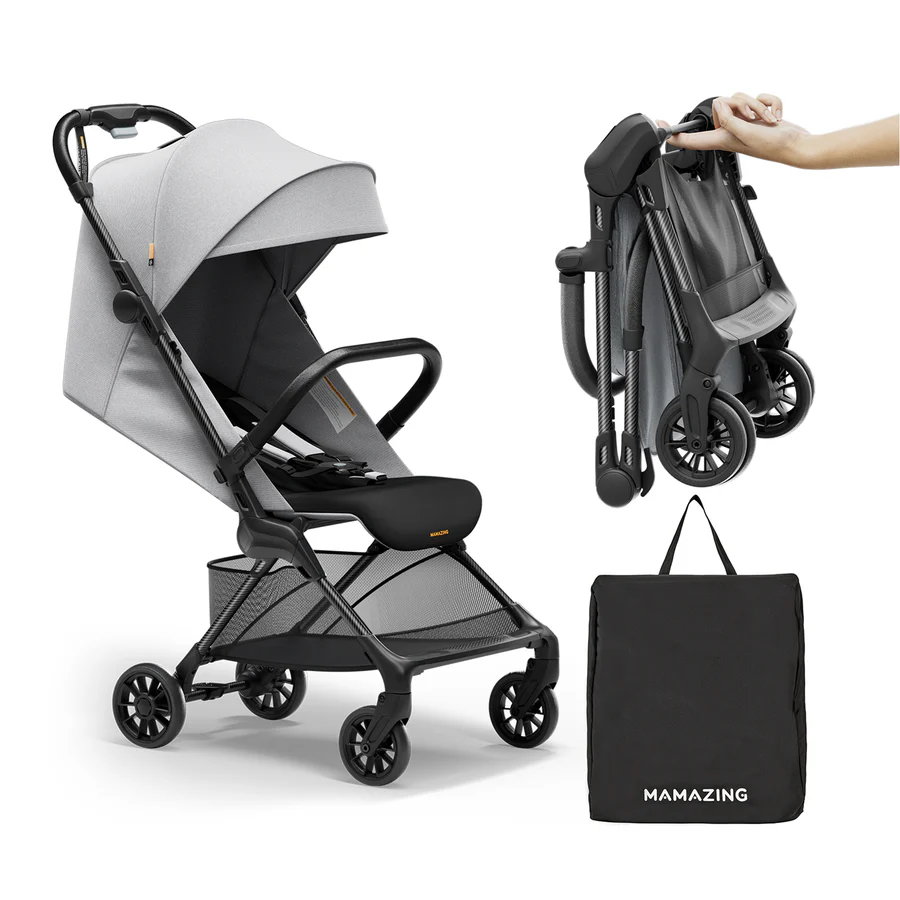
What sets Mamazing strollers apart in practice is the carbon fiber frame. Lighter than aluminum, same structural strength. That weight difference shows up every time you lift it into the car, every time you carry it up stairs, every time you've already got one arm full. It adds up to over two years of daily use.
Three options, depending on your baby's age and what your week actually looks like:
|
Air Lux Bassinet Stroller — starts from day one Lie-flat bassinet for newborns (and this one actually matters — newborns should not be sitting upright in a stroller for extended periods). When your baby develops enough to sit with support, the Air Lux converts to a full seat. It's the version to choose if you're buying before the baby arrives and want one stroller to cover the whole first year. |
|
Ultra Air Carbon Fiber Stroller — daily driver This is the one for everyday use — pushes to the shops, school run, park walks, whatever your version of daily parenting looks like. One-hand fold, deep basket, carbon fiber frame. It weighs meaningfully less than comparable aluminum strollers, and you notice that difference most when you're doing it three times in one day. |
|
Ultra Air X — compact fold, travel-ready Designed specifically for families who need a stroller that folds to a genuinely small size — for overhead bins, small car boots, and tight apartment storage. It still has a proper seat, a harness, and a recline. It just also happens to fold smaller than most full-size competitors. Worth looking at if you travel with the baby regularly or live somewhere where space is genuinely limited. |

Skip the fifteen-point checklist. Three questions, answered honestly, will get you most of the way there.
Think about it specifically. Is it loading it into your car boot three times a day? Is it navigating the narrow café near your house? Is it crossing the gravel path in the park you walk through every morning? Because the stroller that excels in one situation will often be wrong for another.
Pick the hardest thing. Choose for that. You can work around the others.
Newborn to 5 months: lie-flat is not optional, it's a developmental safety thing. The muscles and bones at that age are not ready for extended upright sitting — even slightly reclined is different from flat.
Six months and older is the usual guideline for standard seat use, and there is a reason for that. The CDC developmental milestones show that infants gain head control and that sustained neck and trunk strength typically develops within this window. Still — check your specific stroller's minimum age guidance. It varies.
If not, stop reading this and measure it. Right now. Because the most common stroller purchase regret is not about features or quality, it's 'I didn't realize it wouldn't fit in the car.' Write down the folded dimensions of anything you're considering. Compare them. This step takes three minutes and saves you significant grief.
|
Mamazing buying rule Choose for your hardest moment, not your easiest one. The stroller that handles a smooth, flat pavement perfectly might be genuinely wrong for your actual Tuesday. |

Nobody wants a long section on maintenance. So here's the short version.
Fabric: wipe it down regularly. If snacks are involved — which they will be — remove the liner and machine-wash it when it starts looking grim. A stroller that smells stays at home.
Wheels: clear debris from around the axle joint area. After beach trips or winter salt on the roads, rinse it with water and let it dry completely before you fold it for storage. Sand and salt in bearings is almost always the reason wheels get stiff or noisy over time.
Frame: wipe down occasionally with a damp cloth. The carbon fiber and aluminum frames won't rust, but the hinge points and connectors are worth checking every few months — just spin and flex them to make sure they move smoothly. Takes about two minutes.
Honestly, most parents try to answer this in the wrong order. They look at designs first, then features, then price, and safety kind of gets checked at the end, if at all. Flip that. Start with: does it have a proper five-point harness and a brake that actually works? Then: does the fold fit my life — my car, my stairs, my apartment? Then features.
Most parents who end up loving their stroller do so in this order. Most parents who regret their stroller did not.
She has been photographed with a Silver Cross Wave and a Bugaboo Cameleon over the years — both are legitimately excellent strollers in the premium segment. But here is what nobody mentions: a big part of those choices is aesthetics and brand prestige, not a function you can't find elsewhere.
A well-made carbon fiber stroller at a quarter of the price will push just as smoothly. You are not buying the stroller Kim K has. You are buying a stroller for your life.
The Stokke Xplory gets that nickname most often — distinctive tall design, elevated seat height, very recognizable. The Silver Cross Balmoral is another one in that conversation, literally handmade in England and used by the British royal family. Are they worth the price? Depends entirely on your priorities.
Build quality, yes — they're built to last decades. But functionally? The gap between a top-tier premium stroller and a well-engineered mid-range one is smaller than the price difference suggests.
Kate Middleton was seen with an iCandy Peach and a Silver Cross Balmoral. The Balmoral is the one that gets all the attention — it's a traditional British coachbuilt pram that the royal family has used for generations.
Hand-built, beautiful, heavy, and absolutely not the kind of thing you fold into a car boot. It's more of an heirloom than a daily pushchair. For most of us who are actually parenting, the practical comparison ends there.
There isn't one. That sounds like a cop-out, but it isn't — the most recommended stroller literally changes depending on who's recommending it and what they need. For urban everyday use, lightweight full-size models consistently come up for active families on rough terrain and for air-filled-tire joggers.
For travelers, whatever fits in an overhead bin. The more useful question: what do parents most like me consistently recommend? That's worth searching.
Short answer: head control. A baby under about six months doesn't yet have the neck and trunk muscle strength to handle being sat upright in a stroller seat — especially over bumpy ground. The vibration and angle that's completely fine for a six-month-old can be too much for a three-month-old.
That doesn't mean you can't use a stroller before six months — it means you need one that lies flat (bassinet mode) or a seat that reclines to nearly horizontal. The six-month guideline applies to upright sitting, not to strollers generally.
It's a rough milestone framework — not a clinical protocol, more of a parent shorthand. Three months: most babies develop better head control. Six months: many can sit with support, and most standard stroller seats become appropriate—nine months: usually sitting independently, more mobile, increasingly curious.
In a stroller context, it's most useful at the six-month mark, which is why you see that number everywhere in stroller advice. But every baby is different, and the rule is a starting point, not a deadline.
It depends on what regular means. If the seat can lie flat — genuinely flat, not just reclined — then yes, a four-month-old can use it. If the seat only goes semi-upright, then no, not for extended outings. The issue isn't the stroller, it's the angle. Young babies' spines and airways aren't ready for a prolonged semi-seated position.
Check your stroller manual specifically — it should give a minimum recline angle for infant use. If it doesn't mention one, that's a red flag worth following up on with the manufacturer.
Neither, genuinely. They solve different problems. A carrier is better for newborns, crowded public transport, stairs, and any time the stroller is more trouble than it's worth. A stroller is better for longer walks, carrying gear, and giving your back a break when your baby is heavier.
Most families end up needing both — a carrier for the first few months, especially a stroller for the long haul. Trying to pick one over the other is a bit like asking whether a bag or a basket is better. Right tool, right moment.
Featured Products


Small Nursing Chair for Nursery: How to Choose a Compact Chair for Small Spaces
How Long Do Babies Sleep in a Bassinet