
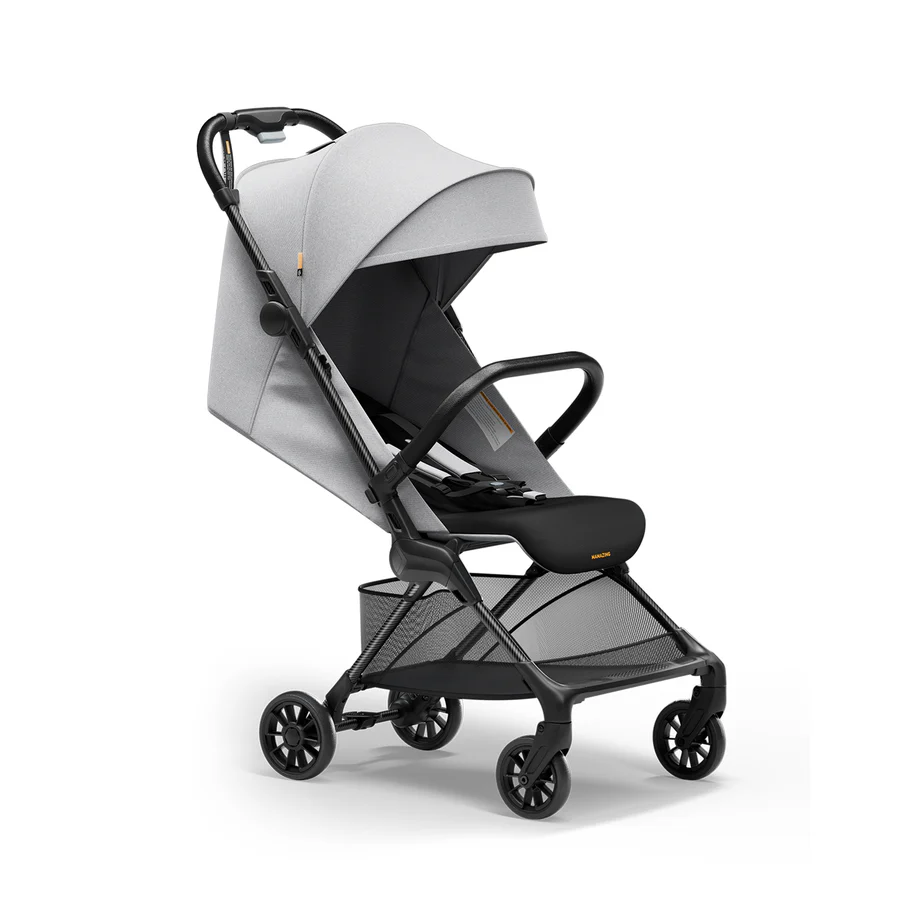
- by Mamazing Team
3 Wheel vs 4 Wheel Stroller: Which Fits Your Life?
- by Mamazing Team
AT A GLANCE
|
The short answer |
3 wheels: agility and mixed terrain. 4 wheels: stability and daily logistics. |
|
The real question |
Which one makes your hardest weekly moment easier? |
|
Choose 3 wheels if |
Mixed routes, one-hand pushing, outdoor movement, gravel or grass |
|
Choose 4 wheels if |
Mostly errands, frequent trunk loading, smooth sidewalks, new baby |
|
Not always jogging |
Many 3-wheel strollers are just everyday strollers. Not joggers. |
|
No universal winner |
The better stroller is the one that fits your actual Tuesday morning |
You know how this goes. Every article says the same two things. 3 wheels: more agile. 4 wheels: more stable. Fine. Also useless for actually making a decision.
The real question is simpler and messier. Tuesday morning. 8 am. Bag over one shoulder. Half a coffee. Tired baby. Two stops before you are done. Which stroller makes that specific thing easier?
That answer is not 3 or 4 wheels as a category. It is about your route, your terrain, your car boot size, and how often you fold it. The wheel count is just a clue.
From a carbon fiber stroller brand built for active families that built the Ultra Air line for exactly this mixed-use problem — here's the guide that stops at the decision instead of stopping at the theory.
One front wheel. That is the physical difference. A 3-wheel stroller puts a single wheel at the front. It pivots faster, tracks more directly, and responds to small hand movements more immediately. A 4-wheel stroller puts two wheels at the front. More contact points mean more stability — the stroller feels calmer, more planted.
Neither is lighter by definition. Neither is objectively safer. What changes is how the stroller feels in motion — and that feel matters a lot when you are pushing it through your actual life every day.
|
Shortest version possible 3 wheels = responsive, turns faster, better on mixed ground. | 4 wheels = steadier, usually folds neater, easier daily logistics for most urban families. |

Fast. Responsive. A 3-wheel stroller feels like it is paying attention. The single front wheel responds to direction changes immediately, which may sound minor until you are navigating a crowded coffee shop with a sleeping baby and a bag that keeps hitting the table.
Mixed ground. The cracked pavement two streets from your house. The gravel car park at the soft-play center. The slightly uneven path through the park is the one you take when the weather is good. On all of that, a 3-wheel stroller moves differently. Less resistance. Less correction. Less effort per meter.
One-handed pushing is also genuinely easier. When your other hand is carrying something, a 3-wheel stroller does not fight you. It leans where you lean.
Sloped ground. A 3-wheel stroller that is not perfectly balanced can feel like it wants to drift when you stop on a slope or park at an angle. Not dangerous — just something you notice. The stroller is more reactive, which is great when you are moving, and less comfortable when you want it to just stay put.
Heavy loads also emphasize this. A fully loaded basket plus a toddler in the seat adds weight, and a 3-wheel stroller distributes that weight across three points rather than four. For most parents, this is not a problem. For parents who are constantly parking on sloped driveways or loading a heavy stroller into an SUV boot, it is worth knowing.
This is the biggest misconception in stroller shopping. Every jogging stroller is a 3-wheel stroller. The reverse is not true. Plenty of 3-wheel strollers are just more maneuverable everyday strollers — no running credentials, no locked front wheel, no performance frame. If you want the turning benefits without the jogging build, that exists.

Calmer. More settled. A 4-wheel stroller does not react as immediately to small inputs — and for many parents, that is exactly what they want. The stroller tracks straight, stays planted when you stop, and rarely surprises you.
The car park. The shopping center. The flat pavement between your house and the high street. The lift at the train station. The café aisle you squeeze through three times a week. On all of that, a 4-wheel stroller asks very little of you. You push; it rolls; you park it; it stays.
For families whose main stroller territory is predictable flat ground with lots of stopping and starting, this is the correct answer, and there is nothing to overthink.
Tight corners. Rough ground. When the pavement gets cracked, when you cut through a gravel path, when you are trying to spin the stroller in a narrow fitting room — a 4-wheel stroller requires more deliberate input. Not a lot more. But enough to notice.
The front wheels on some 4-wheel models are also smaller than on 3-wheel all-terrain builds. Smaller wheels feel more bump-on-pavement rather than roll-over-it. On mostly smooth surfaces, irrelevant. On daily mixed-surface routes, worth thinking about.
Variety. There are far more 4-wheel stroller designs across many categories — full-size, travel, modular, expandable double, and frame strollers. If you want specific newborn support, a particular recline option, or a seat that works across more family stages, the 4-wheel range is broader.

|
3-Wheel ✔ |
3-Wheel ✖ |
4-Wheel ✔ |
4-Wheel ✖ |
|
Sharper, easier one-hand turns |
A folded shape is often bulkier |
Steadier feel, less correction needed |
More effort in a tight turning radius |
|
Handles mixed terrain more naturally |
Feels reactive on slopes when loaded |
More compact fold on most models |
Less natural feel on cracked pavement |
|
Single front wheel guides directly |
Less variety in seat configurations |
Much wider variety in design types |
Can feel less lively in motion |
|
Bigger wheels absorb surface changes |
The frame tends to be heavier overall |
Usually newborn-ready off the shelf |
Smaller front wheels on some models |
This is the clearest part of the decision.
4-wheel stroller. No contest. On flat, predictable ground, you do not need the terrain performance of 3 wheels — you need the stroller to stay out of your way, fold easily, and fit in the lift. That is a 4-wheel job.
3-wheel stroller. Larger wheels and a more terrain-responsive front end reduce friction and resistance, making pushing on rough ground less exhausting. You feel the difference within 20 meters.
Most families live here. This is where the answer gets specific rather than general. All-terrain strollers for mixed routes and everyday use are built for exactly this split — outdoor handling without sacrificing fold size or daily ease. For this scenario, the question isn't 3 wheels or 4, it's which specific model handles your split.
|
Quick clarification A good 4-wheel stroller can manage occasional rough ground. The question is whether rough terrain is your primary use case or your occasional one. Primary use case: 3 wheels. Occasional detour: a quality 4-wheel will manage. |

If you fold your stroller into a car boot every day, this section matters more than terrain does. The best terrain performance in the world is useless if the stroller does not fit behind the seats.
Larger wheels and a more rugged frame. Both are useful on rough ground, but both are annoying in a small car boot. A 3-wheel stroller often takes up more physical space when folded — not necessarily more weight, but a more awkward shape. You notice this on day three, not day one.
Many 4-wheel strollers are designed around the trunk problem. Compact fold, freestanding when folded, fits the corner of a small boot. If your stroller goes in and out of a car five times a week, that fold advantage compounds quickly.
Worth noting: some 3-wheel strollers have quick-release wheels that significantly close the fold-size gap. It is worth checking the folded dimensions of any specific model you are considering, rather than assuming them from the wheel count.
The AAP guidance on stroller safety for parents recommends ensuring the stroller design matches the developmental stage. At the newborn stage, that means lie-flat or deeply reclining options. The range of available options differs between 3 and 4-wheel builds.
4-wheel models, generally. More of them come in modular or full-size configurations, with built-in newborn inserts, bassinet compatibility, and infant car seat attachments. Some 3-wheel strollers do support newborns — many can accommodate a compatible car seat — but the starting options are narrower.
Also, 4-wheel, because the design variety is wider. More expandable options, more seat modes, more routes to a double stroller. Not a dealbreaker for 3-wheel buyers — but if you are planning for more than one child, or want one stroller to cover more stages without accessories, the 4-wheel ecosystem tends to offer more flexibility.
Active outdoor families often use a 3-wheel stroller as their only stroller, start to finish, and never look back. If your life genuinely includes more outdoor movement than urban errands, the terrain performance outweighs the configuration variety. The stroller becomes an extension of how you actually live — not a compromise.
|
Parent type |
Best wheel choice |
Why |
|
Active outdoor family |
3-wheel stroller |
Mixed terrain, longer walks, running. Agility and wheel size match this routine. |
|
City family, mostly errands |
4-wheel stroller |
Smooth sidewalks, store aisles, and frequent car loading. Compact fold matters most. |
|
Compact storage is the priority |
4-wheel stroller |
Smaller boot, tight apartment, frequent folding. 4-wheel shapes usually win. |
|
One stroller for everything (outdoor-leaning) |
3-wheel stroller |
Mixed terrain as main use. Accept bulkier fold for terrain gain. |
|
One stroller for everything (urban-leaning) |
4-wheel stroller |
Smooth ground as main use. Accept the trade-off in turning to daily convenience. |
|
New parent, still figuring it out |
4-wheel stroller |
Wider newborn compatibility, more configuration options, and easier to live with. |
Not true. Jogging strollers are 3-wheel. But not all 3-wheel strollers are joggers. Many are simply everyday strollers with better turning. If you want maneuverability without the running frame, that option is available.
On smooth flat ground, often yes. In tight corners, gravel, or cracked urban pavement — not always. Easier is context-specific. Easier in what situation is the question that matters.
Neither is. The better stroller is the one that fits your most common route and your hardest weekly moment. That answer is different for every family, and it cannot be resolved by a general ranking.
Not the most interesting surface. Not the most common use case. Your hardest, most frequent problem.
Rough sidewalks and outdoor routes happen most: lean 3 wheels.
Trunk loading and store navigation happen most: lean 4 wheels.
The Consumer Reports stroller buying considerations reach the same conclusion from a different direction: stroller satisfaction comes from matching the product to real daily use, not from buying the highest-rated option in the abstract.

If you want a stroller that bridges the gap between the two categories, a compact carbon-fiber travel stroller for city and outdoor use was built for families who refuse to pick one. Active enough for mixed terrain. Compact enough for the boot. Light enough that the daily loading stops feeling like a decision.
Neither is better in the abstract. A 3-wheel stroller is usually better for maneuverability and mixed terrain. A 4-wheel stroller is usually better for stability, compact storage, and daily errands. The better choice is whichever one fits your most common route and hardest weekly use case.
Because the single front wheel makes turning and one-hand steering noticeably easier in tight spaces and on mixed ground. If your walks often include cracked pavement, grass, gravel, or paths that require frequent changes in direction, the 3-wheel layout makes those situations feel less effortful. Active parents, in particular, tend to prefer it.
No. Every jogging stroller uses a 3-wheel design, but not every 3-wheel stroller is built for jogging. Many are simply everyday strollers designed for better maneuverability. A proper jogging stroller has specific frame and wheel specs built for running speeds — if you only want the turning advantages of 3 wheels and have no plans to run, you do not need a jogger.
The main trade-offs are: the folded size tends to be bulkier and less trunk-friendly; the stroller can feel more reactive on slopes or sloped parking lots; and it may feel slightly less planted on hard stops with a heavy load. None of these are dealbreakers — they are design tradeoffs you accept in exchange for the turning and terrain advantages.
This question usually refers to 3-wheel ATVs (all-terrain vehicles), not baby strollers. The US Consumer Product Safety Commission phased out 3-wheel ATVs in the late 1980s because their narrow rear-wheel configuration made them prone to tipping at speed. Baby strollers are a completely different category — they meet separate ASTM safety standards and are not subject to any such restriction.
No, not in ordinary use. This question also typically refers to 4-wheel ATVs or off-road vehicles, not baby strollers. A well-designed 4-wheel stroller is built to stability standards and will not tip in normal use. The relevant check for any stroller — 3- or 4-wheel — is whether it meets the ASTM F833 safety standard. Any reputable brand will confirm this.
This is an automotive and off-road vehicle question, not a stroller question. For strollers specifically: 3-wheel models can feel slightly more reactive on slopes, and 4-wheel models feel more planted. Neither tips easily in normal daily use when used correctly. Always lock the brake when parked, even on mild slopes.
In real-world use, the most common complaints about 4-wheel strollers are: smaller wheels that feel choppy on rough pavement, tighter turning radii that require more effort in confined spaces, and front wheels that catch on kerb edges. These are design trade-offs of the configuration, not manufacturing defects. Choosing a 4-wheel stroller with a larger wheel diameter reduces most of these issues.
Both wheel types can struggle in deep snow, but 3-wheel models with larger, air-filled tires tend to manage better than 4-wheel models with smaller, solid wheels. Wider tires and larger diameter both help in snow for the same reason they help on rough terrain — more surface area means less sink and better forward progress. If snow is a regular part of your routine, wheel size and tire type matter more than 3 vs 4 wheel configuration.
3 Wheel vs 4 Wheel Stroller · 8 Prompts
|
IMAGE |
1 (Hero Banner) |
|
Type |
Type A — Editorial / Lifestyle |
|
Placement |
Hero — directly below H1 |
|
Aspect Ratio |
16:9 hero banner |
|
Recraft Prompt |
Split editorial scene: left side shows a 3-wheel stroller on a mixed outdoor path (gravel, grass edge, dappled light). Right side shows a 4-wheel stroller on a clean urban sidewalk near a café. Morning light. No brand text. No faces shown. Editorial, calm. |
|
What to avoid |
Product branding, dark mood, studio backdrop, both strollers identical, text overlays |
|
IMAGE |
2 |
|
Type |
Type A — Editorial / Lifestyle |
|
Placement |
"How a 3-Wheel Stroller Actually Performs" H2 |
|
Aspect Ratio |
4:3 |
|
Recraft Prompt |
A 3-wheel stroller being pushed along a mixed outdoor path — gravel surface, slight elevation change, natural tree cover. Warm morning light. The parent's hands visible on the handlebar. Conveys ease of movement on rougher ground. |
|
What to avoid |
Brand text, dark background, studio look, fully paved city setting, baby visible |
|
IMAGE |
3 |
|
Type |
Type A — Editorial / Lifestyle |
|
Placement |
"How a 4-Wheel Stroller Actually Performs" H2 |
|
Aspect Ratio |
4:3 |
|
Recraft Prompt |
A 4-wheel stroller parked near a café entrance on a clean urban sidewalk. Bright natural light. No person in frame. The stroller looks compact and ready — conveys everyday urban convenience and easy daily use. |
|
What to avoid |
Rough terrain visible, brand text, dark or rainy setting, person visible, busy cluttered scene |
|
IMAGE |
4 |
|
Type |
Type A — Editorial / Lifestyle |
|
Placement |
"Weight, Fold, and the Car Trunk Reality" H2 |
|
Aspect Ratio |
4:3 |
|
Recraft Prompt |
A parent loading a folded stroller into a car boot from a side or three-quarter angle. Soft outdoor light. The compact folded size is the visual focus. No face shown fully. Practical, honest moment. |
|
What to avoid |
Brand text visible, dark setting, studio look, stroller unfolded, person's face clearly shown |
|
IMAGE |
5 |
|
Type |
Type A — Editorial / Lifestyle |
|
Placement |
"Best Terrain Match" H2 |
|
Aspect Ratio |
4:3 |
|
Recraft Prompt |
Low-angle view of stroller wheels rolling across a rough surface — gravel path or cracked sidewalk. The wheel in motion, shallow depth of field. Natural light from the side. Abstract quality — terrain and wheel, no full stroller or person. |
|
What to avoid |
Brand markings on wheel, dark background, studio lighting, smooth pavement only |
|
IMAGE |
6 |
|
Type |
Type B — Product-Led |
|
Placement |
"Final Verdict" H2 — product context |
|
Aspect Ratio |
4:3 |
|
Recraft Prompt |
A modern compact carbon fiber stroller at a three-quarter angle, photographed outdoors on a clean urban path. Bright daylight. The lightweight frame and compact design are the visual focus. Simple, airy background. No brand text. |
|
What to avoid |
Baby in frame, dark or cluttered background, brand logos visible, indoor-only setting |
|
IMAGE |
7 |
|
Type |
Type A — Editorial / Lifestyle |
|
Placement |
"Best Choice by Parent Type" H2 |
|
Aspect Ratio |
4:3 |
|
Recraft Prompt |
A parent on an outdoor walk, pushing a stroller along a park or mixed-terrain path. Side or rear view. Morning light. Baby in seat. Relaxed, active energy — conveys confident daily use on real ground. |
|
What to avoid |
Studio backdrop, brand text, full face shown, dark mood, smooth indoor setting only |
|
IMAGE |
8 |
|
Type |
Type A — Editorial / Lifestyle |
|
Placement |
"Common Myths Worth Clearing Up" H2 or FAQ section |
|
Aspect Ratio |
4:3 |
|
Recraft Prompt |
Two strollers side by side on a neutral outdoor surface — one with a single front wheel, one with two front wheels. Soft natural light from above. No people in frame. A clean visual comparison of wheel layout. |
|
What to avoid |
Brand text visible, identical strollers, dark background, indoor setting, people in frame |
8 prompts complete. Image 1 is 16:9. Images 2–8 are 4:3. Type A = no product focal. Type B = product anchor. Paste one at a time.
Featured Products


When to Switch From Bassinet to Stroller Seat
How to Get Mold Out of a Stroller: Safe Steps That Actually Work