
- by WengGracy
What Age Can Baby Use a Stroller? Infant Stroller Age Guide
- by WengGracy
Trying to figure out the right baby stroller age can feel surprisingly confusing. One parent says they used a stroller from day one. Another says to wait until 6 months. Both may be right, depending on what they mean by "use a stroller."
The real question is not whether your baby has reached one universal age. It is whether the stroller setup matches your baby's stage of development. A newborn needs a flat or newborn-approved position that supports the head, neck, and airway. An older baby who can hold their head steady may be ready for a more upright stroller seat. A toddler needs a stroller that fits their size, energy level, and daily routine.
This guide walks you through what age for stroller use makes sense from birth through the toddler years, how to choose an infant stroller by stage, and which safety rules matter at every age.
A baby can use a stroller from birth only when the setup is designed for newborns. That usually means a bassinet attachment, an approved infant car seat travel system, or a stroller seat that the manufacturer specifically says is suitable from birth because it reclines enough for newborn support.
Most babies are not ready for a standard upright stroller seat right away. Upright stroller riding usually becomes appropriate when your baby has steady head and neck control and can sit with support without slumping, often around 6 months. Some babies are ready a little earlier, and some need more time.
For premature babies, babies with low muscle tone, reflux, breathing concerns, or other medical needs, ask your pediatrician before changing stroller positions. Always follow the stroller manual, including minimum age, weight, height, recline, harness, and approved accessory requirements.
Use this chart as a practical starting point, not a hard rule. Your baby's development, the stroller manual, and the way your baby fits in the seat matter more than the date on the calendar.
| Baby age | Typical development | Safest stroller setup | Watch-outs |
|---|---|---|---|
| Birth to 3 months | Limited head and neck control | Bassinet, approved infant car seat attachment, or from-birth recline | Avoid upright slumping and chin-to-chest posture |
| 3 to 5 months | Improving head control, still variable | Reclined seat if approved, bassinet, or car seat attachment | Monitor posture, breathing, and harness fit |
| 6 to 8 months | Steadier head control, supported sitting | Standard stroller seat with recline and five-point harness | Start with short rides and keep checking alignment |
| 9 to 12 months | Independent sitting, more active movement | Upright everyday stroller seat | Use the harness every time, even for quick stops |
| 12 to 36 months | Toddler walking, climbing, and leaning | Lightweight, travel, or everyday stroller within limits | Watch for standing, leaning, and overloading handles |
| 3 years and up | More stamina, occasional need for rest | Use as needed for travel, long days, or special circumstances | Follow height and weight limits over age alone |
Once you know your baby's stage, compare an infant stroller that matches your child's age, recline needs, and everyday routine.
Yes, a newborn can use a stroller, but only in a newborn-safe setup. This is the most important distinction in the stroller for newborn age conversation. A newborn should not be placed in an upright-only stroller seat simply because the seat has a harness or looks padded.

Newborns have heavy heads compared with their bodies and limited neck strength. If a stroller seat is too upright, a newborn may slump forward or sideways. That can make it harder for them to maintain a comfortable, open position.
A newborn-ready stroller setup should keep your baby well supported and positioned according to the stroller manufacturer's instructions. Look for clear language in the manual, such as suitable from birth, newborn mode, bassinet mode, or compatibility with a specific infant car seat adapter. If the manual gives a minimum age or says the seat is for babies who can sit unassisted, do not use it for a newborn.
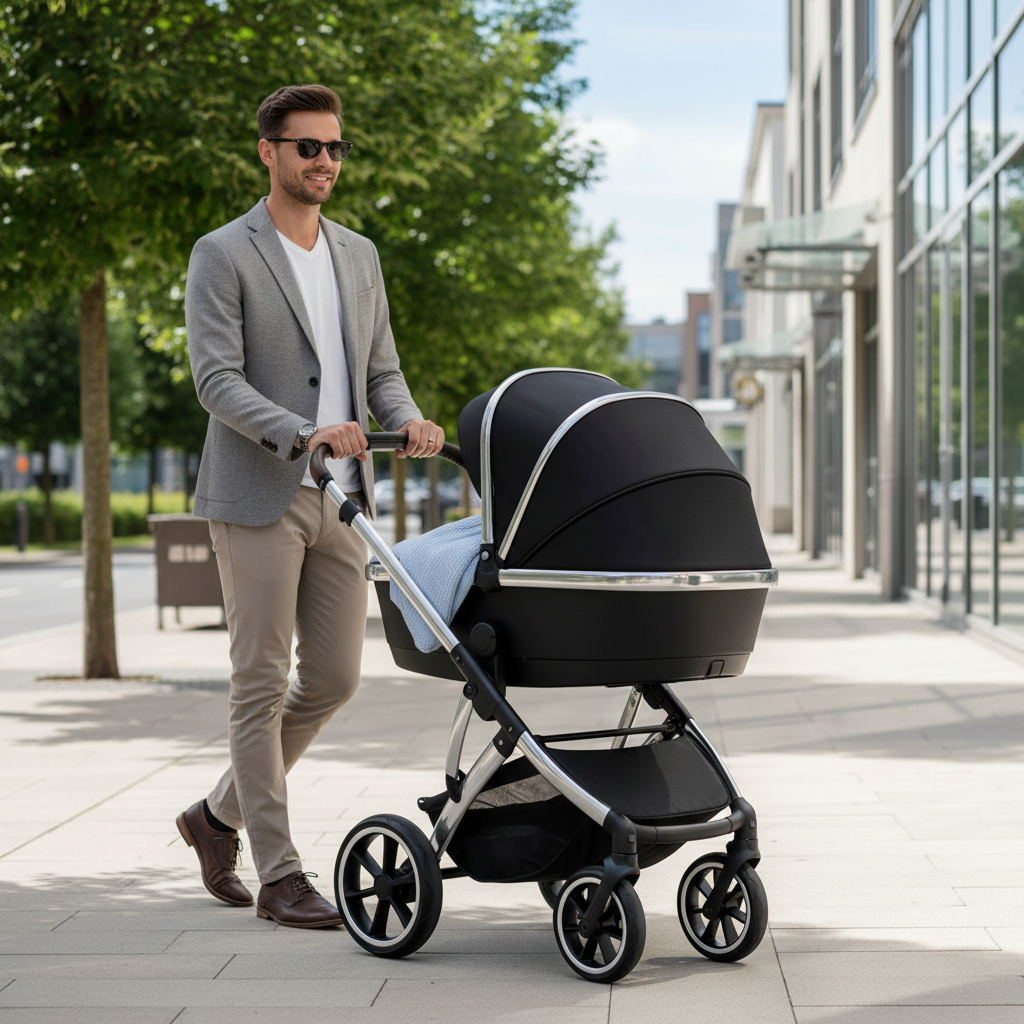
A bassinet stroller is often the most intuitive newborn option for neighborhood walks because it keeps your baby in a flat, roomy position while you can supervise them. It can be especially useful during the first months when your baby spends much of the day feeding, sleeping, and needing careful position checks.
An infant car seat attachment is convenient for short transfers, such as going from the car to a quick errand. It should be used only with approved adapters and within the car seat and stroller limits. A car seat attached to a stroller is not a substitute for routine sleep, and younger babies should not be left in seated devices longer than necessary.
A flat-recline stroller seat can work from birth only if the manufacturer approves that use. Do not assume "reclines a lot" means newborn-safe. The manual should tell you the minimum age, recline rules, and whether any inserts or accessories are required or prohibited.
Before every newborn ride, check that the stroller is fully locked open, the brake works, the attachment is clicked in correctly, and your baby is positioned as the manual describes. If a harness is used, it should fit snugly without bulky blankets under the straps.
Keep loose blankets, pillows, and unapproved head positioners out of the stroller. They may look cozy, but they can interfere with positioning or harness fit. If your baby slumps, turns red, seems uncomfortable, breathes noisily, or drops their chin toward their chest, stop and reposition them right away.
For many families, this is the real question hiding behind "what age can baby use a stroller?" A baby may use a newborn-safe stroller from birth, but sitting upright in a stroller seat is a later milestone.
Your baby may be ready for a more upright stroller position when they can hold their head steady, sit with support, and ride without folding forward or sliding sideways. The harness should sit correctly at the shoulders and hips, and your baby's back should be supported by the seat.
If you want a deeper readiness checklist, Mamazing also has a dedicated guide on when babies can sit in a stroller. For this age guide, the short version is simple: wait for control, not just age.
Many babies are ready for a standard stroller seat around 6 months, which is why you often see 6 months mentioned in stroller guidance. But your baby may be ready slightly earlier for a semi-reclined position, or may need longer before sitting upright comfortably.
Adjusted age matters for babies born early. A baby born two months premature may not have the same head and trunk control as a full-term baby of the same calendar age. When in doubt, choose the more reclined option and ask your pediatrician.
Start with the stroller more reclined than you think you need. Buckle the five-point harness, take a short walk, and pause to look at your baby's posture. Their head should stay centered and supported, their chin should not press into their chest, and their breathing should look calm.
If your baby starts to slump when tired, go back to a more reclined setting. Readiness can change across the day. A baby who sits well for ten minutes after a nap may need more support during a longer outing.
The best stroller is not just the one with the longest feature list. It is the one that fits your baby's stage, your walking environment, your storage space, and the way you actually leave the house. For broader shopping criteria, this Mamazing guide on how to choose a baby stroller can help you compare safety, lifestyle, and everyday usability.

During the first months, prioritize recline, support, and visibility. A bassinet attachment is helpful for walks when your baby is awake or lightly dozing under supervision. A travel system can make short errands easier when you are moving between the car and stroller. A from-birth stroller seat can be convenient if it is truly approved for newborn use.
Features that matter at this stage include a stable frame, easy brake, smooth push, large canopy, and a seat or attachment that keeps your baby positioned correctly. Lightweight design is nice, but it should not come at the expense of newborn suitability.
Once your baby has stronger head and trunk control, an everyday stroller seat becomes more useful. Look for multiple recline positions, a secure five-point harness, a canopy for shade, and enough seat depth to support your baby without forcing them into a curled posture.
This is also when your baby may become more interested in facing the world. Some parents prefer a stroller that allows parent-facing and forward-facing options, while others prioritize compact folding and easy lifting. Your daily routine should guide the choice.
After the first birthday, many families start caring more about portability. A toddler may want to walk part of the time, then ride when they are tired. A lightweight stroller can be helpful for daycare drop-off, travel, shopping, and busy sidewalks.
Check the stroller age limit, weight limit, and height limit before assuming a compact model will last. Toddlers grow quickly, and a stroller that feels perfect at 13 months may feel cramped later if the seat back, footrest, or canopy is too small.
Jogging strollers and rough-terrain strollers are a special case. A model may be approved for walking with a newborn attachment, but jogging is different because it creates more bounce and force. Wait until your baby has strong head and neck control, follow the manufacturer's minimum age, and ask your pediatrician if you are unsure.
For trails, uneven pavement, and longer walks, look for suspension, reliable brakes, and wheels designed for the terrain. Your baby's posture still comes first. A rugged stroller is not automatically appropriate for every baby age.
Stroller safety is not only about the first ride. The same habits protect newborns, older babies, and toddlers. The American Academy of Pediatrics' HealthyChildren stroller safety guidance highlights practical features and habits such as using a five-point harness, checking brakes, choosing a stable stroller, and keeping bags off the handles to reduce tipping risk.
Use the harness every time, even when your baby seems calm or the walk is short. A five-point harness is especially helpful because it secures the shoulders, waist, and between the legs. As babies become toddlers, they may lean, twist, or try to stand before you expect it.
Engage the brakes whenever the stroller stops. This matters on hills, in parking lots, near doors, and even inside a store. A wide, stable base also helps reduce tipping, especially when your child shifts their weight.
Do not hang heavy diaper bags, shopping bags, or purses from the stroller handles unless the manual specifically allows it. Handle weight can tip a stroller backward. Use the storage basket within its weight limit instead.
Keep your baby and older siblings away from the stroller while you open or fold it. Make sure the frame is fully locked before placing your child inside. Little fingers can get pinched in hinges, and a partly locked stroller can collapse or shift.
It is normal for babies to fall asleep during a walk, but a stroller is not the same as a safe sleep space. The AAP safe sleep guidance on HealthyChildren recommends a firm, flat sleep surface and notes that inclined surfaces are not safe for infant sleep. If your baby falls asleep in a stroller, car seat, swing, carrier, or sling, move them to a firm, flat sleep surface on their back as soon as possible.
If you are comparing stroller comfort features, read them through that lens. A good canopy, smooth suspension, and recline can make supervised outings more comfortable.
The U.S. Consumer Product Safety Commission stroller and carriage FAQ explains that carriages and strollers are regulated products and addresses safety areas such as stability, brakes, restraints, folding mechanisms, latches, wheels, seat recline, and labeling. That is why the label and manual are part of stroller safety, not paperwork to toss aside.
Register your stroller when possible so you can receive recall notices. Before using a secondhand stroller, check that it has not been recalled, that the brakes and locks work, and that the harness is complete.
There is no single safe number of minutes that fits every baby and every stroller. The right length depends on age, position, temperature, feeding needs, diaper comfort, and whether your baby can move and rest comfortably.
For newborns and younger infants, keep early stroller outings simple. A short walk around the block or a brief errand gives you time to learn how your baby fits, how the stroller handles, and whether the setup keeps your baby comfortable.
Check your baby often. Look at their head position, breathing, skin temperature, and mood. Young babies may not fuss right away when they are too warm, too cold, or poorly positioned.
Older babies and toddlers can usually handle longer stroller outings, but they still need breaks. On travel days, theme park days, or long city walks, give your child time out of the stroller to stretch, crawl, stand, or walk when safe.
Plan for shade, hydration, snacks when age-appropriate, diaper changes, and weather. A stroller can make a long day easier, but it should not keep your child strapped in for hours without movement.
Take a break if your baby is slumping, sweating, shivering, fussing hard, rubbing at the straps, showing red marks, or falling asleep in a position that needs transfer to a safe sleep surface. For toddlers, repeated attempts to stand, climb, or lean may mean they need movement or a different setup.
Just as there is no universal start age, there is no universal stop age. Some children are mostly done with the stroller in the toddler years. Others still use one occasionally for long travel days, medical needs, late outings, or big walking environments.
The CPSC FAQ discusses carriages and strollers in the context of products normally used for infants and children up to 36 months, but real family use varies. A healthy preschooler may no longer need a stroller for daily walks, yet may still benefit from one at an airport or amusement park.
Think about your child's stamina, safety awareness, and the environment. A stroller may be practical near traffic or in crowded places even after your child can walk well.
Your stroller's limits matter more than your child's age. If your child exceeds the weight or height limit, the stroller may not brake, steer, fold, or restrain as designed. The same applies if your child's head sits above the seat back or the harness no longer fits properly.
When your child is ready, transition gradually. Use the stroller for long trips and skip it for short, familiar walks. Let your child practice holding hands, stopping at corners, and walking safely in low-pressure settings.
You do not need to prove anything by retiring the stroller early. The goal is a safe, comfortable outing for your child and a manageable day for you.
A baby can use a stroller from birth only with a newborn-safe bassinet, approved infant car seat attachment, or manufacturer-approved full recline. Upright stroller seats are usually best around 6 months, when head and neck control are steady.
Yes, a newborn can go in a stroller if the setup is designed for newborn positioning and used according to the manual. Do not place a newborn in an upright-only stroller seat.
Many babies can sit in a stroller without a car seat around 6 months, but readiness depends on steady head and neck control, supported sitting, proper harness fit, and the stroller's minimum age guidance.
Three months is not too early for a newborn-safe reclined stroller setup. It is usually too early for a fully upright stroller seat unless your baby, pediatrician guidance, and the stroller manual all support that position.
Some 4-month-olds can use a reclined stroller seat if the model allows it and the baby stays well supported. Most are not ready for fully upright stroller riding yet.
If your baby falls asleep in a stroller, supervise closely and move them to a firm, flat sleep surface on their back as soon as possible. A stroller is not a routine safe sleep space.
Many lightweight strollers are best from around 6 months or when a baby has steady head control. Check the model's minimum age, recline, harness, weight limit, and height limit.
Use the stroller's height and weight limits, your child's stamina, and the needs of the outing. Many families taper stroller use between the toddler and preschool years.
A baby can use a stroller from birth only with a newborn-safe bassinet, approved infant car seat attachment, or manufacturer-approved full recline. Upright stroller seats are usually best around 6 months, when head and neck control are steady.
Yes, a newborn can go in a stroller if the setup is designed for newborn positioning and used according to the manual. Do not place a newborn in an upright-only stroller seat.
Many babies can sit in a stroller without a car seat around 6 months, but readiness depends on steady head and neck control, supported sitting, proper harness fit, and the stroller's minimum age guidance.
Three months is not too early for a newborn-safe reclined stroller setup. It is usually too early for a fully upright stroller seat unless your baby, pediatrician guidance, and the stroller manual all support that position.
Some 4-month-olds can use a reclined stroller seat if the model allows it and the baby stays well supported. Most are not ready for fully upright stroller riding yet.
If your baby falls asleep in a stroller, supervise closely and move them to a firm, flat sleep surface on their back as soon as possible. A stroller is not a routine safe sleep space.
Many lightweight strollers are best from around 6 months or when a baby has steady head control. Check the model's minimum age, recline, harness, weight limit, and height limit.
Use the stroller's height and weight limits, your child's stamina, and the needs of the outing. Many families taper stroller use between the toddler and preschool years.
Featured Products


Stroller Naps: How to Help Baby Sleep in a Stroller
Stroller Frame Materials Guide: Aluminum vs Steel vs Carbon Fiber