
- by Gracyweng
Rocking Chair vs Recliner for Nursery: Which One Wins?
- by Gracyweng
It is 2 AM. Your three-week-old has finally drifted off in your arms, and you are trying to stand up from your nursery chair without breaking the spell. Suddenly, the chair you chose during your second trimester matters more than any review ever told you it would. With newborns nursing 10 to 12 times every 24 hours in the early weeks, new parents easily spend hundreds of hours in their nursery chair during the first year — more time than most adults spend at a desk in a full quarter. So the rocking chair vs recliner for nursery debate is not a small one.
This guide from Mamazing compares both chair types across the six factors that actually shape your daily experience: space, comfort, safety, cleanability, price, and longevity. Whether you are pricing out nursery essentials or trying to find the best chair for nursing and rocking long overnight feeds, you will leave with a clear, no-fluff answer. Let's break down the nursery rocking chair vs recliner question the way a real parent would.
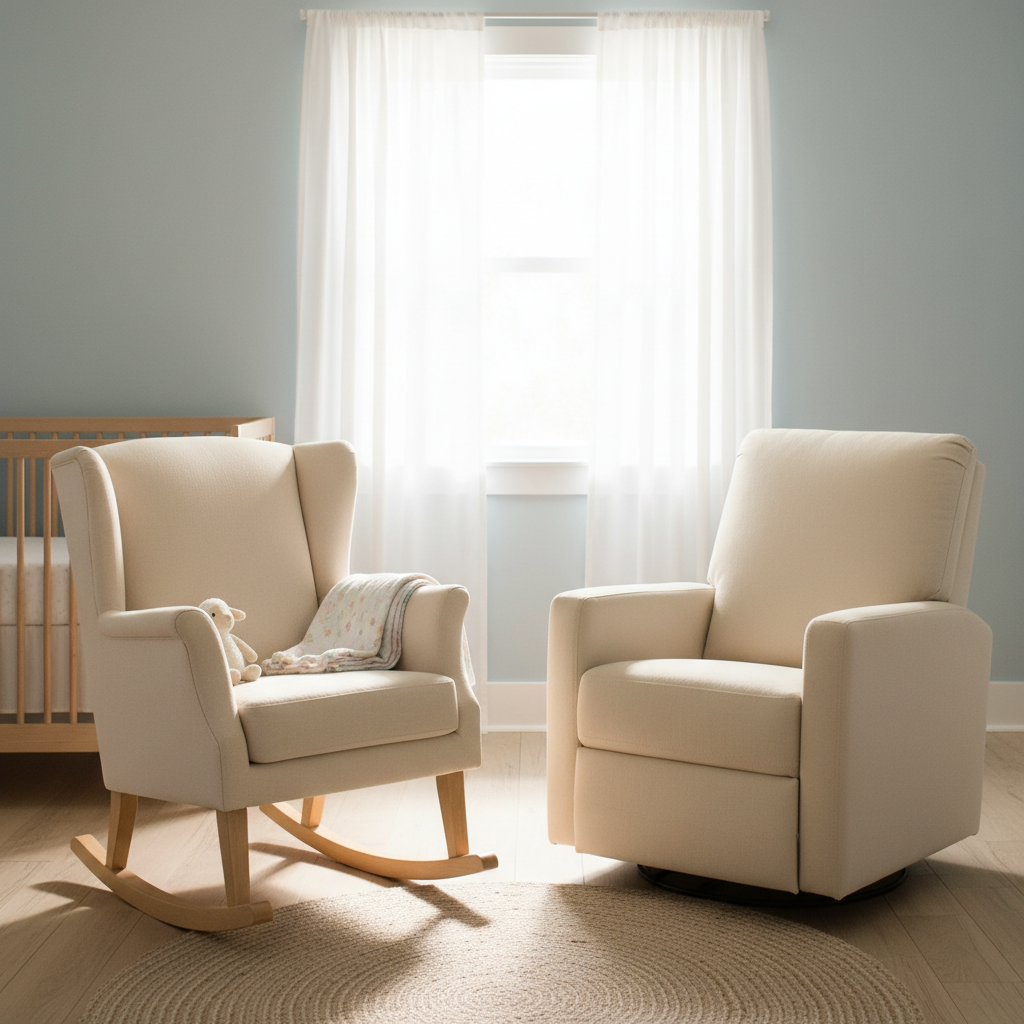
The traditional rocking chair has earned its place in nurseries for a reason. It moves in a gentle arc on curved base runners (sometimes called "rockers"), and that arc-shaped motion is one of the oldest tricks for calming a fussy newborn. Frames are usually wood, sometimes upholstered, and they tend to weigh less and cost less than recliners or gliders. Visually, a rocking chair adds warmth without bulk, which is why minimalist and small-space nurseries often gravitate toward it.
It is worth pausing to distinguish a rocker from a glider. A rocker moves in a curved arc, while a glider moves in a straight forward-and-back line on a fixed track. Both rock, but the motion feels noticeably different in practice.
Rhythmic, repetitive motion mimics what babies experienced in the womb, which is why so many caregivers default to rocking when nothing else works. Pediatric sleep guidance has long associated gentle rocking with shorter time to settle and longer stretches of sleep. A rocking chair lets you generate that motion with minimal effort, even when you are exhausted, and many parents find the science behind why rocking helps babies sleep reassuring when nothing else is working at 3 AM.
A nursery recliner is built around one priority: keeping your body fully supported during long, repetitive feeding sessions. Most nursery recliners offer either manual or power recline, a built-in or extendable footrest, deeper seat cushioning, and often a swivel base. The newer category called the glider-recliner hybrid combines the smooth linear glide motion of a nursery glider with the lay-back support of a recliner, which is why so many recliner for nursery pros and cons lists put it in a separate column.

Recliners gained popularity in nurseries as parents began treating overnight feeds as the highest-stakes furniture decision in the room. Full-body support reduces the neck and shoulder tension that builds during hour-long cluster feeds, and powered recline is genuinely useful during the early weeks after a c-section, when getting up from a chair is one of the harder daily tasks.
If you anticipate long feeding sessions, are recovering from a c-section, or have an existing back issue, the ergonomic case for a recliner is strong. A power recliner nursery setup is also a quiet way to ease back into a reclined position without disturbing a sleeping baby, which is often impossible with a manual lever.
Here is the side-by-side breakdown of nursery rocking chair vs recliner across the six decision points that come up in every real parent conversation. The glider-recliner hybrid is included as a third column because, for many parents, it is the actual answer to the vs. question.
| Factor | Rocking Chair | Nursery Recliner | Glider-Recliner Hybrid |
|---|---|---|---|
| Footprint / Space | Small — no swing clearance needed | Larger — footrest clearance required | Medium |
| Comfort (long sessions) | Upright; good for active rocking | Full recline; better for prolonged sitting | High — combines both |
| Safety (fall-asleep risk) | Lower — upright keeps you alert | Higher — reclined position invites sleep | Medium — depends on use |
| Cleanability | Varies by fabric; wood absorbs spills | Often performance fabric | Best — purpose-built fabrics |
| Price Range | $150-$500 | $300-$1,200+ | $400-$1,500 |
| Longevity | 2-3 years nursery; repurpose later | 3+ years; doubles as adult seating | 3-5 years nursery + living room |
Space. A rocking chair takes up less floor area, but it does need a little clearance front and back for the arc. A recliner with an extended footrest needs more depth, which can dominate a tight nursery.
Comfort. Rocking chairs encourage an upright posture that is great for short, active rocking. Recliners and hybrids win for hour-plus sessions because you can shift between upright and reclined positions without standing up.
Safety. An upright rocker keeps you more alert during night feeds. Recliners are comfortable enough to invite accidental sleep, which raises real safety concerns covered later in this guide.
Cleanability. Spit-up happens. Performance fabrics common on recliners and hybrids wipe clean quickly, while traditional wood rockers with cushion covers may need more careful spot cleaning.
Price. Rockers are the budget-friendly entry point. Power recliners and glider recliners cost more, but the per-hour value can pencil out across the first year.
Longevity. A simple rocker often lives in the nursery for two to three years before being moved. A glider recliner can stay useful long after the nursery phase ends, especially if the design works in a living room.
Most chair comparisons focus on the baby. This section focuses on you. In the first six to eight weeks postpartum, your body is doing recovery work that affects everything from how you stand up to how you hold a baby for forty minutes at a stretch. The American College of Obstetricians and Gynecologists notes that back, neck, and shoulder pain are among the most common postpartum complaints, and the chair you sit in for hours each day directly influences how those issues develop.
The two ergonomic features that quietly make or break a nursing chair are lumbar support and arm height. Lumbar support keeps the natural curve of your lower spine in position, which prevents the slumped posture that triggers mid-back and neck pain. Armrests need to support your elbows at roughly the height of your nursing position so you are not holding your baby's weight with your shoulders. Pairing the right chair with breastfeeding positions designed to reduce strain makes a noticeable difference within the first week. An adjustable armrest nursing chair is a meaningful upgrade for this exact reason — newborn nursing height and six-month nursing height are not the same.
A c-section is major abdominal surgery, and the CDC reports that roughly one in three U.S. births is a cesarean delivery. Recovery typically means avoiding any movement that recruits the abdominal wall, which is why a powered recliner or glider recliner is the most practical c-section recovery chair: you can lower yourself in, rest, and use the motorized recline to shift positions without engaging your core. Armrests that let you push up with your arms — rather than crunching forward to stand — are critical during the first three to four weeks.
This is the part of the rocking chair vs recliner conversation that does not get enough attention. Nursing exhaustion is real, and falling asleep with a newborn in a chair is one of the most common scenarios pediatricians warn against. The American Academy of Pediatrics specifically warns against sleeping with an infant on couches, armchairs, or recliners, because babies can slip into a position that restricts breathing before a parent wakes up.

This is not a reason to avoid recliners entirely. It is a reason to use one with awareness. A reclined position is exactly the position that invites accidental sleep, which is why some parents intentionally choose an upright glider or rocker for overnight feeds — staying a little less comfortable is the point. Others keep their recliner upright during night sessions and only recline for daytime feeds when they are clearly awake.
Safe sleep guidelines apply to every nursery chair, not just recliners — but the reclined position raises the stakes.
Nursery footprint conversations usually start with chair dimensions, but the more useful number is the chair's cleared footprint — the chair plus the space it needs to function. A rocking chair needs clearance in front and behind for its arc, typically six to ten inches. A recliner needs clearance in front for the footrest, which can be 18 to 24 inches when fully extended. A compact glider recliner with an integrated footrest can actually have a smaller combined footprint than a glider plus a separate ottoman, which is something parents often miss when comparing options on paper.
Use painter's tape to outline the chair's footprint on the floor, then add the clearance zone. Walk through it. Sit in the marked space holding a pillow as your stand-in baby. You will know within thirty seconds whether the room can absorb that chair without feeling cramped. This single exercise prevents most "the chair looked smaller online" returns.
Aesthetically, traditional rockers lean rustic or farmhouse. Upholstered glider recliners lean modern or transitional. Either can be styled in a minimalist nursery — fabric color matters more than chair type.
Once you have decided on a chair type, the feature checklist becomes the deciding factor. The right nursing chair is not the most expensive one — it is the one with the features that match your real daily routine.
Feature checklist for the best chair for nursing and rocking:
Nursery furniture sits in the room where your baby breathes the most concentrated indoor air. The EPA notes that indoor air can be two to five times more polluted than outdoor air, so low-emission certifications like GREENGUARD Gold are not marketing — they meaningfully reduce VOC exposure. OEKO-TEX-certified fabrics confirm textiles are free from harmful substances, which is especially relevant for a chair your baby will press their face against thousands of times.
For parents who want a chair purpose-designed for both nursing and rocking — rather than a standard living room recliner adapted for the nursery — the Mamazing nursing chair collection is worth browsing. The range includes glider recliners with adjustable armrests designed around breastfeeding ergonomics, power recline, and fabrics tested for spill resistance — features that directly address the tradeoffs this article covers.
A rocking chair offers gentle motion that helps soothe babies during feeds, while a recliner provides better full-body support for longer sessions — especially during the early postpartum weeks when back and shoulder fatigue sets in fast. The best choice depends on how long you typically feed and whether motion or comfort is your priority. Many parents find a glider recliner combines both benefits in a single chair.
A rocking chair moves in an arc on curved base runners, while a glider moves forward and backward on a fixed track — producing a smoother, more linear motion. Gliders are generally quieter, have a controlled range of movement, and tend to offer more cushioning. Rocking chairs are often lighter, more affordable, and take up less floor space.
Yes, but a standard living room recliner is not purpose-built for nursing. Nursery-specific recliners and glider recliners are designed with adjustable armrests at the correct height for breastfeeding, performance fabrics for easy cleanup, and swivel bases that let you stand without disturbing a sleeping baby. A regular recliner can work short-term, but purpose-built nursery seating typically holds up better over two to three years of heavy use.
No — pediatric safe sleep guidelines advise against it. Falling asleep in a recliner or sofa with a newborn significantly increases the risk of accidental suffocation, as babies can slump into unsafe positions before a parent wakes. If you feel drowsy during a night feed, transfer the baby to a firm, flat sleep surface such as a crib or bassinet right away.
Rocking chairs typically range from $150 to $500, while nursery recliners and glider recliners range from $300 to $1,200 or more depending on features like power recline, adjustable armrests, and premium fabrics. Given that parents average close to 1,000 hours in this chair during the first year, investing in a mid-range option with strong ergonomic support is widely considered worthwhile.
A powered recliner or glider recliner tends to be the most comfortable option post-c-section, because standing up from a reclined position requires less abdominal engagement than pushing up from an upright chair. Look for a chair with armrests at a height that lets you push up with your arms rather than your core, and prioritize lumbar support for the long sitting sessions typical in the first weeks.
Most parents use their nursery chair daily for 18 to 24 months, with reduced but ongoing use through the toddler reading-and-story-time years. A glider recliner with a transitional design often migrates into a living room or bedroom afterward, which is why the longevity column favors hybrid models.
The honest answer to the rocking chair vs recliner for nursery question depends on what your first year actually looks like. If space is tight and your budget is firm, a quality rocking chair covers the essentials and earns its place. If long overnight feeds and postpartum recovery support are your priority, a nursery recliner or glider recliner justifies the larger footprint and higher price. For most parents who will use the chair daily for more than a year, the middle ground — a glider recliner with adjustable ergonomic armrests — delivers the strongest return on those hundreds of hours.
Whatever you choose, comparing purpose-built options side-by-side is the fastest way to land on the right fit. The Mamazing nursing chair collection is a practical starting point — the range is designed specifically around nursing ergonomics, which makes the feature comparison straightforward when you are ready to decide.



The Complete Nursery Glider Checklist for First-Time Parents
Best Nursing Chair: How to Choose a Comfortable Feeding Chair for Mom