
- by WengGracy
Is White Noise Safe for Babies? How to Use It Correctly
- by WengGracy
You finally get your baby sleepy, turn on the sound machine, and then a new worry arrives: is this helping, or is white noise for babies secretly too much for tiny ears? The honest answer is reassuring but specific. White noise can be a useful sleep cue when it is quiet, steady, and set up away from the crib. It becomes a problem when parents use it loudly, place it too close, or let it replace the basics of safe sleep and responsive care.
This guide is the practical version: where to put the machine, how loud it should be, what baby sleep sounds to choose, when to use a timer, and which mistakes to avoid tonight. PatPat designs nursery products for real family routines, and this article keeps the same goal in mind: calm sleep support without overcomplicating your nursery.
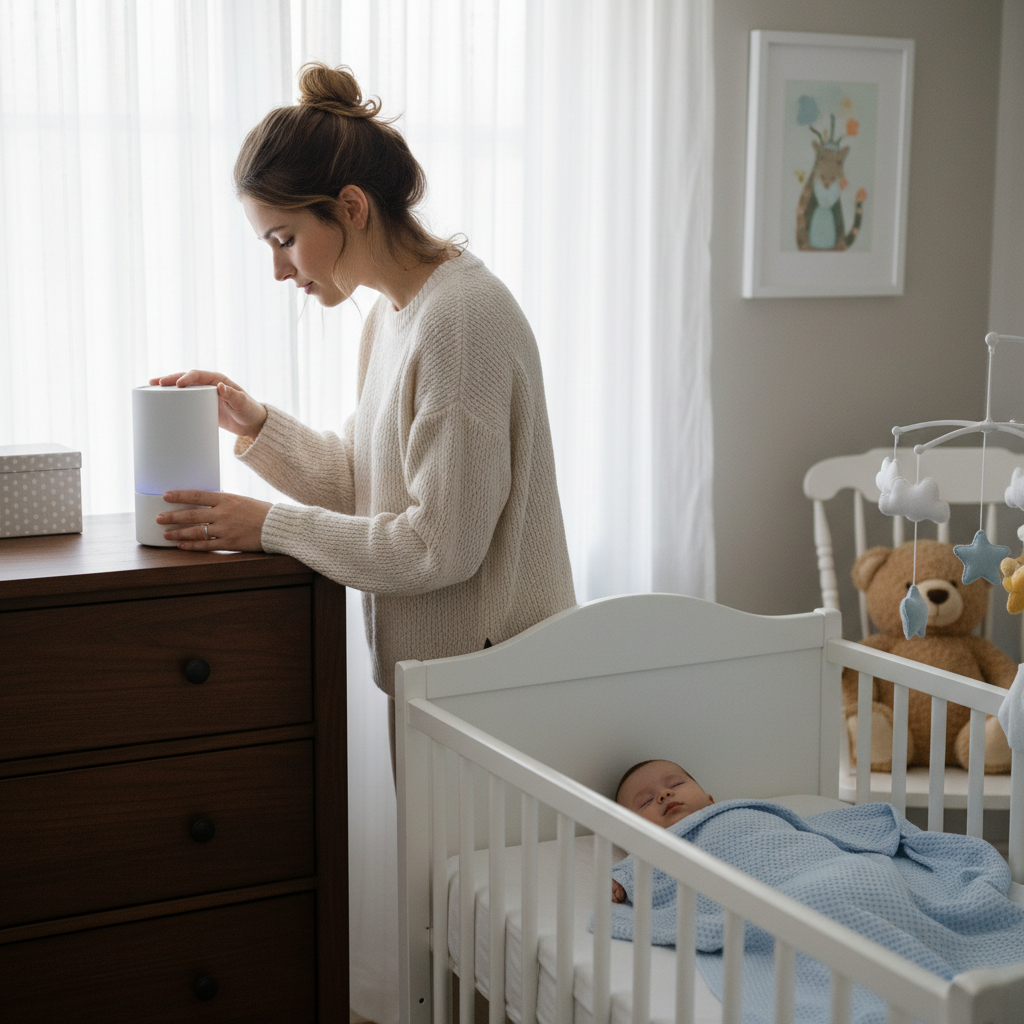
White noise for babies can be safe when it is used as low background sound, placed away from the crib, and paired with a safe sleep space. Think of it as one sleep cue, like dim lights or a short bedtime routine. It should not be loud enough to dominate the room, and it should never be placed inside the crib.
The simple safe-use checklist is:
If you want the deeper medical-safety background, check our white noise safety guide. Here, we focus on how to use white noise correctly in a normal nursery.
The question "is white noise bad for babies" usually comes from three worries: hearing, dependence, and overstimulation. Those are fair concerns. The good news is that the risk is mostly about setup, not the idea of white noise itself.

The best-known safety warning comes from an AAP Pediatrics study that tested infant sleep machines at different distances. The researchers reported that 14 infant sleep machines were tested and found that all devices exceeded 50 dBA at 30 cm when played at maximum volume. The same study found that three devices exceeded 85 dBA, which shows why maximum volume and close placement are the wrong combination.
For context, CDC/NIOSH describes an occupational recommended exposure limit of 85 decibels as an 8-hour time-weighted average. That is an adult workplace reference, not a baby sleep target. For a nursery, the lesson is not "85 dBA is fine." The lesson is that if a baby sound machine can reach that range near the crib, parents should keep it much lower and farther away.
Some parents worry their baby is "addicted" to white noise. A calmer way to say it is this: your baby may learn that a steady sound means sleep is coming. That can be useful, especially for naps, travel, siblings, or apartment noise. It becomes inconvenient only when your baby cannot settle anywhere without it, or when the machine is so loud that everyone tiptoes around the setting.
Sleep associations are not automatically bad. Feeding, rocking, a dark room, and a bedtime song can all become cues. The goal is flexibility. Keep white noise for babies at a gentle level, use it mostly for sleep times, and gradually lower it later if you want to reduce reliance.
Not every baby likes static. Some babies fuss at brighter white noise but relax with deeper brown noise. Others do better with no machine at all. Watch your baby, not the marketing copy. If the sound causes startling, squirming, crying, or wide-awake staring, lower it, change the sound, or turn it off.
This is the part that matters most in daily use. A safe sound machine setup is less about the label on the product and more about what your baby hears from the mattress.
A common practical benchmark is about 50 dBA or lower at your baby's sleep space. The AAP Pediatrics sleep-machine paper advised that manufacturers should limit output and that parents should use infant sleep machines as far away as possible from the infant and for short periods when feasible. In practical nursery terms, white noise should sound like a soft background layer, not like a shower running beside your baby's head.
You can use a phone decibel app as a rough check, but do not treat it as a medical instrument. The better habit is simple: stand where your baby's head will be, listen for a moment, and ask yourself whether the sound feels gentle. If you would need to raise your voice to talk beside the crib, it is too loud.
Distance protects tiny ears and reduces the chance that a cord or device ends up near the sleep surface. Across the room is usually better than on the crib rail or right next to the bassinet. If your nursery is small, place the machine as far from your baby's head as the room allows, pointed away from the crib if possible.
A practical target many parents use is about 7 feet, or roughly 2 meters, from the baby's head when the room allows.
Try this setup method:
The goal is not to erase every sound in the house. A baby can sleep through normal family noise. White noise for babies works best when it smooths sudden changes, such as a door closing, a sibling laughing, or traffic outside, without becoming the loudest thing in the room.
The best white noise for newborn sleep is usually the most boring sound you can tolerate. That may sound funny, but boring is the point. Sleep sounds should be steady enough that the baby's brain does not keep checking for what happens next.
Good baby sleep sounds often include:
For newborns, simple is better. Womb comparisons can be comforting for parents, but they should not be used as permission to make a machine loud. Outside the womb, your baby's ears are in a different environment. Keep the sound gentle.
Skip sounds with sudden birds, waves that crash, music that swells, lullabies that change intensity, ads, notifications, or loops with obvious breaks. These may be relaxing for adults, but they can become little wake-up events for babies.
If you use an app, put the phone on airplane mode if possible, disable notifications, keep it away from the crib, and avoid charging cords near the sleep area. A phone on the crib mattress is not a safe shortcut.
| Sound Type | What It Feels Like | Best Use | Watch For |
|---|---|---|---|
| White noise | Brighter, static-like | Masking sharp household sounds | Can feel harsh if too loud |
| Pink noise | Softer and more balanced | Everyday naps and bedtime | Some tracks include changes |
| Brown noise | Deeper, lower rumble | Babies who dislike sharp static | Bass can carry through walls |
There is no single best sound for every newborn. Choose the sound that lets your baby settle at the lowest volume. That one detail matters more than whether the label says white, pink, brown, shushing, or rain.
White noise works best when it is part of a predictable rhythm, not a rescue button you crank up after your baby is already upset. The routine can be very short. Babies do not need a production.

Try a pattern like this:
It can stay on all night if the volume is low and the machine is safely placed. Some babies wake when a timer stops during a lighter sleep stage, especially if the sound disappears suddenly. Other babies only need baby sleep sounds for the first part of settling.
If you prefer a timer, test it gently. Use a fade-out setting if your machine has one, or start with naps before trying overnight. If the timer repeatedly wakes your baby, continuous low sound may be more restful than abrupt silence.
White noise is for sleep, not all-day life. During awake time, babies benefit from normal voices, household sounds, songs, and responsive interaction. Turn the machine down or off when your baby is awake for longer play periods, when you are talking and bonding, or if the sound seems to irritate them.
Also turn it off and check your baby if crying changes, feeding seems off, breathing seems unusual, or your instincts say something is not right. White noise can soothe, but it should not cover up a real need.
White noise safety is part of the whole sleep setup. A sound machine cannot make an unsafe sleep space safe, and a safe crib should not be filled with gadgets.
The AAP-backed safe sleep message is consistent: babies should sleep on their backs, on a firm, flat, non-inclined surface, with no soft bedding in the sleep area. Babies should be placed to sleep on their back, and use a firm, flat sleep surface and keep soft items out of the sleep area.
White noise works best when the sleep space is already simple and safe: a firm, flat crib mattress, fitted sheet only, cords out of reach, and a safe crib setup that keeps devices outside the sleep area.
That means no sound machine in the crib, no phone on the mattress, no speaker clipped where it can fall in, and no plush sound toy left with a sleeping baby. If a device has a cord, route it behind furniture or along a wall where the baby cannot reach it now or as they grow. Babies get mobile faster than nursery plans get updated.
Most white noise problems are ordinary setup mistakes. They are easy to fix once you know what to look for.
A 40% setting on one machine may be very different from 40% on another. The same machine can also sound louder if it sits on a shelf, in a corner, or near a wall. Check from the crib. That is the only listening position that really matters.
White noise for babies can help soften the transition into sleep, but crying can mean hunger, gas, a wet diaper, discomfort, illness, or a need for closeness. Do not turn the sound up to push through crying. Check the baby first, then use sound as a calm cue if everything else is okay.
A phone beside the crib can bring notifications, bright light, overheating, charging cords, and a much louder speaker than expected. If you use an app, place the phone well away from the sleep space and keep the sound low. A dedicated sound machine with simple controls may be easier to manage, but it still belongs outside the crib.
Music, ocean waves, heartbeat tracks, and nature sounds can be lovely, but some are too dynamic for sleep. If your baby seems to wake at the same point in a loop, switch to a steadier sound. The best white noise for newborn sleep is the sound your baby can ignore.
White noise is not a full sleep strategy. It works better beside the boring basics: enough daytime feeding, age-appropriate wake windows, a simple wind-down, safe crib placement, and realistic expectations. Newborn sleep is naturally irregular. A sound machine can help create continuity, but it cannot make a brand-new baby sleep like an older child.
Not when used carefully. The main risks are loud volume, close placement, and overuse. Keep it low, steady, and away from the crib.
Use a low background level at the crib, commonly around 50 dBA or lower. If it sounds loud from the crib or you need to raise your voice nearby, turn it down.
A practical target is across the room, about 7 feet or 2 meters from the baby's head when possible, with cords fully out of reach.
It can contribute to risk if it is too loud, too close, or used for long stretches at high volume. Safe use is about low volume and distance.
Choose a steady, low, non-startling sound such as shushing, fan noise, pink noise, brown noise, or gentle static. The best choice is the one that works at the lowest volume.
It can be okay if it is low and safely placed. Some babies wake when a timer stops, while others only need it for settling.
Some babies form a sleep association. That is not automatically harmful, but you can gradually lower volume or reserve it for sleep times if you want more flexibility.
It can be used carefully, but keep the phone out of the crib, disable notifications, avoid overheating and cord hazards, and check the sound level from the crib.
White noise for babies is safest when it stays boring, low, and far from the crib. Use it to soften sudden sounds, not to flood the nursery. Choose steady baby sleep sounds, check the volume where your baby sleeps, keep devices and cords out of reach, and build the sound into a calm routine rather than relying on it as the whole plan.
If you are setting up a nursery from scratch, start with the sleep space first, then add sound around it. PatPat can help you create a calmer room with safe, practical nursery essentials that support real bedtime routines, not perfect-photo parenting.
Featured Products


How to Create a Safe and Sleep-Friendly Nursery
Newborn Sleep Schedule: How Much Should a 0-3 Month Baby Sleep?