
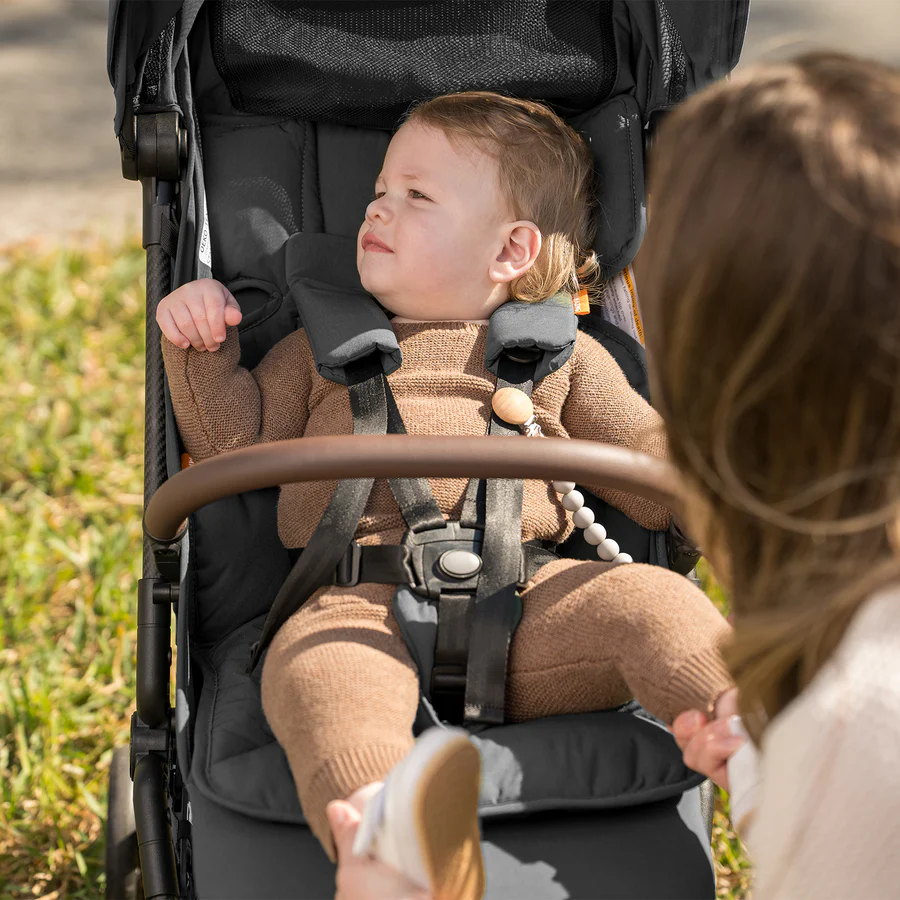
- by Mamazing Team
When Can Your Baby Sit in a Stroller
- by Mamazing Team

AT A GLANCE
|
From birth |
Yes — in a bassinet, fully reclining seat, or infant car seat attachment |
|
Upright seat (semi-recline) |
Around 3–4 months — only with emerging head control, deep recline, supervision |
|
Upright stroller seat (full) |
Around 6 months — steady head, can sit with support, 5-pt harness required |
|
The real signal |
Physical readiness, not the calendar. Check head control before the age of. |
|
Jogging strollers |
Not until 8–9 months minimum — vibration and impact require stronger neck muscles |
|
Safety bottom line |
Chin on chest = recline immediately. Harness on = every time, every outing. |
Week four of parenting. You are desperate to get outside, the baby is screaming, and someone at your antenatal group said their baby has been in the stroller from the start. You look at the bassinet attachment you did not order. Then at the stroller. Then back at the baby.
So, when can your baby actually sit in a stroller? The answer is more nuanced than any single number, and also more practical than most guides make it sound. Babies can use a stroller from day one — just not in the seat position. A stroller built around how babies actually develop should cover both stages: the flat-lying newborn months and the upright-sitting months that follow.

Age is a guide. What your baby's body is actually doing is the real answer.
|
Baby age |
Head/neck control |
Stroller angle |
Best stroller setup |
Key note |
|
Birth–3 months |
Cannot hold head |
Lie-flat only (0–10°) |
Bassinet or flat-recline stroller |
Head and neck support is critical |
|
3–6 months |
Emerging head control |
Semi-recline (20–45°) |
Reclined stroller seat or car seat |
Test head control before changing the angle |
|
6–8 months |
Steady head, early sitting |
Upright (60–80°) |
Standard stroller seat with 5-pt harness |
Start with short rides, monitor closely |
|
8–12 months |
Sitting independently |
Fully upright |
Any appropriate stroller seat |
Most babies prefer to be upright at this stage |
|
12+ months |
Strong core and balance |
Any position |
Same stroller, more confident rider |
Continue using the harness at all times |
The CDC developmental milestones for ages 4 to 6 months are useful here — they show the genuine range of when head and neck control develops, which is wider than most parenting articles acknowledge. Some babies hit steady head control closer to four months. Others are still working on it at six. Both are normal.

Forget the month. Watch the baby. These are the actual signals — and the ones that tell you to wait.
|
Readiness sign |
How to check it |
What it means |
|
Head stays up without wobbling |
Hold your baby upright under the arms. Head stays centered for 30+ seconds. |
Ready — primary signal |
|
Tracks toys left and right |
Baby follows a toy moving side to side without losing head position. |
Ready — strong signal |
|
No lag in pull-to-sit test |
Hold hands and pull gently to sit. Head stays aligned with body. |
Ready — good indicator |
|
Sits on your lap without slumping |
Propped briefly, the torso stays upright without collapsing forward. |
Getting close — watch closely |
|
Pushes up strongly in tummy time |
Lifts chest at 45° or more, holds for several seconds. |
Good foundation — keep building |
|
Head drops forward when upright |
Chin touches chest in supported sit. Airway risk. |
Not ready — stay in recline |
|
Body slumps heavily to one side |
Cannot maintain the center without constant correction. |
Not ready — more tummy time needed |

Lay your baby flat on their back. Hold their hands gently and pull them slowly up toward sitting. Watch what the head does. If it stays aligned with the body as they come up, that is a good sign. If it lags, flopping backward before eventually catching up, the neck muscles are not yet ready for a stroller seat.
The KidsHealtharticle "newbornmuscledevelopmentandheadcontrol" describes this developmental window clearly: head control develops progressively over the first several months, not in one jump. You are looking for consistent steadiness, not a few good moments.

Three options work for newborns and young babies who cannot yet hold their heads up independently. Not all strollers offer all three — this is the thing to check before buying.
|
1 |
Bassinet attachment — the gold standard for newborns Baby lies flat in a properly enclosed space. No angle on the airway. Safe for extended outings. Most bassinet attachments are suitable until the baby starts rolling or approaches the weight limit, usually around 20 lbs. |
|
2 |
Fully reclining seat (0–10° angle) If the stroller seat reclines nearly flat, it can work from birth — but only if the manufacturer rates it as newborn-safe. Always check. Not all full-recline positions are flat enough for safe newborn use. |
|
3 |
Infant car seat on a stroller frame or travel system The car seat provides head and neck support independently of the stroller's recline angle. Works well for the first few months and makes car-to-stroller transfers easy without waking the baby. |

The strollers worth buying at this stage are those that do not force you to choose between the newborn months and the sitting months. One stroller, different configurations as the baby grows.
|
Air Lux with Bassinet — from day one through first sitting Reversible seat, full recline, and bassinet compatibility — this is the model that covers the whole first-year arc. Parent-facing mode for the 3–9-month window when your baby needs reassurance, and you need to monitor their posture. Switch to world-facing once your baby is confidently sitting and curious about everything outside the stroller. |
|
Ultra Air Compact — for babies who are ready to sit upright Once your baby has steady head control and can sit with support — usually from six months — a lightweight, compact stroller becomes the daily driver. The carbon fiber frame significantly reduces weight. One-handed fold for parents who are always holding the baby with the other arm. The seat reclines but also supports a confident upright position for the sitters who want to see everything. |
The full range of options is in the stroller collection, covering newborn through toddler stages — worth filtering by the age range you are buying for right now, not the age range you are planning for.

You might notice the articles that focus on tummy time as a developmental activity — and then the articles about when babies can sit in strollers — never really connect the two. They should.
The muscles your baby builds in tummy time — neck, shoulder, upper back, core — are exactly the muscles they need to sit upright in a stroller seat safely. The AAP tummy time guidance for infant development recommends starting from day one, several times a day, even if sessions are only a few minutes initially.
|
How to use tummy time to build stroller readiness 3–5 minutes, 3–5 times a day from the early weeks. Increase as your baby tolerates it. You are looking for them to lift and hold their head at 45 degrees or higher, and eventually to push up on their arms and actively look around. That is the body doing what it needs to do before the stroller seat is appropriate. |

Do not switch from flat to fully upright in one go. Here is the gradual version that actually works:
|
1 |
Start with a slight recline (30–45°) Even if your baby has passed the readiness checks, start here. Run a few short outings — ten to fifteen minutes — and watch. Are they holding their head comfortably? Do they stay centered after a bump? That is the information you need before going further upright. |
|
2 |
Try parent-facing first If your stroller allows it, keep the baby facing you for the first few weeks of upright sitting. You can see their posture, comfort, and head position in real time without constantly. When they look relaxed and curious, that is a good sign. |
|
3 |
Increase the angle gradually over a week or two Move from 30° to 45° to 60° to 80° over several outings. No rush. Babies who feel unstable in a new position will let you know — usually with fussing that starts within a few minutes of sitting upright. |
|
4 |
Keep rides short at first Twenty to thirty minutes for a new sitter. Their core muscles are still building, and they tire more easily than you think. Longer rides come naturally as the muscles strengthen — usually within a month. |
|
5 |
Harness snug, every time The harness does not just prevent falls. It keeps a new sitter centered in the seat, which protects posture and prevents the chin-on-chest slump that can compress the airway. Snug, not tight — one finger between harness and body. |

In simple terms: the stroller has to match where your baby is now, not where you hope they will be in three months. Here is what actually matters:
|
What to check |
Why it matters |
What to look for |
|
Recline range |
Newborns need 0–10°. Early sitters need 20–45°. Full sitters need up to 80°. |
Look for multi-position or mechanical recline, not just one flat and one upright. |
|
5-point harness |
Mandatory at every age and stage. Non-negotiable. |
Check that the straps adjust as your baby grows — especially at shoulder height. |
|
Parent-facing mode |
Valuable in the 3–9 month window when the baby needs reassurance and monitoring. |
A reversible seat or parent-facing option significantly extends the stroller's usefulness. |
|
Seat depth and width |
Too narrow, and the baby feels cramped by 6 months. Too wide and they slump. |
Check seat dimensions for your baby's weight range before buying. |
|
Frame weight |
Lighter frame = easier to manage when lifting, folding, and loading solo. |
Carbon fiber frames cut weight without reducing strength — worth prioritizing. |
|
Canopy coverage |
New sitters cannot self-regulate temperature. Full coverage matters more than style. |
Extendable canopy with UV protection for all seasons. |
You might notice that most stroller marketing focuses on weight capacity and fold size. Recline range is the spec that matters most in the first year, and it is rarely highlighted prominently. Check it specifically before buying.
These do not change as the baby gets bigger. If anything, more active, mobile babies need the harness more — not less.
|
Safety rule |
What it means in practice |
Priority |
|
5-point harness every time |
Shoulders, waist, between legs — all five points, every outing, even two minutes. |
Non-negotiable |
|
Start at the deepest recline |
New to upright seating? Begin reclined. Increase the angle gradually over days. |
First transition step |
|
No loose items in the stroller |
Nothing in the seat can shift during a bump and block the airway. |
Safety rule |
|
No sleeping in a fully upright seat |
If the baby falls asleep upright, recline the seat — having the chin on the chest restricts the airway. |
Non-negotiable |
|
Check the harness fit after growth spurts |
Babies change size fast. A snug fit from last month may already be wrong. |
Ongoing maintenance |
|
Avoid rough terrain early on |
New sitters get jolted more easily. Start on smooth paths, build up from there. |
Early sitter care |
|
Keep the baby in your line of sight |
Parent-facing mode or a viewing window — check posture, alertness, comfort. |
Monitoring practice |
Babies can use a stroller from birth — just not in a standard upright seat. A bassinet attachment or fully reclining seat is appropriate from day one. The transition to an upright or semi-reclined stroller seat typically occurs between 4 and 6 months, once a baby has steady head and neck control and can maintain a seated position without immediately slumping.
Six months is the most common guideline, but physical readiness is a better indicator than the calendar.
From birth, with the right setup. A bassinet attachment is appropriate from day one for most standard strollers. A fully reclining seat rated for newborn use also works, provided the recline angle is nearly flat (0-10 degrees). An infant car seat on a stroller frame or travel system is another safe option.
What is not appropriate from birth: a standard upright stroller seat, even on its deepest recline setting, unless the manufacturer specifically rates it as newborn-safe.
Any age, depending on the stroller type. Bassinets and flat-recline strollers from birth. Semi-recline stroller seats from around 3 to 4 months if head control is developing well. Upright or standard stroller seats from around 6 months once head and neck control is steady, and the baby can sit with support.
Jogging strollers from around 8 to 9 months minimum. The age is a guide — the physical milestones are the actual gate.
Babies can nap in a stroller at any age — but only in a fully reclined or flat position. A young baby sleeping in a semi-upright seat risks their chin dropping to their chest, which can compress the airway.
The rule is simple: if the baby falls asleep in an upright seat, recline the seat. If the stroller does not recline far enough to keep the airway clear, take the baby out. Never leave a sleeping baby unattended in an upright stroller position, regardless of age.
As soon as you need to take your baby somewhere and want your hands free, which is usually within the first week home. A bassinet stroller or travel system is practical from day one for errands, walks, and anything that would otherwise mean carrying the baby.
The question is less about when to start and more about which stroller configuration is appropriate at your baby's current developmental stage.
Featured Products


Does a Stroller Count as a Carry On
When to Use a Baby Stroller Bassinet Safely