
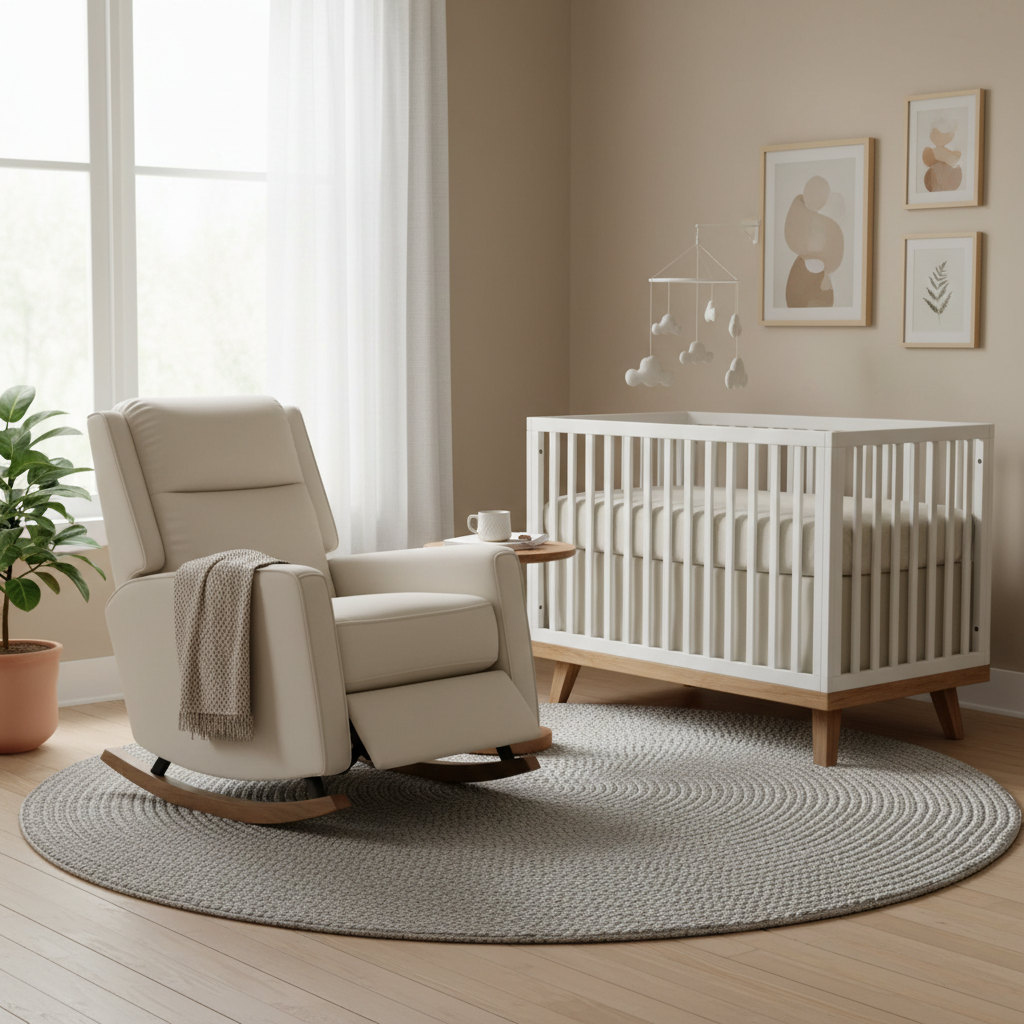
If you want the short answer first, the best rocking chair for a nursery is the one that lets you feed, cuddle, and settle your baby without forcing your shoulders up, your lower back forward, or your knees into an awkward angle. A beautiful chair matters, but comfort at 2 a.m. matters more. If the seat supports your back, the arms meet your elbows during feeds, the motion feels smooth, and the footprint still works once the crib and dresser are in place, you are looking at the right kind of chair.
That is why the best nursery rocking chair is not always the biggest, plushest, or most expensive option. Some parents do best with a simple rocker that glides through short feeds and bedtime stories. Others need a recliner because they spend long stretches feeding, pumping, or contact napping nearby while staying awake. If you are comparing styles right now, start with your routine first, then your room, and only then the finish, fabric, or color.
At Mamazing, we usually tell parents to make this decision the same way they would choose a mattress or stroller: look at how you will actually use it every day. If you want to compare real nursery-ready options while you read, you can browse the Mamazing nursing chair collection or use this guide alongside our related comparison on rockers, gliders, and recliners.
What Makes the Best Rocking Chair for a Nursery?
The best rocking chair for a nursery combines five things: supportive posture, smooth motion, easy entry and exit, nursery-friendly upholstery, and a shape that still makes sense after the baby stage. If one of those pieces is missing, the chair may photograph well but feel disappointing in real life.
A lot of nursery chairs are marketed as cozy, yet they fail in exactly the moments when you need them most. The chair that feels soft for three showroom minutes can feel wrong during a forty-minute feeding if the seat is too deep, the arms are too low, or the back is too upright. That is why it helps to judge a chair by use case instead of by appearance alone.

The five features worth prioritizing first
- Supportive backrest: You should feel your lower back supported without having to stuff extra pillows behind you every single time.
- Useful arm height: Good arm support matters during bottle feeds, nursing sessions, and long soothing stretches because your elbows should not hang in space.
- Smooth, quiet motion: Rocking or gliding should feel controlled, not jerky or noisy enough to distract a sleepy baby.
- Easy-clean upholstery: Spit-up, milk drips, snack crumbs, and lotion smudges happen fast in a nursery.
- Practical scale: The chair should fit the room, leave clear walking space, and still feel useful when the nursery becomes a toddler room or reading corner.
One practical way to judge a chair is to sit all the way back, place your feet flat, and raise your forearms as if you are feeding a baby. If you already feel like you need a pillow under your elbows, a stool under your feet, and another cushion behind your back, that chair is asking too much of you.
| Feature | Why it matters | Who notices it most |
|---|---|---|
| Arm height | Helps support baby weight during feeding | Parents doing longer nursing or bottle sessions |
| Seat depth | Keeps your back in contact with the chair without forcing a slouch | Shorter parents or anyone with lower-back sensitivity |
| Lumbar support | Reduces the urge to lean forward and round your shoulders | Parents feeding multiple times overnight |
| Motion style | Changes how soothing, quiet, and space-efficient the chair feels | Light sleepers and small-room households |
| Fabric and finish | Determines how easy the chair is to live with after spills | Families planning to use the chair for years |
If you are stuck between several models, do not ask which one looks most premium. Ask which one will still feel good during your third feed of the night. That question usually gets you to the right answer much faster.
Rocking Chair vs Recliner for Nursery: Which One Fits Your Routine?
If your routine is mostly short feeds, quick soothing, and bedtime winding down, a rocking chair or glider is often enough. If you expect long feeding sessions, pumping time, or want a chair that can double as a recovery seat after birth, a recliner starts to make more sense. The better option is the one that matches how long you will actually stay in the chair and how much body support you want while doing it.
Parents often frame this as a style question, but it is really a rhythm question. A rocker gives you a smaller visual footprint and a more classic nursery feel. A recliner gives you more positions, more leg support, and usually a more lounge-like experience. That extra comfort can be worth it, but only if your room can handle the footprint and moving parts.

| Chair type | Best for | Main advantage | Main trade-off |
|---|---|---|---|
| Classic rocker | Simple soothing and a timeless look | Smaller feel and straightforward motion | Less full-body support during longer sessions |
| Glider | Quiet movement in a nursery | Smooth back-and-forth motion on a fixed base | Not every glider has strong recline or deep cushioning |
| Recliner rocker | Long feeds, recovery, and all-purpose comfort | Leg support plus multiple sitting positions | Takes more room and costs more |
| Power recliner | Parents who want the easiest adjustment | Small angle changes without jerking the chair | Requires power access and a bigger budget |
When a classic rocker makes more sense
A classic rocker or compact glider usually wins when you have a modest nursery, want a lighter visual look, or know the chair will later move into another room. It also works well if you like an upright posture for feeds and mostly want a gentle soothing motion instead of a full recline setup.
When a recliner earns its extra footprint
A recliner becomes easier to justify if you are planning for long evening feeds, pumping sessions, C-section recovery, or simply want one chair that can carry more of the physical load. The important caution is safety: even if a recliner feels incredibly comfortable, babies should not sleep on sofas, armchairs, or recliners because those surfaces increase the risk of suffocation and entrapment, as the NICHD Safe to Sleep program explains. In practice, that means recline can help your body, but it should never become a substitute for a safe sleep space.
If you are deciding between the two, this is the simplest rule: choose a rocker when space is your main constraint, and choose a recliner when physical comfort during longer sessions is your main constraint.
The Comfort Features That Matter Most During Feeding Sessions
The most comfortable nursery rocking chair is the one that helps you keep your body neutral while bringing your baby close. During feeding, the little details do the heavy lifting: arm height, lumbar support, seat depth, foot support, and a backrest that does not force you to curl forward.
That posture point matters more than many parents expect. The NHS breastfeeding guidance recommends getting yourself comfortable first, supporting your back, and bringing your baby to the breast rather than leaning your body toward the baby, which is one reason chair support matters so much during repeated feeds. You can see that principle in the NHS guide to positioning and latching, and ACOG also emphasizes comfortable positioning and the use of pillows or arm support in its How to Breastfeed infographic.
In other words, the best chair for nursing a baby is not just soft. It is a chair that helps you stay supported enough that you do not spend every feed adjusting yourself instead of focusing on your baby.
Why arm height, lumbar support, and seat depth matter
- Arm height: High enough to support your forearms without hunching your shoulders.
- Lumbar support: Strong enough that you do not collapse into the chair after ten minutes.
- Seat depth: Deep enough to feel secure, but not so deep that your lower back loses contact with the backrest.
- Seat firmness: Supportive rather than marshmallow-soft, because over-soft cushions often make getting up harder while holding a baby.
- Foot support: A built-in footrest or a separate ottoman can help, especially if your feet otherwise dangle.
What feels good in a showroom but fails at 2 a.m.
Some chairs feel luxurious in a store because the cushion is overstuffed and the recline is dramatic. Then real life begins. Your shoulders creep up because the arms are too low. Your hips sink so far that standing up becomes awkward. The headrest pushes your neck forward instead of supporting it. If you are testing in person, mimic a feeding posture, lean back, sit forward, and stand up without using both hands. That quick sequence tells you more than color swatches ever will.
General ergonomic guidance from MedlinePlus also supports the same idea: neutral posture, back support, and avoiding prolonged strain make a difference over time. Nursery feeding may not look like office ergonomics, but your neck, back, and shoulders still care about alignment.

If your goal is maximum comfort, look for a chair that lets you settle into one supported position quickly. The best comfortable nursery rocking chair is the one that asks the least from your body while you are already tired.
Best Rocking Chair for a Small Nursery
The best rocking chair for a small nursery is usually the chair with the smartest footprint, not the narrowest catalog width. What matters is how the chair moves, how much clearance it needs behind or in front, and whether it blocks drawers, doors, or the path to the crib once it is actually in the room.
Parents often measure wall-to-wall space and stop there, but that misses the real problem areas. A recliner needs space to open. A swivel chair needs turning clearance. Even a compact rocker can feel oversized if it sits too far off the wall or forces you to sidestep around it during nighttime changes.

The measurements that matter more than overall width
- Back clearance: Important for recliners and some gliders.
- Leg-room clearance: Necessary if a footrest extends forward.
- Arm-to-crib distance: Enough room to lift and transfer comfortably.
- Walkway width: You should still have an easy nighttime path through the room.
- Visual bulk: Thick arms and oversized wings can make a room feel crowded even when the measurements technically fit.
How to avoid buying a chair that blocks your room
Tape the chair footprint on the floor before you buy. Then open the nursery door, pull out dresser drawers, and walk to the crib in the dark. It sounds simple, but it prevents a lot of expensive regrets. For many small spaces, a compact glider or rocker with a tighter silhouette makes more sense than a full recliner, even if the recliner feels better in the moment.
If you want more small-space inspiration, our guide to best rocking chairs for nursery on a realistic budget can help you think through scale, value, and everyday usability. The best small nursery rocking chair is the one that supports you without stealing the whole room.

Do You Need a Nursing Chair in a Nursery?
No, a nursing chair is not a strict nursery requirement in the same way a safe crib is. But for many parents, it becomes one of the most-used pieces of furniture in the room because it creates a reliable place for feeding, settling, reading, and recovery. Whether you need one depends on how often you expect to feed or soothe in the nursery and how supportive your other seating options already are.
If your home already has a truly supportive armchair near the nursery and you prefer feeding there, you may not need a dedicated nursery chair. But if you find yourself balancing pillows on a couch, twisting on the edge of a bed, or standing to soothe a baby every evening, then yes, a nursery rocking chair quickly becomes worth it. Convenience is part of the value, but consistency is the bigger advantage. Babies respond to routine, and so do tired parents.
This is also where the term nursing chair can be misleading. It is not only for breastfeeding. Bottle-feeding parents, pumping parents, grandparents helping with bedtime, and families who use the chair for reading or contact naps nearby can all get the same benefit: a dependable, comfortable station for calm repetitive care.
If you are looking for one chair that can work through newborn feeds and still make sense after the nursery years, focus on neutral upholstery, durable cushioning, and a silhouette you would be happy to move into a bedroom or living room later. That is where a well-chosen chair starts to feel less like baby gear and more like long-term furniture.
Materials, Safety, and Easy-Clean Details You Should Not Skip
The best nursery rocking chair should feel easy to live with, not delicate. That means upholstery that can handle milk, spit-up, and snack messes, plus a frame and motion system that feel stable when you sit down, stand up, or shift weight with a baby in your arms.
For everyday life, performance fabrics, easy-wipe surfaces, and removable or washable covers usually outperform trend-first materials. A boucle or textured fabric can look warm and elevated, but you should still ask how it handles drips, lint, and spot cleaning. If you love the look, great. Just make sure the chair can survive the routine you actually have.
Safety details deserve the same level of attention. If you are choosing a recliner or any chair with moving components, inspect gaps, hinges, and footrest mechanisms carefully. The U.S. Consumer Product Safety Commission has warned about entrapment risks in recliner mechanisms, which is a good reminder to keep fingers clear and choose well-built hardware. Stability matters too: the chair should not lurch, tip, or feel loose at the joints when you rise with a sleeping baby.
Another safety point is sleep location. A deeply padded rocker or recliner can be soothing, but it is still a chair, not a sleep surface. The NICHD safe sleep guidance is clear that babies should sleep on a flat, firm surface made for infant sleep, not on sofas, armchairs, or recliners.
- Choose upholstery you can clean without special treatment.
- Check the frame for wobble, squeaks, and rough movement.
- Inspect recline and footrest gaps before buying.
- Look for cushions that recover their shape after repeated use.
- Favor neutral, durable finishes if you want post-nursery longevity.
A great chair should reduce stress, not create extra maintenance work or safety worries. That is one reason truly practical nursery chairs often age better than highly styled ones.
How to Choose the Right Nursery Rocking Chair for Your Home
The easiest way to choose the right nursery rocking chair is to match the chair to your routine, room, and recovery needs. Once you do that, the decision stops feeling abstract and starts feeling obvious.
- Choose a compact rocker or glider if your nursery is tight, your feeds are usually shorter, and you want a chair that can migrate to another room later.
- Choose a recliner if you expect long feeding sessions, want foot support, or know your body feels better when you can change positions often.
- Choose stronger lumbar and arm support if you have a history of neck, shoulder, or lower-back tension.
- Choose easy-clean upholstery if you want low-maintenance comfort over the next few years, not just an attractive first impression.
- Choose a more neutral silhouette if you want the chair to outlast the nursery and still look at home elsewhere.
If you are down to two finalists, imagine a real week in your life. One hand is full, the room is dim, and you are sitting down for the fourth time since midnight. Which chair makes that moment easier? That is usually the best rocking chair for your nursery.
If you want to compare more nursery-specific options, browse the Mamazing nursing chair collection or continue with our related guide on best rated rocking chairs for nursery for more side-by-side thinking.
Frequently Asked Questions
What features make a nursery rocking chair comfortable?
A comfortable nursery rocking chair has supportive lumbar cushioning, arms at a useful feeding height, a seat depth that keeps your back supported, smooth quiet motion, and fabric that stays comfortable through longer sessions.
What should I look for in a nursery rocking chair?
Look for back support, arm height, easy entry and exit, the right motion for your room, easy-clean upholstery, and a footprint that still leaves clear space around the crib and dresser.
Rocking chair vs recliner for nursery: which is better?
A rocking chair is often better for smaller rooms and simpler routines, while a recliner is better if you want more leg support and spend longer periods feeding, pumping, or settling your baby in the chair.
What is the best rocking chair for a small nursery?
The best rocking chair for a small nursery is usually a compact rocker or glider with a controlled footprint, smooth motion, and enough support for feeding without needing the larger clearance of a full recliner.
Do you need a nursing chair in a nursery?
You do not strictly need one, but many parents find a dedicated nursing chair worth it because it gives them a consistent, supportive place for feeding, cuddling, reading, and recovery.
Are reclining rocking chairs worth it for nursery use?
Reclining rocking chairs are worth it if you want more body support, longer-session comfort, or recovery-friendly seating, but they are not always the best choice for small nurseries because they need more room.
Which rocking chair is safer to use?
The safer rocking chair is the one with stable construction, smooth controlled motion, well-designed moving parts, and a layout that allows you to sit and stand securely while remembering that babies should always be moved to a safe sleep surface rather than left sleeping in the chair.
Final Thoughts
The best rocking chair for a nursery does not win because it sounds luxurious. It wins because it supports your real life: feeding when you are tired, soothing when the room is dark, and giving you one dependable place to slow everything down. For some families that will be a simple rocker. For others it will be a recliner that earns every extra inch it takes up.
If you start with comfort, support, and fit, style usually falls into place after that. And if you want a chair that balances nursery function with a design you will still want later, Mamazing is a good place to keep comparing what that balance looks like in practice.
Best Nursery Chairs: Glider Recliner, Rocker, and Small-Space Picks
Rocker Recliner Chairs: How to Choose One That Grows with Your Family