A small nursery can make every furniture decision feel bigger than it should. Once the crib, dresser, changing station, and laundry basket are in place, the chair often becomes the hardest piece to get right. You need something compact enough to fit the room, but still comfortable enough for feeding, soothing, contact naps on your chest, and the kind of late-night sitting that makes poor support obvious fast.
That is why the best nursery chair for small spaces is not always the narrowest one. What matters more is how the chair moves, how much clearance it needs once it reclines or glides, whether it gives your arms and back enough support, and whether it avoids extra bulk like a separate ottoman. Parents searching this topic are usually not asking for a giant roundup first. They want to know how to choose a chair that actually works in a tight room.
This guide focuses on that decision. We will look at rocker vs glider trade-offs, what measurements matter before you buy, which features help most in a small nursery, and which compact Mamazing chairs are worth shortlisting if you want comfort without giving up too much floor space.
Why the best nursery chair for small spaces is not always the smallest one
In a nursery, “small” only helps if the chair still works well once you start using it every day. A chair can look compact in product photos but feel awkward in real life if the armrests are too low, the seat is too shallow, or the recline path blocks the dresser drawers behind it. That is why the best compact nursery chairs balance two things at once: a controlled footprint and real sitting comfort.
The practical goal is to preserve movement around the room. You want enough clearance to walk between the crib and changing area without turning sideways, enough room to glide or recline without hitting the wall, and enough support that you do not end every feeding session with tight shoulders. A compact chair should make the room easier to use, not simply occupy fewer inches on a spec sheet.
That is also why many parents end up comparing a small nursing chair for nursery guide against a broader comfort wish list. The right chair should feel intentional, not like a compromise you regret after the first week home.
Rocker vs glider: which works better in a small nursery?
For most small nurseries, a glider is usually easier to live with than a traditional rocker. That does not make rockers wrong, but it does make gliders more predictable in tight layouts. Predictability matters when your chair is close to a wall, a crib, or a dresser corner.
A traditional rocking chair moves in a wider arc on curved runners. That classic motion can feel cozy, but it usually needs more open space in front of and behind the chair. In a tight room, that extra swing path can force the chair farther away from the wall than you expected.
A nursery glider for small spaces usually works better because the base stays in place while the seat moves on a fixed track. That means the motion feels smoother, the footprint is easier to plan around, and the chair often sits closer to the wall. If you already know gliding motion is what you want, Mamazing’s best nursery glider for small spaces guide is the most natural next read.
| Chair type |
Motion |
Small-room advantage |
Watch for |
| Traditional rocker |
Back-and-forth arc |
Classic feel |
Needs more swing clearance |
| Glider |
Fixed-track glide |
Easier wall placement |
Check depth and recline path |
| Swivel glider |
Glide plus turn |
Useful in corners |
Needs side clearance to rotate |
The best choice depends on how your room is laid out. If the chair has to live in a corner or beside the crib, gliding motion usually gives you more control. If the room is wider and you care most about the traditional rocking feel, a rocker can still work well. The mistake is assuming all “small” chairs behave the same once they start moving.
How to measure for a nursery chair in a tight room
This is the step many parents skip, and it is usually where small-room frustration begins. Measure more than the chair width. What you really need is the chair width, the chair depth, the amount of space needed behind it for motion or recline, and the walking path you still want to keep open after the chair is in place.
-
Measure the wall space where the chair will sit, not just the room itself.
-
Measure the live footprint of the chair while it glides, swivels, or reclines.
-
Leave a real walking lane between the chair and the crib or dresser.
-
Check nearby drawer clearance so the changing station or dresser still works normally.
-
Account for side tables and baskets before deciding the room can “fit one more thing.”
A good rule is to think in daily routes, not empty-floor measurements. Ask yourself whether you can stand up while holding a baby, step toward the crib without bumping the armrest, and reach what you need without twisting awkwardly. That kind of practical fit matters more than shaving off one or two inches on paper.
It also helps to mark the chair zone with painter’s tape before you buy. Tape out the upright footprint first, then add the extra space needed for gliding, swiveling, or reclining. Once you can see the full working area on the floor, it becomes much easier to spot conflicts with drawer pull-outs, diaper caddies, and the walking path you rely on in the dark.
If you want a broader selection framework after the measuring step, Mamazing’s nursery chair buying guide is a useful companion page.
Features that matter most in a nursing chair for small spaces
The best compact chairs earn their space by removing the need for extra furniture or awkward workarounds. In a small nursery, features are not just luxuries. They can determine whether the chair helps the room function or makes the room feel busier.
-
Integrated footrest: a built-in footrest often works better than a separate ottoman, because it gives you leg support without adding another object to step around.
-
Swivel function: this can make a corner placement much easier, especially if you need to turn toward the crib, a nightstand, or the door.
-
Supportive armrests: compact chairs need good arm support even more than oversized ones, because there is less room for you to compensate with extra pillows.
-
Easy-clean materials: in a small room, spit-up, milk drips, and snack messes feel more immediate because the chair gets used constantly.
-
Quiet motion: small nurseries amplify squeaks and mechanical noise. Smooth, quiet movement matters more than you think at 2 a.m.
The feature that often gets overrated is “smallest size possible.” The features that get underrated are arm support, foot support, and how easy the chair is to live with during repeated night feeds. Those are the things parents notice first after the novelty of the purchase wears off.
Another useful filter is to separate must-haves from comfort upgrades. In a very tight room, integrated leg support, a manageable recline path, and supportive arms usually matter more than tech extras. In a room with slightly more flexibility, powered controls or charging ports may become more attractive. Thinking this way keeps you from paying for the wrong conveniences while still missing the features that actually reduce daily strain.
Comfort and ergonomic support during long feeds and soothing sessions
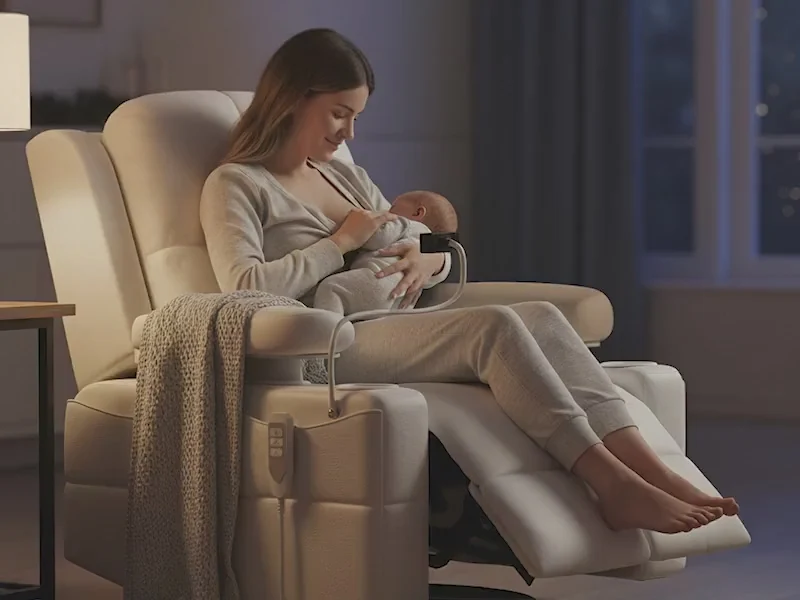
A nursery chair can look compact and still feel exhausting if it does not support your feeding posture. HealthyChildren notes that when breastfeeding in a chair, sturdy back and arm support can make the session more comfortable, and pillows behind your back or under your arms can help reduce strain. You can read that guidance in HealthyChildren’s breastfeeding positioning guide.
That advice maps directly to small-space chair shopping. Look for a chair that supports your head and shoulders, lets your elbows rest naturally, and keeps you from collapsing into a forward slump. A chair that is technically compact but too low, too soft, or too unsupportive can leave you more tired after every feed.
For many parents, the best comfort details in a small room are the simplest ones:
- A seat depth that feels supportive, not cramped
- Armrests high enough for feeding support
- A backrest that supports your head during long sessions
- A footrest or leg support that reduces pressure on your lower back
Mamazing’s compact models are most helpful when you treat them as examples of these principles rather than shortcuts around them. A chair earns its place in a small nursery when it still feels good after the fourth feed of the day, not just when it photographs well.
Small-room safety and layout mistakes to avoid
In a small nursery, safety issues are often layout issues. When furniture sits close together, it is easier to create pinch points, blocked walkways, or tempting climbing setups around the chair.
-
Do not crowd the chair too close to the crib. You want enough room to stand up, turn, and transfer your baby without bumping rails or corners.
-
Do not rely on a loose ottoman if the room is already tight. It adds one more object to navigate in the dark.
-
Anchor nearby dressers or shelves. The U.S. Consumer Product Safety Commission recommends anchoring furniture to protect children from tip-over hazards; their Anchor It guidance is a useful reminder for any nursery where the chair sits near storage furniture.
-
Do not treat the chair as a sleep surface. If your baby falls asleep after a feed, move them to a firm, flat sleep surface as soon as practical. HealthyChildren includes that reminder in its safe sleep guidance.
The main small-room safety goal is calm movement. You should be able to sit, feed, stand, and transfer your baby without squeezing through clutter or stepping around unstable extras. If the chair makes the room feel more complicated at night, it is probably too bulky for the layout.
This is also where placement beats decoration. A beautiful chair can still be the wrong chair if it forces the side table too close, blocks access to blackout curtains, or turns every overnight transfer into a sidestep around furniture. In a small nursery, the smartest setup usually looks slightly simpler than what you first imagined because it prioritizes movement and reach over filling every corner.
Two Mamazing nursery chairs worth shortlisting for small spaces
If you already know you want a compact chair and are narrowing down real options, two Mamazing models make the shortlist for different reasons. The key is to choose the one that matches how your room and routine actually work.
| Feature |
Lullapod Nursery Chair |
Lullacloud |
| Best for |
Parents who want powered convenience |
Parents maximizing a tighter room |
| Recline |
Power recline up to 135° |
Manual recline up to 165° |
| Swivel |
240° |
360° |
| Upholstery |
Soft fabric |
Washable fabric cover |
| Helpful extra |
USB / Type-C charging |
Adjustable headrest |
This table works best when you read it through a small-room lens. The Lullacloud makes a strong case if you want maximum corner flexibility, deep recline, and washable practicality. The Lullapod becomes more appealing if you care about powered adjustments and built-in charging enough to justify a slightly more tech-forward setup.
Neither option is automatically best in every nursery, and that is the point. The better fit depends on whether your biggest friction is space, cleanup, or convenience. Parents in a truly compact room usually benefit most from the chair that creates the least visual and physical spillover into the rest of the nursery.
How to choose between Lullacloud and Lullapod
If your nursery is truly tight and you want the chair that feels most adaptable, Lullacloud is the easier answer for many families. The 360° swivel, deeper manual recline, integrated footrest, and washable cover all map well to the realities of a smaller room where every item needs to earn its space.
If your room can handle a little more operational complexity and you care a lot about powered convenience, Lullapod is the better fit. Parents who expect to spend long stretches in the chair may appreciate the powered motion and charging ports, especially if that convenience matters as much as absolute compactness.
A helpful way to decide is to picture your most common hard moment. If it is turning gently in a corner while keeping essentials close, the more flexible swivel story matters. If it is settling in for a longer session and wanting fewer manual adjustments, powered convenience may matter more. Choosing from that real-life scenario usually works better than comparing marketing labels like “premium” or “luxury.”
The deciding question is not which chair sounds more premium. It is which chair removes more friction from your actual routine. If you want to compare more models after narrowing the small-room criteria, Mamazing’s broader nursery chair roundup is the better next step than guessing from isolated product features.
Frequently asked questions
What is the best nursery chair for a very small room?
Usually, the best choice is a compact glider with good back support, a built-in footrest, and a motion path that does not demand much wall clearance. In Mamazing’s current lineup, Lullacloud is the stronger fit for many very small rooms because it combines deep recline, 360° swivel, and a tighter-space-friendly design.
Are gliders better than rockers for small spaces?
Often, yes. Gliders usually move on a fixed track, which makes their footprint easier to plan around in a tight nursery, while traditional rockers often need more front-and-back clearance.
How much clearance does a nursery chair need?
There is no one universal number because it depends on the chair’s motion and recline path. The safest approach is to measure the live footprint of the chair while it moves and still leave a comfortable walking lane to the crib and changing area.
Should I choose a chair with an ottoman?
In a small nursery, many parents prefer an integrated footrest instead. It gives you leg support without adding another piece to step around during nighttime feeds.
Is a recliner too big for a small nursery?
Not always, but it can be if the recline path eats into your walkway or blocks nearby furniture. A recliner can work well in a small room when the depth, wall clearance, and daily movement path have been measured honestly.
How do I clean my Mamazing chair?
That depends on the upholstery. Fabric models like Lullacloud benefit from removable, washable covers, while wipe-clean surfaces are often the easiest choice for parents who expect frequent everyday messes.
Final thoughts
The best nursery chair for small spaces is the one that makes the room calmer, not more crowded. It should support feeding and soothing, fit the real movement patterns of your nursery, and remove the need for extra clutter whenever possible.
If you focus on motion type, real clearance, back and arm support, and integrated features, you can choose a compact chair that still feels genuinely comfortable. And if you want a small-space shortlist that stays practical instead of overwhelming, Mamazing’s compact nursery chairs are easiest to compare when you treat them as answers to specific room problems—not just as a list of specs.



When Do Babies Start Crawling? Milestones & Tips
Small Nursing Chair for Nursery: How to Choose a Compact Chair for Small Spaces