If you want one stroller that feels genuinely helpful from the newborn stage, a bassinet stroller usually earns its place for one simple reason: it gives your baby a flatter, more supportive place to ride than a standard upright seat. That matters most in the early months, when your outings are short, your baby falls asleep constantly, and every transfer in and out of the stroller feels bigger than it should.
What makes the category confusing is that not every bassinet stroller solves the same problem. Some are roomy but heavy. Some look compact online but still feel awkward when you lift them into the trunk. Some are comfortable for baby but not especially easy for you. So the real buying question is not just Do you need a bassinet stroller? It is Will this setup make your daily routine easier often enough to be worth the space, money, and effort?
If you are looking at the Mamazing Air Lux with bassinet, the strongest case for it is not that it does everything. It is that it combines a newborn-ready lay-flat setup with the kind of lighter frame, one-hand fold, and everyday practicality that many parents end up caring about more than flashy add-ons. This guide walks through the real benefits of a bassinet stroller, how long you will realistically use one, and what to check before you decide.
Why many newborn parents choose a bassinet stroller in the first place
The main benefit of a bassinet stroller is not style. It is setup. In the earliest months, babies spend most outings sleeping, feeding, or drifting between the two. According to the CDC's safe sleep guidance, babies sleep safest on their back on a firm, flat surface. A stroller bassinet is not a replacement for your baby's regular sleep space at home, but that same flat, supported layout is one reason many parents prefer bassinet mode over putting a very young baby straight into a more upright stroller seat for walks and errands.
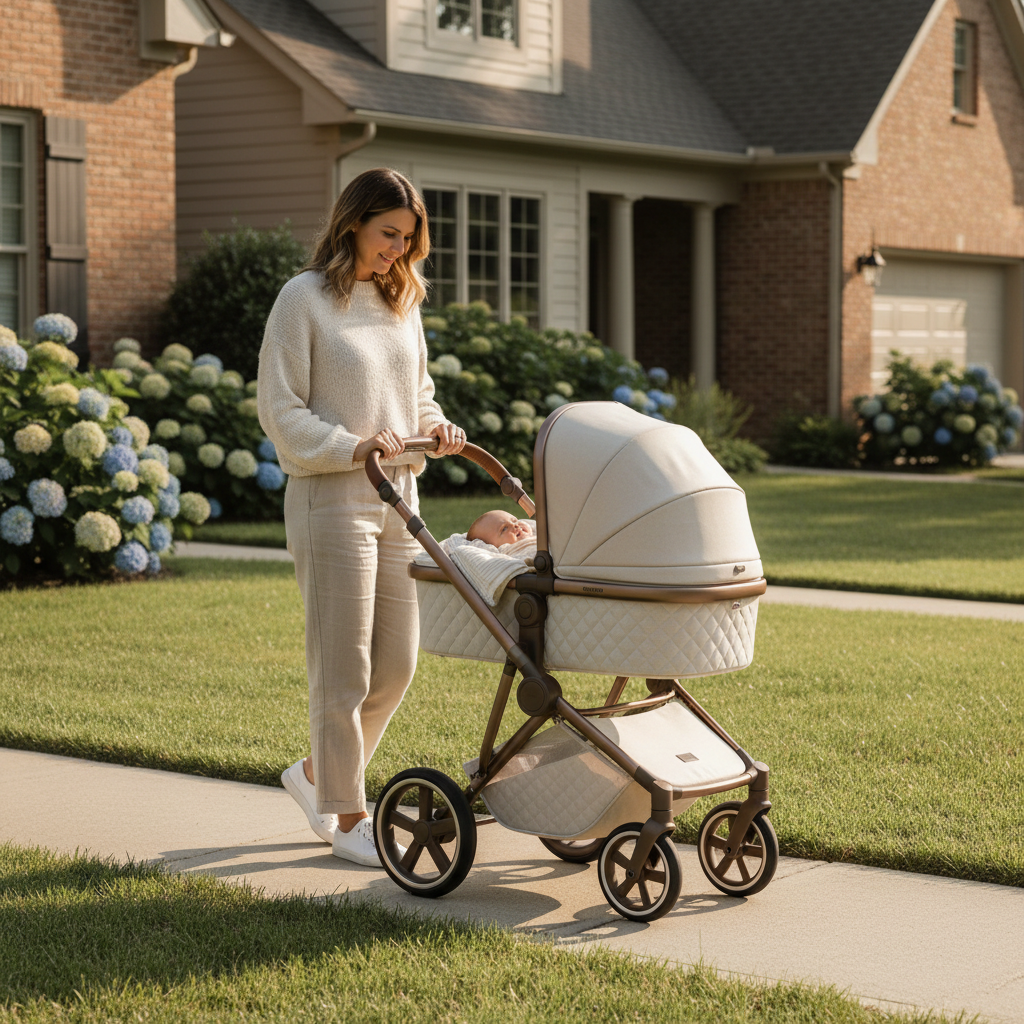
That difference becomes more obvious in real life than it does on a product page. When your baby falls asleep five minutes into a walk, you do not have to wonder whether the seat angle still looks comfortable. When you move from the sidewalk to a coffee shop, or from the parking lot to a pediatrician appointment, you are not re-positioning a floppy newborn every few minutes. You are simply rolling forward with a setup designed for the stage you are in.
There is also a practical parent benefit here: bassinet mode tends to make those first outings feel less complicated. You can lay your baby down more gently. You can keep blankets, burp cloths, and the diaper caddy within reach instead of balancing everything around a car seat. And if your newborn tends to nap better while moving, a bassinet stroller often gives you a calmer rhythm than an upright stroller seat that is better suited to older babies.
That does not mean every family needs one. If most of your early outings are quick car trips, you babywear constantly, or your stroller is only for occasional use, a bassinet setup may matter less. But if you expect regular walks, neighborhood errands, or longer stretches out of the house, the category makes sense because it supports the way newborn days actually unfold: stop, start, feed, walk, settle, repeat.
The Mamazing Air Lux is especially interesting in this category because it does not ask you to choose between a newborn-friendly setup and a lighter everyday stroller. The current product page lists a 15.8 lb stroller weight, a one-hand fold, a 5-point harness, and a bassinet configuration for 0-6 months, which is exactly the combination many parents hope to find but often struggle to get in one package.
What a lightweight stroller with bassinet changes for everyday life
A lot of bassinet stroller articles talk about comfort for baby, which matters, but the hidden buying decision is usually about friction for you. A stroller can look great on day one and still become annoying if it is heavy, awkward, or slow to fold. That is why the query lightweight stroller with bassinet matters so much. Parents are not only asking whether a bassinet stroller is useful. They are asking whether it will still feel worth using once real life shows up.
This is where a lighter model can change the experience more than people expect. When a stroller is easy to lift, easy to steer, and easy to fold with one hand, you use it more spontaneously. You bring it for a grocery stop instead of debating whether the errand is short enough to skip it. You reach for it before a walk around the block because loading it into the car or getting it down the front steps does not feel like a whole second task. A stroller that is simple to use tends to become part of your routine instead of a backup plan sitting by the door.
On the Mamazing Air Lux product page, the brand highlights the carbon-fiber frame, one-handed fold, and underseat basket with up to 30 lb of storage. Those details matter because they answer three common pain points at once: lifting, folding, and carrying the rest of your life with you. If you live in an apartment, regularly load the stroller into a trunk, or need one hand free for a diaper bag, those details are not extra features. They are the difference between a stroller that helps and one that quietly adds work.
There is also a less obvious benefit to a lighter stroller: it gives you more flexibility as your baby grows. In the newborn stage, the bassinet is the headline feature. A few months later, the question becomes whether you still like the stroller when the bassinet phase is over. If the frame itself already feels easy to live with, you are more likely to keep using it confidently instead of shopping for a separate daily stroller too soon.
This is one reason many families end up preferring a more balanced setup over the biggest, bulkiest stroller they can find. More features do not automatically mean more help. Sometimes the better choice is the one that fits your doorway, your trunk, your arm strength, and your weekly rhythm. If your stroller comes with you to sidewalks, doctor visits, coffee runs, and travel days, lighter weight is not a luxury feature. It is part of the product doing its job.
How long can you realistically use a bassinet stroller?
This is the question parents usually ask after they have already started liking the idea. The short answer is: the bassinet stage is useful, but it is also temporary. That does not make it a bad buy. It just means you should evaluate the stroller as a full system rather than as a bassinet alone.
For the Mamazing Air Lux, the current product page lists the bassinet for 0-6 months and up to 20 lb, while the stroller seat is designed for children 6 months to about age 3 and up to 50 lb. In practice, most parents do not switch based on age alone. They switch when the combination of size, mobility, and curiosity changes. If your baby is pushing up, rolling consistently, or simply looking cramped, bassinet mode usually stops feeling like the right match even if you have not hit the posted limit yet.
That is why weight limit and age range are both useful, but neither tells the whole story on its own. Age gives you a rough planning window. Weight gives you a hard product boundary. Your baby's behavior tells you when the transition really feels due. The smartest way to read the spec sheet is not, "Great, this lasts exactly six months." It is, "This gives me a newborn setup now, and I already know what the next stage looks like."
If you are worried about buying something you will outgrow too fast, this is where a convertible system becomes easier to justify. You are not buying a stand-alone bassinet that becomes dead weight. You are buying a stroller that starts with a lie-flat newborn phase and then moves into regular seat use. That is a very different value equation.
It also helps to think about your actual routine, not just the calendar. If your baby naps well on walks and you get outside often, you may use the bassinet heavily for a shorter period and still feel it was absolutely worth it. If you spend more time in the car and less time strolling, you may switch sooner. Neither outcome is wrong. The point is to buy the system that fits your habits, not an imaginary version of parent life where every feature gets equal use.
For many families, the sweet spot is this: you get an easier newborn phase now, and you do not have to restart the stroller search later. That is what makes a good bassinet stroller feel practical rather than indulgent.
What to check before you buy a bassinet stroller
If you are comparing models, skip the temptation to count features like a scoreboard. Start with the handful of things that are hardest to fix once the stroller is in your house: newborn positioning, stroller weight, fold, braking, harness, and storage. The AAP's HealthyChildren stroller guide recommends looking for easy-to-use brakes, a wide base, and a five-point harness, while the CPSC's stroller guidance highlights brakes, restraint systems, stability, latches, and folding mechanisms as core safety concerns.
That sounds technical, but it turns into a straightforward buying checklist:
| What to check |
Why it matters |
What it looks like on Air Lux |
| Lay-flat newborn setup |
This is the point of choosing bassinet mode in the first place. |
Bassinet configuration for 0-6 months on the product page. |
| Manageable stroller weight |
Heavy strollers are the first ones you stop wanting to load or lift. |
15.8 lb stroller weight listed by Mamazing. |
| One-hand fold |
Useful when you are holding your baby, your keys, or both. |
Highlighted as a core product feature. |
| Brakes and harness |
These are basic safety features you should expect to use every outing. |
Mamazing lists a one-step brake and 5-point harness. |
| Storage and compatibility |
A stroller feels more useful when it actually carries the daily clutter that comes with baby life. |
30 lb basket and car-seat adapter support listed on the product page. |
You should also ask yourself one honest lifestyle question: where will this stroller frustrate you? If your answer is stairs, tight trunks, quick fold-downs, or long walks with a fully packed basket, prioritize weight and fold before almost anything else. If your answer is rough sidewalks, longer naps, or frequent transfers between stroller and car seat, then ride quality, bassinet ease, and compatibility deserve more attention.
The model that looks best in a comparison chart is not always the one you will enjoy owning. The better test is whether the stroller makes your most common outing easier. If it helps with the hardest 20 minutes of your day, that matters more than a long spec list.
Is the Mamazing Air Lux a good fit for your routine?
For most parents, the Air Lux makes the strongest case if you want one stroller that feels capable in the newborn stage but still light enough to stay practical later. It is a particularly good fit if your routine includes neighborhood walks, frequent car loading, apartment living, compact storage, or travel days when every pound suddenly feels louder.
It is also a good match if you care about not buying two separate personalities of stroller. Some systems feel great for newborn life but cumbersome once your baby is bigger. Others feel sleek for older babies but underwhelming in the first months. The Air Lux sits in the middle in a useful way: newborn-ready with the bassinet, then still relevant as a lighter everyday stroller when you switch to the regular seat.
Where it may be less compelling is if you barely stroll in the newborn stage or you want the largest possible full-size stroller with every oversized luxury feature. If your priority is maximum bulk and maximum padding over portability, you may prefer something bigger. But if your real goal is a bassinet stroller that still feels manageable for daily life, the Air Lux solves a more common problem: how to make a newborn setup feel realistic instead of aspirational.
If you want to compare adjacent use cases before deciding, Mamazing already has useful related reads on what a stroller with bassinet actually helps with, a broader best bassinet stroller comparison guide, and a practical article about stroller, bassinet, and car-seat compatibility. Those are useful if you are still deciding whether your bigger priority is newborn naps, travel-system flexibility, or long-term value.
My practical read is this: the Air Lux is most convincing when you view it as a convenience tool, not a luxury object. If a stroller needs to work in real hallways, real trunks, real sidewalks, and real one-handed moments, a lighter bassinet system is usually more useful than a bigger one you keep avoiding.
Frequently asked questions
Can a bassinet stroller be used for older babies?
Only for a while. Bassinet mode is usually for the early months, then you switch once your baby is bigger, more active, or reaches the product limit. On the Air Lux, Mamazing lists the bassinet for 0-6 months and up to 20 lb, so the regular stroller seat is the better next step after that.
How long will you realistically use the bassinet mode?
For many families, the most frequent use is in the first few months, especially if your baby naps on walks. Some babies outgrow it by size or mobility before the time window ends, so the realistic answer is usually “long enough to matter, but not forever.” That is why the value depends on the stroller still being useful after bassinet mode ends.
What matters more: age range or weight limit?
Weight limit is the hard stop, but age range helps you plan. The better way to think about it is to use both, then watch your baby. If your baby is rolling, pushing up, or obviously cramped, that is your cue to move on even before the calendar says you have to.
Is a lightweight stroller with bassinet worth it if you mostly drive?
Usually yes, if you are still lifting the stroller in and out of the car a lot. Lightweight matters just as much for trunk loading, quick errands, and pediatrician visits as it does for long walks. If your stroller only comes out occasionally, it matters less, but it still makes every use a little easier.
Are Mamazing bassinet strollers suitable for air travel?
They can be travel-friendly, but you should separate “easy to travel with” from “every airline will treat it the same way.” The Air Lux is designed around a lighter frame and compact fold, which helps on travel days, but airline cabin and gate-check rules still vary. It is worth checking your carrier before you fly rather than assuming the same policy everywhere.
Is it easy to fold and store a bassinet stroller?
That depends on the model, which is exactly why fold style matters so much. A one-hand fold and lower stroller weight usually make the biggest difference for storage at home and faster loading into the car. On paper, those are two of the Air Lux's strongest everyday advantages.
The bottom line
A bassinet stroller is most worth it when it makes your newborn stage feel smoother, not just more fully equipped. You are paying for easier walks, easier transfers, and a setup that suits the stage your baby is actually in right now. If the stroller is also light enough to keep using happily later, the value gets much stronger.
That is the best argument for the Mamazing Air Lux. It gives you the newborn-ready benefit people want from a bassinet stroller, but it pairs that with the lighter weight, fold, storage, and adaptability that matter once the first few months move quickly into the next stage. If your priority is a bassinet stroller that fits everyday life instead of slowing it down, it is a strong place to start.
If you want to keep comparing before you buy, the smartest next step is to line up your real routine against the options: how often you walk, how often you drive, how often you lift the stroller, and how long you want one system to last. That usually tells you more than any oversized feature list ever will. And if you already know you want a lighter newborn-to-toddler setup, the Mamazing Air Lux with bassinet is the version of the idea that feels easiest to live with.



Strollers for 4-Year-Olds: 10 Must-Have Features for Active Kids
Stroller with Bassinet: 10 Reasons Why It's a Must-Have