
- by Artorias Tse
Traveling Abroad with a Stroller: How to Choose a Cabin-Approved Travel Stroller
- by Artorias Tse
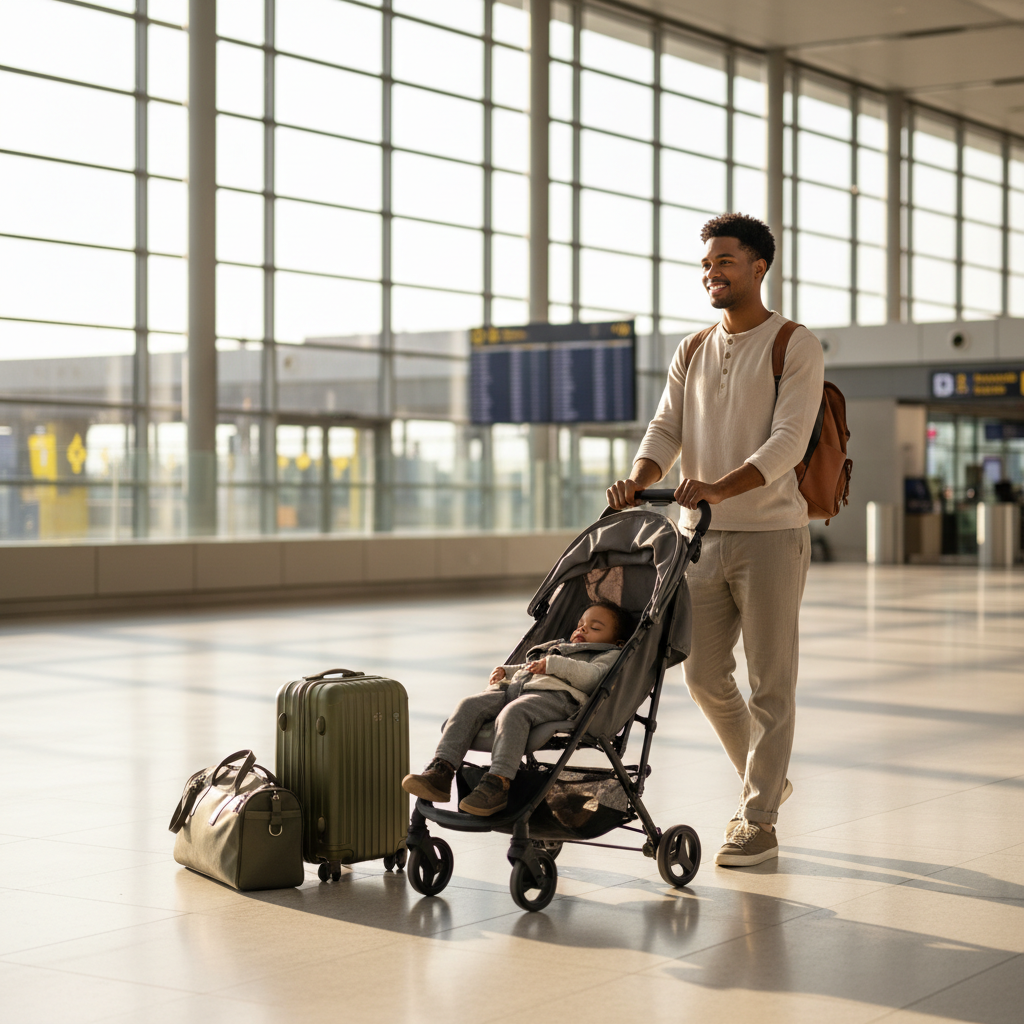
If you are traveling abroad with a stroller, the best choice is usually not the smallest stroller you can find. It is the stroller that fits your flight plan, your child’s size, and the streets you will actually walk on once you land. For some families, that means a true cabin-approved stroller that folds small enough to carry into the airport and possibly onto the plane. For others, it means a compact stroller that is easy to gate-check, quick to fold with one hand, and comfortable enough for long sightseeing days.
The mistake most parents make is planning only for the flight. International travel is a chain of transitions: curbside drop-off, check-in, security, boarding, layovers, customs lines, trains, sidewalks, cobblestones, naps, snacks, and tired legs at the end of the day. A stroller that feels perfect in the store can feel frustrating when you are carrying a backpack, guiding a sleepy toddler, and trying to fold it at the boarding gate.
This guide helps you choose more strategically. You will learn when a cabin-approved stroller really matters, when gate-checking is totally fine, what features matter most for international trips, how to think about rough terrain and bigger toddlers, and which small accessories make the day easier instead of messier. If you want a simpler answer first, here it is: choose compactness for airports, but do not sacrifice comfort, wheels, and toddler capacity so aggressively that the stroller becomes miserable once you reach your destination.
No, you do not always need a cabin-approved stroller to travel internationally, but you do need a stroller that behaves well in airports and transfers. A cabin-approved model is most helpful when you are moving through multiple flights, short connections, and crowded terminals where fast folding and easy carrying matter more than plush suspension.
A true cabin-friendly stroller makes the biggest difference when you are traveling solo with your child, switching planes in large airports, or relying on trains and taxis after landing. In those cases, every extra pound and every awkward folding step becomes noticeable. A stroller that stands on its own after folding, fits into a narrow car trunk, and can be lifted with one hand is often worth more than extra bulk storage.
But “cabin-approved” should not become a trap. Some parents choose the tiniest model possible and then regret it the moment they hit broken sidewalks, long walking days, or a child who still needs to nap comfortably. If your itinerary includes old city centers, uneven roads, beachside resorts, or a bigger toddler, a slightly larger travel stroller may serve you better even if you gate-check it.
The better question is this: what kind of international travel are you doing? If your trip is airport-heavy and city-light, go smaller. If your trip includes long walks, mixed terrain, and a child who will spend serious time in the stroller, aim for the smallest stroller that still feels stable, supportive, and genuinely useful.
Yes, families can usually bring a stroller to the airport and onto the travel journey, but the exact handoff point depends on security rules and airline policy. The Transportation Security Administration’s child-travel guidance explains that strollers, umbrella strollers, baby carriers, car seats, booster seats, and backpacks must be screened, and children need to be removed from the stroller before you go through screening. If the stroller cannot fit through the X-ray machine, TSA says it will receive additional visual or physical inspection instead.
That matters because your airport workflow starts before boarding. If your stroller basket is crammed with toys, snacks, blankets, chargers, and loose baby gear, security becomes slower and more stressful. A neater setup makes it much easier to unload, screen, and repack quickly.
After security, the next question is whether the stroller travels with you to the gate, goes into the cabin, or gets checked. This is where airline policies matter more than general travel advice. Airlines publish their own child-travel pages, and the rules can differ by stroller size, route, aircraft type, and whether your stroller fits cabin dimensions. For example, Delta’s baggage page for children and infants notes that standard checked-bag fees do not apply to strollers, car seats, or booster seats, while American Airlines’ traveling-with-children page says each ticketed customer may check one stroller and one car seat. That is helpful, but it is still not a guarantee that your specific stroller will ride in the cabin on your specific flight.
In practical terms, think in three layers. First, airport security decides how the stroller gets screened. Second, your airline decides whether the stroller can travel to the gate, go in the overhead bin, or must be checked. Third, the aircraft and crew situation on that day can affect what is realistically possible. That is why the safest strategy is to check your airline before departure, take screenshots of the relevant policy, and mentally prepare for gate-checking even if your stroller is marketed as cabin approved.

A stroller becomes travel-friendly abroad when it solves airport friction without becoming useless on the ground. You are not shopping for a spec sheet. You are shopping for fewer annoying moments during the trip.
The first feature to judge is the fold. You want a fold that is fast, intuitive, and realistic when one hand is busy. A stroller that technically folds small but requires two calm hands and careful alignment is less useful than one that folds slightly larger but works in five seconds under pressure. Also pay attention to how it carries after folding. Can you lift it onto a train? Can you drag luggage with your other hand? Can you store it in a taxi without a small wrestling match?
The second feature is weight, but weight only matters in context. A very light stroller is wonderful in airports and hotel lobbies, yet a stroller that is too light can feel twitchy on rough sidewalks or top-heavy once you hang a bag from the handle. If you are planning long walking days, some structural stability matters more than chasing the absolute lowest number.
The third feature is seat comfort. International travel often means your child spends more time in the stroller than usual because the days are longer and the schedule is less predictable. A decent recline, supportive seat, secure harness, and generous canopy matter more abroad than they do during a quick neighborhood errand. This is also where many ultra-mini strollers start to feel limiting.
Next, look closely at wheel quality and suspension. Many parents focus on fold size and forget that destination terrain can ruin the experience. Smooth airport floors make almost any stroller feel good. Uneven sidewalks, curb drops, old stone streets, tram gaps, and park paths quickly expose weak wheels. You do not need a giant jogging stroller for most international trips, but you do need wheels that will not make every bump feel like a problem.
Toddler capacity is another feature parents underestimate. Search interest around travel strollers for 4- and 5-year-olds reflects a real issue: older toddlers may walk plenty at home, then suddenly need a stroller on travel days because airports, jet lag, queues, and sightseeing add up. If your child is taller, heavier, or still naps on the go, check the stroller’s weight limit and seat proportions before you assume any compact model will do.
Finally, be honest about parent-facing preferences. A parent-facing seat can feel reassuring, especially with younger babies, but many highly compact travel strollers give up that feature to save size and weight. If parent-facing is non-negotiable for your stage of parenting, accept that your stroller choice may be less cabin-friendly. That is not a failure. It just means your travel plan should lean toward gate-checking rather than chasing the smallest fold.
If you want a compact starting point, the Mamazing Ultra Air Compact Stroller for Travel fits the kind of trip where easy folding, low carry stress, and everyday travel comfort matter more than oversized bulk or a heavy frame.
Neither option is automatically better. The right choice depends on whether the hardest part of your trip is the flight itself or everything around it.
| Setup | Best for | Trade-offs |
|---|---|---|
| Cabin-approved stroller | Frequent flights, short connections, solo parent travel, tight airport transfers | Often less plush, less storage, less capable on rough terrain |
| Compact gate-check stroller | Families who want more comfort, slightly stronger wheels, and better nap support | You may need to hand it over before boarding and wait for it again after landing |
| Larger travel or all-terrain stroller | Long walking days, rougher streets, beach towns, older toddlers, destination-first trips | Bulkier to fold, slower in airports, less likely to work as a cabin option |
If you hate uncertainty, a compact stroller that is easy to gate-check is often the sweet spot. You still get airport mobility, but you are not depending on overhead-bin space or crew discretion. If you are doing multiple flights with minimal luggage and a younger child, a true cabin-friendly stroller can feel incredibly efficient. If your destination is the whole point of the trip and the streets will be demanding, prioritize ride quality over cabin status.
The best outcome is not “I got the stroller onto the plane.” The best outcome is “I barely thought about the stroller because it kept working all day.”
Your destination should shape your stroller choice almost as much as your airline. The CDC Yellow Book guidance for traveling with infants and children specifically recommends comparing stroller size with your destination, and it also notes that in areas with mosquito-borne illness, mosquito netting over strollers and baby carriers can help protect children. That is a useful reminder that a stroller is not just a transport tool. It is part of your child’s comfort, climate protection, and daily routine abroad.
For city breaks, prioritize a compact footprint, easy steering, and enough wheel quality to handle curb cuts, train platforms, and broken pavement. You want something that turns well in cafés, elevators, and narrow hotel entries. For historic European streets, do not over-romanticize tiny wheels. Cobblestones are tiring for both the stroller and the person pushing it. A little more wheel strength and suspension can make a major difference.
For resort travel, tropical travel, or rural routes, focus on canopy coverage, airflow, weather protection, and better stability. You may not need a full all-terrain stroller, but you do need something that will not feel fragile after two days of cracked sidewalks and long outdoor walks. If beach time or mixed surfaces are part of the plan, your stroller choice should reflect that before you fly, not after you land and regret the wheels.
If your trip relies heavily on public transportation, measure inconvenience differently. A stroller that is slightly less smooth on rough streets may still be the smarter option if it folds fast on buses, trains, and airport shuttles. On the other hand, if you are staying in one place and walking for hours every day, comfort usually beats ultra-compactness.

It helps to picture one honest travel day from beginning to end. Imagine customs lines, a train ride, a walk to the hotel, an afternoon outing, and a drowsy child by 4 p.m. Now ask which stroller would still feel like a relief at the hardest point of that day. That is usually the right stroller for the trip.
Yes, a 4- or even 5-year-old may still benefit from a travel stroller abroad. That does not mean your child suddenly needs a stroller all day. It means international travel creates longer distances, more waiting, more schedule disruption, and more tired moments than daily life at home.
This is why search interest around “travel stroller for 5 year old” keeps appearing. Parents are not looking for a baby stroller. They are looking for a practical backup plan for heavy travel days. If your child still naps occasionally, struggles after long airport walks, or melts down late in the day, a stroller can turn an exhausting itinerary into a manageable one.
The key is to avoid buying a stroller that is too babyish for your actual child. Check the weight limit, seat height, backrest support, and footrest usability. A stroller that technically supports the weight but leaves your child folded awkwardly into the seat will not feel good for anyone. Bigger toddlers also place more stress on weak frames and low-quality wheels, which is another reason to avoid choosing only by folded size.
If you are unsure, think of the stroller as a travel energy management tool. You may use it only at the airport, during museum days, at night markets, or after missed naps. That can still make it worth bringing. The more ambitious the itinerary, the more likely a bigger toddler will appreciate a seat when their energy drops before yours does.
The best travel accessory is the one that removes one repeated annoyance. You do not need to cover your stroller in gadgets. You need a few items that reduce friction without creating more clutter.
A good organizer is one of the most useful additions because it keeps passports, wipes, snacks, sanitizer, headphones, and quick-grab items where you can reach them without opening the main suitcase every hour. If you want that kind of setup, a compact option like the Mamazing Universal Stroller Organizer makes more sense than stuffing every pocket randomly and then searching for essentials at security.
A stroller travel bag can also be worthwhile, especially if you expect to gate-check often or hand the stroller over early. It adds one more thing to manage, so it is not automatically necessary, but it can reduce scratches, dirt, and loose parts getting caught in handling. If you use one, label it clearly and keep it simple enough that you can still pack the stroller quickly.
Rain cover, sun canopy, and ventilation matter more than parents expect on international trips. Weather changes fast, and your child may spend long stretches in the stroller while you are still moving between places. The CDC also notes that children are more susceptible to heat and cold stress than adults, which is another reason to think beyond folding size and consider shade, airflow, and climate protection.
Before you leave, it is also worth reviewing a practical packing guide such as Mamazing’s first-trip travel stroller checklist. Even if your child is no longer a baby, the same principle applies: anything that keeps your airport routine predictable will make the trip feel lighter.
The easiest airport routine is the one you have already rehearsed in your head. Keep it boring and repeatable.
This is also the point where a well-balanced compact stroller earns its keep. You do not need it to perform one perfect trick. You need it to behave consistently when everyone is tired and the plan is no longer neat.
Yes. TSA says strollers, umbrella strollers, baby carriers, car seats, booster seats, and backpacks must be screened, and you need to take your child out of the stroller before going through security.
Often, no, but you should still check your airline because the exact allowance can vary. Delta and American Airlines both publish child-travel baggage pages, and their stroller rules are part of those family-travel policies rather than standard carry-on advice.
There is no single universal size. A stroller is only cabin approved if it meets your airline’s size expectations and the crew can accommodate it on the aircraft, so always verify the policy for your specific carrier and route.
Sometimes, but not always. A compact travel stroller can handle light uneven pavement, but if your trip includes a lot of cobblestones, broken sidewalks, or resort paths, stronger wheels and better suspension matter more than the tiniest fold.
Yes, if the stroller has the right weight capacity and seat size. Bigger toddlers often walk well at home but still benefit from a stroller on airport days, long sightseeing routes, or late afternoons when travel fatigue hits.
Not always, but it can be useful if you plan to gate-check or check the stroller early. A travel bag helps protect the stroller and keeps loose parts contained, but it is worth bringing only if it does not make your airport routine more complicated.
The right stroller for international travel is the one that matches the hardest part of your trip. If airports and tight connections are the challenge, a cabin-friendly fold matters. If long walking days and mixed terrain are the challenge, comfort and wheel quality matter more. If your child is older, toddler capacity matters more than marketing labels.
Start with your real itinerary, not the most attractive feature list. Then choose the smallest stroller that still feels comfortable, stable, and useful once you are actually abroad. If you want a practical place to start, Mamazing’s travel-friendly stroller collection and accessories are built around that exact balance: lighter to handle, easier to pack, and still comfortable enough for real family travel days.
Featured Products


Full Size Stroller vs Travel Stroller: Which One Fits Your Family, Budget, and Daily Routine?
Best Travel Strollers for Urban Environments: Narrow Sidewalks, Public Transit, and City Commuter Picks