
- by Artorias Tse
Carbon Fiber Stroller Guide: Benefits, Tradeoffs, and Who It Fits Best
- by Artorias Tse
If you are considering a carbon fiber stroller, the short answer is this: it can be an excellent choice when your biggest priorities are low carry weight, easy folding, and a more premium feel in daily use. It is not automatically the best stroller for every family, though. A carbon fiber frame can make a stroller easier to lift into a trunk, carry up apartment stairs, or move through airports, but your real-world experience still depends on the fold, wheel setup, harness, brake system, recline, and how you actually use the stroller every week.
That is why the best way to evaluate a carbon fiber stroller is not to ask whether carbon fiber sounds impressive. It is to ask what changes when you are holding a baby in one arm, folding the stroller with the other hand, getting through a crowded elevator, or trying to fit everything into a small car. If you are searching for a carbon fibre stroller or even a carbon fibre pram, you are usually asking that same practical question in different words: will this make everyday outings easier, or is it just a more expensive frame material?
The material matters because it can change the balance between strength and weight. The U.S. Department of Energy notes that carbon fiber reinforced composites can cut component weight dramatically, and NIST describes polymer composites as being valued for stiffness, high strength-to-weight ratio, and corrosion resistance. That does not automatically make every stroller with carbon fiber a winner, but it does explain why the material shows up in products aimed at travel, compact storage, and easy carrying.
So instead of treating carbon fiber as a magic word, this guide looks at what it actually changes, where it earns its premium, where aluminum still makes sense, and how Mamazing fits if you are comparing lightweight stroller options right now.
The biggest change is not usually how the stroller looks on a spec sheet. It is how often the stroller feels easier to live with. A lighter frame can matter every single time you lift it into a trunk, carry it through a station, slide it into a closet, or hold it briefly while your child wants up and down during a quick errand.
That is especially true if your routine includes apartment stairs, small elevators, public transit, rideshare trunks, frequent travel, or narrow walkways. In those situations, shaving a few pounds off the frame can feel more meaningful than adding one more convenience feature. A carbon fiber stroller can also feel less clumsy when the fold is well designed, because the material gives brands more flexibility to chase a compact, travel-friendly shape without making the stroller feel flimsy.
Still, the material does not solve every problem. A poorly designed carbon stroller can still have awkward storage, a fussy fold, weak suspension, or limited seat comfort. If you are shopping for a carbon fiber baby stroller, you are not only buying a material. You are buying a whole system that has to work with your storage space, your route, your child’s age, and your tolerance for carrying, folding, and lifting.

For most parents, this is the comparison that matters most. Carbon fiber is not simply “better” in every direction. It is better in a particular direction: getting more stiffness and premium feel without dragging as much weight around. Aluminum remains popular because it offers a strong middle ground, while steel usually makes the most sense only when absolute cost or a very specific frame style matters more than portability.
| Material | What it usually does well | Where it can feel limiting | Best fit |
|---|---|---|---|
| Carbon fiber | Low carry weight, crisp frame feel, premium look, compact travel positioning | Usually costs more and still needs a good fold, wheels, and seat design to justify it | Parents who travel often or want the easiest day-to-day lifting and carrying |
| Aluminum | Balanced cost, good availability, practical everyday performance | Often heavier than carbon fiber and not always as easy to carry when folded | Families who want a sensible all-rounder without paying a premium for frame material |
| Steel | Solid feel and lower entry cost in some models | Heavier to lift, less attractive for travel, apartment living, and daily carrying | Shoppers who care more about price than portability |
If you are deciding between a carbon fiber stroller and an aluminum stroller, the most honest answer is that aluminum is still good enough for many families. Carbon fiber becomes more convincing when lifting, carrying, and compact storage are not occasional annoyances but daily friction points. If you rarely fold your stroller, mostly walk locally, and do not carry it often, aluminum may be the more rational buy. If you are constantly dealing with stairs, trunks, airports, and grab-and-go errands, carbon fiber starts making more sense.
Safety is a separate question from the material itself. The CPSC’s stroller guidance focuses on brakes, stability, restraints, latches, folding mechanisms, and structural integrity, and HealthyChildren highlights a five-point harness, easy brakes, and a wide stable base as major buying checks. In other words, a carbon fiber frame can be useful, but it does not remove the need to judge the stroller as a whole.
The real benefits are easiest to see when you stop describing carbon fiber in abstract material terms and connect it to the things parents actually do. For most families, the appeal comes down to portability, easier carrying, and the fact that a premium frame often helps a lightweight stroller feel less compromise-driven.
This is usually the number-one reason people search for a carbon fiber travel stroller. You feel the difference when you are lifting the stroller into an overhead bin-sized space, carrying it over a curb, moving it into a closet, or one-handing it for a few seconds while your child needs attention. A lighter stroller does not magically change parenting, but it can remove a surprising amount of background annoyance from daily logistics.
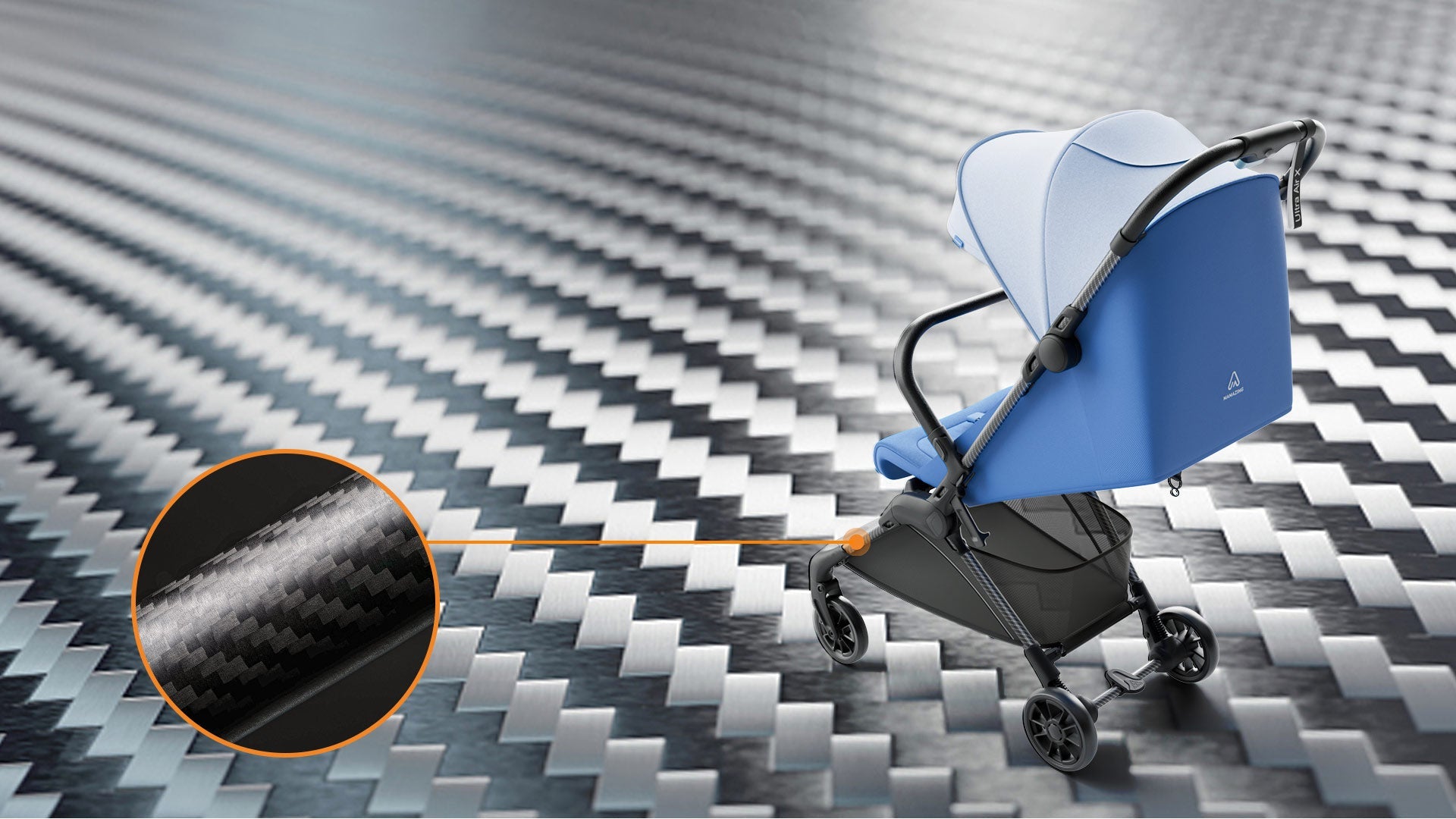
That is why travel-focused models often lean hard into the category. On Mamazing’s current Ultra Air Compact Travel Stroller page, the brand lists an 11.6 lb stroller weight without the organizer and cushion, a folded size of 19.3 x 11 x 22 inches, a five-point harness, and a brake system. Those details matter more than broad marketing language because they help you picture the actual carry-and-store experience.

Parents often describe certain lightweight strollers as convenient but a little too flimsy, rattly, or disposable-feeling. One reason carbon fiber gets attention is that it can help a stroller feel more composed without pushing the frame weight back up. That does not mean every carbon fiber stroller feels perfect, but it helps explain the category’s premium positioning.
It also explains why this material appeals to parents who want a stroller that feels easier to carry without looking or feeling stripped down. If you care about everyday handling and not just a lower number on the scale, this is one of the more convincing advantages.
It is easy to dismiss style as a superficial benefit, but for this category it is not trivial. Parents who shop carbon fiber often do care about weight and travel, yet they also want a stroller that looks intentionally designed rather than purely utilitarian. Carbon fiber has a more technical, modern feel, and that matters for buyers who want their stroller to feel sleek instead of bulky.
That should not be the only reason you buy one, but it is a legitimate part of the decision. If you already know you want a lightweight stroller, choosing the one that feels easier to live with and nicer to look at is not shallow. It is part of using the product every day.
A carbon fiber stroller is usually worth the premium when portability solves a real problem for you, not when it just sounds advanced. It tends to earn its keep in a few very specific scenarios: city living with stairs or tight storage, frequent travel, one-car households where trunk space matters, and families who are constantly folding and lifting the stroller rather than leaving it open all day.
It is also a strong fit if your current stroller annoys you because it feels fine while rolling but awful when folded. That is the moment when the weight difference becomes very real. A lighter stroller can make school runs, short errands, transit connections, and airport movement feel less like a small workout every time you leave home.
It may be less worth the extra money if your stroller mostly lives in a garage, rarely gets carried, and is used on smoother predictable routes. In that case, a good aluminum stroller may give you nearly everything you need. Carbon fiber is best treated as a lifestyle fit, not a universal upgrade.
It can also be worth paying more if you share stroller duty with grandparents, caregivers, or anyone who notices lifting strain quickly. A stroller that feels manageable to the least enthusiastic carrier in the household often gets used more consistently, and that matters in real life. On the other hand, if you already own a stroller that handles your routine well and the only thing missing is a more premium material story, upgrading to carbon fiber may not change enough to justify the switch.
If your search started with “best carbon fiber pram” or “carbon fiber baby stroller,” this is the core takeaway: buy into the category because the weight and fold solve your routine, not because the material sounds futuristic on its own.
The smartest carbon fiber stroller buyers look past the headline material quickly. That is where you protect yourself from paying a premium for something that only sounds impressive.
Start with safety basics. The CPSC has specifically warned caregivers to use the safety harness every time, especially with younger babies, because restraint use is a core part of stroller safety. HealthyChildren also recommends easy-to-operate brakes, a stable base, and attention to hinge and tip risks. So even if a stroller is beautifully light, it still needs to feel secure, predictable, and properly locked when open.
If you want a good reality check, use the current Ultra Air dimensions as an example of the kind of concrete sizing information worth reviewing before purchase. Material is part of the story, but dimensions and daily handling are what decide whether the stroller feels right after the novelty wears off.
This is also the point where your route matters more than showroom impressions. Parents who spend most of their time in compact urban spaces usually benefit more from a lighter fold and easier carry. Parents who mainly take longer neighborhood walks may care more about wheel confidence, seat comfort, and whether the stroller feels settled over imperfect pavement. A strong buying decision usually comes from matching the stroller to your route first and the material second.
Mamazing makes the most sense in this conversation when you already know portability matters more to you than a heavier all-purpose build. The current Ultra Air Compact Travel Stroller is positioned exactly around that use case: low carry weight, one-handed fold, compact dimensions, and travel-friendly daily convenience. If that is your biggest friction point, it fits the strongest reason to shop carbon fiber in the first place.
What I like about using Mamazing in this guide is that the product can be framed honestly. It is not the right answer for every family, and it should not be sold that way. But if you want a stroller that is easier to carry, easier to store, and more pleasant to take through airports, tight hallways, and crowded daily routes, it is a relevant option to compare. If you want a broader browse before narrowing down, Mamazing’s stroller collection is a better starting point than jumping straight into one model.

If you are also curious about where stroller design is heading more broadly, Mamazing’s piece on futuristic stroller design is a useful companion read because it puts lightweight materials, foldability, and real-world portability into a bigger category view.
Usually, it is better only if low carry weight and a more premium frame feel are high on your list. Aluminum is still a strong practical choice, and many families will be perfectly happy with it if the stroller folds well and handles smoothly.
For frequent travel, often yes. The lighter carry weight and compact fold can make airports, train stations, car trunks, and quick gate checks much less annoying, but it is still worth confirming folded size and storage before you buy.
They can be, but the frame material is only part of the answer. Safety still depends on a stable design, reliable brakes, a proper harness, secure folding mechanisms, and using the stroller the way the manufacturer intends.
No. A lighter stroller can still feel solid if the frame design, wheel setup, and locking points are well engineered, but lighter does not automatically mean better built, so it is smart to look at everyday use details as well as the material.
If your priority is the lowest price, a true newborn setup, or rough-terrain performance, you may be better off with a different stroller category. Carbon fiber usually makes the most sense for parents who care most about portability, compact storage, and easy day-to-day carrying.
A carbon fiber stroller is not the automatic best choice for all families, but it can be a very smart one if your life rewards low weight, compact storage, and easy carrying. That is why the category keeps showing up in travel-focused and urban-friendly stroller conversations. The material can make a real difference when you fold often, carry often, and do not want your stroller to feel like dead weight every time you leave home.
If that sounds like your routine, Mamazing is worth a closer look, especially if you want a stroller that leans hard into portability without giving up the basics that still matter. The key is to buy the stroller for the life you actually live, not just for the material name printed on the product page.



Stroller Sizes and Prices Guide: Dimensions, Costs, and How to Choose
Foldable Stroller Maintenance: A Monthly Checklist to Clean, Inspect, Store, and Know When to Replace Parts