
- by WengGracy
Stroller Safety Standards Explained: ASTM, JPMA & European EN Certifications
- by WengGracy
When you are comparing a baby stroller, the safety language can feel oddly technical: ASTM stroller, CPSC rule, JPMA stroller certification, EN 1888, certified safe, independently tested. Those phrases are useful only if you know what they actually mean. This guide explains the main stroller safety certification terms in plain English so you can read a product page, label, or manual with more confidence.
The short version: named standards matter more than vague safety promises. A certification mark can be a helpful clue, but it should never replace checking the stroller model, date of manufacture, weight limit, manual, recall status, and real-world fit for your child.
For a stroller sold in the United States, the most important baseline is compliance with the U.S. federal carriage and stroller rule. The U.S. Consumer Product Safety Commission says carriages and strollers are regulated under 16 CFR Part 1227, which incorporates ASTM F833 with any CPSC modifications. The current text for 16 CFR 1227.2 states that each carriage and stroller shall comply with ASTM F833-21.
JPMA certification is different. The JPMA Certification Program is voluntary, and JPMA says certified products are sample-tested at an independent laboratory. That makes a JPMA mark a useful extra trust signal, not a replacement for federal compliance.
European EN 1888 standards matter when you are shopping for pushchairs or prams designed for European markets. A European standard claim may be reassuring context, but if you are buying in the U.S., you should still look for U.S. CPSC/ASTM compliance.
If a listing says only "safe," "premium safety," or "certified safe," keep looking for specifics. Better wording names the standard, such as ASTM F833-21, 16 CFR Part 1227, JPMA Certified, or EN 1888-1:2018+A1:2022. Then match that claim to the product manual, frame label, model number, date of manufacture, and manufacturer support page.
These terms get mixed together because they all live around stroller safety, but they do different jobs. ASTM creates technical standards. CPSC is the U.S. regulator that makes certain requirements mandatory for covered products. JPMA runs a voluntary certification program. EN 1888 is a European standards family for pushchairs and prams.
| Name | What It Is | Region/Context | Mandatory? | Parent Takeaway |
|---|---|---|---|---|
| CPSC 16 CFR Part 1227 | U.S. federal rule for carriages and strollers | United States | Yes, for covered products | Best baseline claim for U.S. purchases |
| ASTM F833-21 | Consumer safety performance specification | Used in U.S. rule | Mandatory through CPSC rule | Look for named ASTM F833 language |
| JPMA Certification | Voluntary third-party certification program | Juvenile products market | No | Helpful extra verification, not a legal substitute |
| EN 1888-1:2018+A1:2022 | European pushchair and pram standard | Europe/UK standards context | Market-dependent | Useful for EU/UK products; still check U.S. claims if buying in the U.S. |
ASTM F833 is the standard most U.S. stroller shoppers are likely to see in product specifications. ASTM International lists ASTM F833-21 as an active "Standard Consumer Safety Performance Specification for Carriages and Strollers," last updated May 24, 2022. ASTM describes the scope as safety performance requirements, test methods, and labeling requirements for carriages and strollers.

An ASTM stroller claim means the product is being tied to a defined technical standard, not just a brand's own idea of safety. The standard is written for the product category, so it addresses stroller-specific hazards rather than general baby gear quality.
At a parent level, you do not need to memorize every lab test. What matters is that ASTM F833 creates a common framework for issues such as stability, parking brakes, restraint systems, latching mechanisms, folding hazards, openings, wheel assemblies, car seat/stroller combinations, and labeling. CPSC's stroller guidance lists many of these general and performance requirement areas for carriages and strollers, including latching mechanisms, openings, parking brake requirements, stability, restraining systems, and wheel/swivel assembly detachment.
Look for wording like "complies with ASTM F833-21" or "meets 16 CFR Part 1227." If the product page only says "ASTM tested" without naming the stroller standard, check the downloadable manual or ask the manufacturer. For a used stroller, do not rely on the seller's memory. Find the frame label, model name or number, date of manufacture, and manual before you decide.
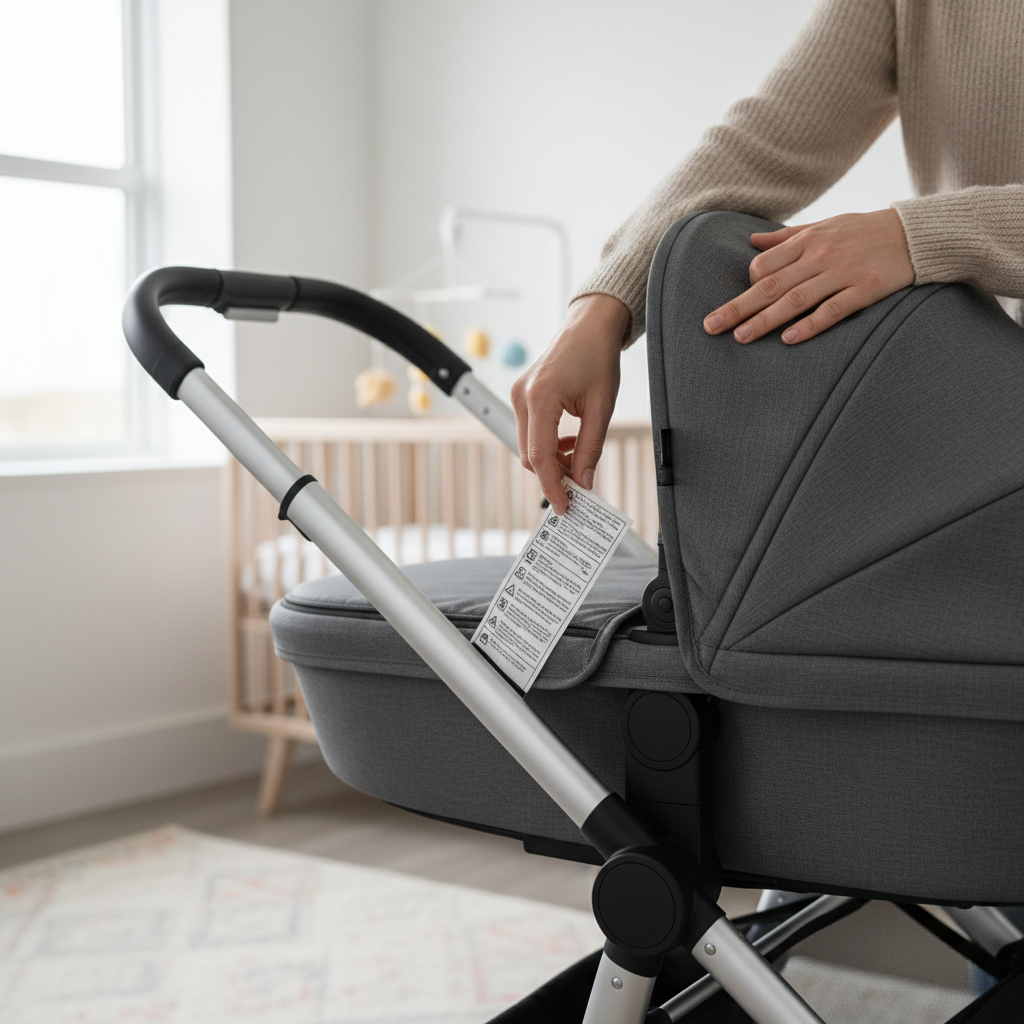
One more quiet-but-important detail: product labels matter. CPSC guidance says durable infant or toddler products must have permanently affixed English labeling with manufacturer or importer information, contact information, model name or number, and date of manufacture under 16 CFR 1130.4. That label is what lets you verify recalls, replacement parts, and instructions later.
CPSC is the key U.S. regulator in this conversation. Its carriages and strollers business guidance explains that the agency codified the rule at 16 CFR Part 1227 and incorporated ASTM F833 by reference, with the latest Commission-accepted version identified in 16 CFR 1227.2.
As of the currently published text, 16 CFR 1227.2 says each carriage and stroller must comply with applicable provisions of ASTM F833-21, approved June 15, 2021. In practical shopping terms, this is why a U.S. baby stroller listing may mention both CPSC and ASTM: CPSC is the rulemaking and enforcement body, while ASTM F833 is the technical standard incorporated into the rule.
CPSC also states that manufacturers and importers of children's products subject to a CPSC-enforced regulation must certify compliance by issuing a Children's Product Certificate, and for carriages and strollers the citation to use is "16 CFR part 1227 - Carriages and strollers." That certificate is generally a manufacturer/importer compliance document, not something parents usually see on a hangtag, but it explains why serious brands keep careful compliance records.
Standards evolve. CPSC's guidance lists previous accepted ASTM versions by manufacture date, including ASTM F833-21 for products manufactured after February 15, 2022, ASTM F833-19 after November 5, 2019, and ASTM F833-15 after October 2, 2016. That is one reason a secondhand stroller deserves extra attention: it may have been made under an older accepted version, may be missing parts, or may have a recall you would not know about from a marketplace photo.
Before using a secondhand stroller, search the CPSC recalls database with the brand and model number. Also check the manufacturer's support page for replacement parts and current manuals. A stroller with a missing harness, unreliable brake, cracked frame, damaged fold latch, or unknown model label is not a bargain.
JPMA stroller certification is a voluntary program run by the Juvenile Products Manufacturers Association. JPMA says its certification seal indicates that a product meets minimum government requirements plus additional marketplace requirements; JPMA also says each certified product is sample-tested at an independent laboratory, and that certification is based on ASTM standards, federal and state laws, and some retail requirements.

Think of ASTM as the standard, CPSC as the U.S. rule that makes the accepted stroller standard mandatory for covered products, and JPMA as a voluntary certification program that can provide another layer of verification. A stroller can be subject to CPSC requirements even if it does not carry a JPMA seal. A JPMA Certified stroller should still be checked for model, manual, weight limit, and recall status.
This distinction is especially helpful when a product page piles up acronyms. "ASTM stroller" language points to a standard. "JPMA Certified" points to a certification program. Neither phrase means you can ignore the instruction manual or use the stroller outside its intended age, weight, recline, or accessory limits.
If a brand claims JPMA certification, look for the JPMA seal on packaging, product materials, or the product page, then cross-check the brand in JPMA's certified product resources. JPMA's certified product directory says the program covers more than 2,000 products in 29 product categories, and carriages/strollers are one of those categories.
Directory checks are worth the minute because old product pages, third-party sellers, and copied marketplace text can be messy. Match the brand, category, and model family as closely as possible. If the claim still feels unclear, ask the manufacturer directly for the current certification status.
EN 1888 is the stroller standard family you are most likely to see on European pushchairs and prams. The standard applies to pushchairs and prams designed for children up to 15 kg each, with integrated platforms designed for children up to 20 kg.
EN 1888-1:2018+A1:2022 applies to pushchairs and prams designed for children up to 15 kg each, with integrated platforms designed for children up to 20 kg.
For parents, the useful takeaway is that EN 1888 is a real standards system, but it is not the same thing as ASTM F833. If a stroller is marketed in Europe, EN wording may be the clearest standard claim. If you are buying from a U.S. retailer, imported marketplace seller, or cross-border site, ask which market version you are looking at and which standards the exact model is designed and labeled to meet.
An EN 1888 claim should not be treated as a one-for-one replacement for U.S. CPSC compliance. Different regions can use different test methods, labeling rules, warnings, and product versions. A stroller sold under the same brand name may also have market-specific details, including different accessories, manuals, or labels.
If you travel internationally, the same common-sense checks still apply: use the harness, follow weight limits, keep the manual handy, and do not use an unapproved car seat adapter or accessory. Standards help define the product's safety baseline; they do not make every setup automatically safe.
Once you know the acronyms, the buying process becomes much calmer. You are not trying to decode every test clause. You are looking for a chain of evidence: named standard, credible seller, matching model information, accessible manual, appropriate child fit, and no unresolved recall.
Pause before buying if the listing uses vague safety language without a named standard, hides the model number, has no manual, shows copied or inconsistent product photos, or comes from an unknown third-party seller with unclear returns. For used strollers, be even more direct: no readable label, no harness, damaged wheels, weak brake, bent frame, broken fold lock, missing screws, or unknown recall status should stop the purchase.
Foldable and travel strollers deserve special attention because the compact mechanisms are part of the safety story. If you are narrowing options in that category, compare safety-focused features after checking the certification basics.
A compliant stroller is still only the right stroller if it fits your child and your life. Confirm the age, weight, and height limits. Check whether the seat is appropriate for your baby's developmental stage. Review harness adjustability, parking brake placement, fold lock feel, wheel security, canopy clearance, basket weight limit, and car seat adapter compatibility.
When you are ready to move from label-checking to real comparison, you can compare baby strollers with safety-focused features and use the certification checklist from this article as your filter.
Stroller safety standards are not marketing fluff. They give parents a concrete way to separate named, verifiable claims from soft language. For a U.S. baby stroller, start with CPSC 16 CFR Part 1227 and ASTM F833-21. Treat JPMA stroller certification as a valuable voluntary signal. Read EN 1888 as European standards context, especially for pushchairs and prams sold outside the U.S.
Then bring the conversation back to daily use. Buckle the harness every ride. Engage the brake whenever the stroller is stopped. Follow the weight limits for the seat, basket, rider board, and accessories. Avoid hanging heavy bags from the handle unless the manual allows it. Register the product when possible so recall information can reach you.
For a stroller sold in the U.S., the key baseline is compliance with CPSC 16 CFR Part 1227. The current 16 CFR 1227.2 text states that each carriage and stroller shall comply with applicable provisions of ASTM F833-21.
ASTM usually refers to ASTM F833 for carriages and strollers. It is a consumer safety performance specification covering defined performance requirements, test methods, and labeling requirements for the stroller category.
No. JPMA Certification is voluntary. It can still be useful because JPMA says certified products are sample-tested at an independent laboratory and the program is based on ASTM standards, federal and state laws, and some retail requirements.
No. ASTM F833 is a standard. JPMA Certification is a voluntary certification program that uses ASTM standards and other requirements as part of its certification process.
EN 1888 is a European standard family for pushchairs and prams. EN 1888-1:2018+A1:2022 applies to pushchairs and prams designed for children up to 15 kg each, with integrated platforms up to 20 kg.
Check the product listing, manual, frame label, model number, date of manufacture, manufacturer support page, JPMA directory for JPMA claims, and the CPSC recall database before you buy or use the stroller.
For a stroller sold in the U.S., the key baseline is compliance with CPSC 16 CFR Part 1227. The current 16 CFR 1227.2 text states that each carriage and stroller shall comply with applicable provisions of ASTM F833-21.
ASTM usually refers to ASTM F833 for carriages and strollers. It is a consumer safety performance specification covering defined performance requirements, test methods, and labeling requirements for the stroller category.
No. JPMA Certification is voluntary. It can still be useful because JPMA says certified products are sample-tested at an independent laboratory and the program is based on ASTM standards, federal and state laws, and some retail requirements.
No. ASTM F833 is a standard. JPMA Certification is a voluntary certification program that uses ASTM standards and other requirements as part of its certification process.
EN 1888 is a European standard family for pushchairs and prams. EN 1888-1:2018+A1:2022 applies to pushchairs and prams designed for children up to 15 kg each, with integrated platforms up to 20 kg.
Check the product listing, manual, frame label, model number, date of manufacture, manufacturer support page, JPMA directory for JPMA claims, and the CPSC recall database before you buy or use the stroller.



Mother's Day Survey Results: Baby Gear Moms Want Most
Stroller Naps: How to Help Baby Sleep in a Stroller