
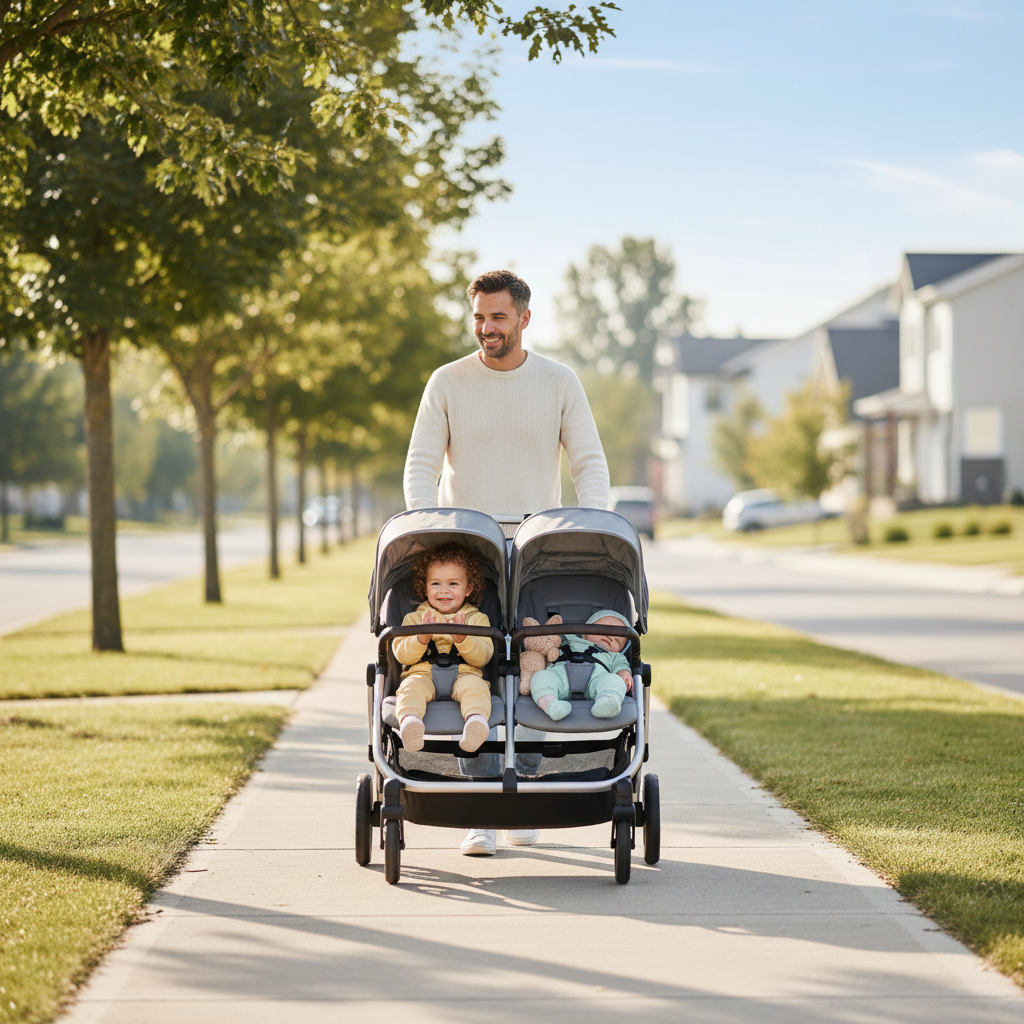
Double Stroller vs. Two Singles: Which Is Worth It?
- by WengGracy
Picture this: you have a wiggly toddler holding one hand and a newborn strapped to your chest, you are trying to push a single stroller with the other hand, and a stranger at the park just asked if you "need help, dear." If you are a parent of two, you have lived some version of this scene. The big question is whether a double stroller will actually rescue your sanity, or if two single strollers will give you more flexibility for less money. We hear this question every single week from parents of twins, "two under two" households, and families juggling an infant and a toddler. This guide breaks down the real cost, space, and lifestyle trade-offs so you can pick the right stroller for two kids with confidence, not guesswork.
We will compare double strollers and two single strollers across cost, fit, push-ability, and child age combos. You will get a side-by-side comparison table, pros and cons, and answers to the questions parents actually ask on Reddit, in pediatrician waiting rooms, and at 2 a.m. registry-building sessions. By the end, you will know whether a twin stroller belongs on your registry or whether two singles plus a clever carrier setup is the smarter play. If you are still deciding between configurations more broadly, our overview on how to choose a baby stroller for your lifestyle is a great companion read.
Before you compare anything, you need a quick map of the category. "Double stroller" is an umbrella term covering several very different designs, and choosing the wrong type is the biggest reason parents end up reselling on Facebook Marketplace six months later.
Both children sit at the same level, next to each other. Sightlines are equal, snack distribution is fair, and accessing both kids takes one motion. The trade-off is width: most side-by-sides measure 28 to 31 inches across, which is a tight squeeze against the 32-inch clear-width doorway minimum laid out in the 2010 ADA Standards for Accessible Design. This style is the gold standard for twins.
One child sits in front, the other behind, on a single narrow frame. The footprint is closer to a single stroller, which makes it the city-parent favorite. The catch is that the front child sometimes has a limited view, and turning radius can feel longer.
This hybrid keeps a regular seat in front for the younger child and adds a rear platform or jump seat for an older sibling. It is a useful bridge between a full double and a single stroller with a board, especially when your toddler still wants to ride sometimes but mostly wants to walk.
You have probably seen pull-and-push stroller wagons taking over the playground in the last two years. They are a legitimate third option for families with two-plus kids who do a lot of outdoor adventuring. For the rest of this article, we will treat the traditional double stroller as the benchmark since it is the most common purchase for daily use.
Here is the part nobody on Pinterest explains clearly: the price gap between a double stroller and two singles is much smaller than parents assume. The real cost story lives in the accessories, the storage logistics, and the resale window.

A mid-range double stroller typically runs $350 to $700. Two quality single strollers, one full-size and one lightweight or umbrella style, usually come in at $150 to $250 each, for a combined $300 to $500. For a deeper dimension-by-dimension breakdown of what you actually get at each price tier, our stroller sizes and prices guide walks through fold sizes, weight ranges, and what to expect at $200 versus $700. The headline takeaway: cost is rarely the deciding factor on its own.
Premium double strollers hold value well on the secondary market, but the buyer pool is narrower. Single strollers can be passed sequentially to future children, which spreads the cost across years. With CDC data showing twin birth rates around 31 per 1,000 live births, the secondhand twin-stroller market stays active in most metro areas.
| Feature | Double Stroller | Two Single Strollers |
|---|---|---|
| Average upfront cost | $350-$700 | $300-$500 combined |
| Footprint when in use | Wider (24-32 in side-by-side) | Two separate footprints |
| Folded storage size | Large; may not fit compact trunk | Two smaller folds |
| Maneuverability | Varies by type; tandem narrower | Each agile independently |
| Adaptability as kids age | Fixed dual-seat config | Mix and match by need |
| Public transit friendliness | Challenging on buses and subways | One at a time is easier |
| Travel and airplane use | Gate check possible; bulky | Single is more air-travel friendly |
| Age range covered | Birth to ~4 years per seat | Individually birth to 5+ |
| Best for twins | Yes, purpose-built | Logistically harder to push both |
| Best for infant + toddler | Yes, with recline seat | Carrier + single is a viable alternative |
| Resale value | Good for premium brands | Broader secondary market |
| Convenience (one operator) | High | Lower; needs two adults or compromises |
Stroller specs on a product page rarely tell the truth about how the thing will live in your real home and car. This is where the double-vs-singles decision gets very personal.
An average side-by-side folds to roughly 45 by 30 by 22 inches. If you live in an apartment, measure your elevator, hallway, and the spot near your front door where the stroller will live. Many side-by-sides exceed the 32-inch standard interior door width, so you may need to fold every time you head out.
Tandem doubles generally fit in midsize sedans when folded; most full-width side-by-sides require an SUV, minivan, or crossover. Two folded single strollers can paradoxically fit more easily in a sedan trunk because each is smaller and can be slotted in around groceries.
Real-world width matters at grocery store aisles (around 36 inches standard), zoo paths, and theme park corridors. A side-by-side may force one-at-a-time navigation in tight aisles; a tandem moves closer to a single stroller's footprint and is much friendlier in retail environments.
Pushing 60 pounds of children plus 40 pounds of stroller is a workout. Pushing two single strollers is, frankly, often impossible for one adult. Here is how the maneuverability question really plays out day to day.
A loaded double stroller can weigh 35 to 55 pounds before kids, with combined child weight often adding another 30 to 60 pounds. Prioritize swivel front wheels, adjustable handlebars, and confirmed one-hand steering reviews. A good double stroller pushes nearly as easily as a single, with practice.
All-terrain double strollers with larger wheels and air-filled tires handle mixed surfaces well but add bulk. Double jogging strollers are built for serious movement but have fixed front wheels and are not ideal for slow grocery store walks. Match the wheels to where you actually spend your time, not where you imagine you might.
Bus and subway ramps are sized for a single mobility footprint, which means folding a wide double stroller on a crowded bus is the daily reality. Urban parents who ride transit twice a day often find two singles plus a baby carrier the smoother system.
The right answer depends almost entirely on the age gap between your kids. Let's go scenario by scenario, because the best double stroller for infant and toddler is not the same as the best stroller for two toddlers, and twins are their own category. If you are still on the fence about whether you even need a second stroller at all, our honest guide to do I need a double stroller covers the most common age gaps in detail.
This is the clearest use case for a double stroller, full stop. Side-by-side allows both infants to lie flat at the same time. Look for dual full-recline seats or compatibility with two infant car seats. A twin stroller is purpose-built and nearly impossible to replicate by pushing two singles. The American Academy of Pediatrics emphasizes that infants need a flat, firm sleep surface to reduce SIDS risk, which is why true lie-flat recline is critical for newborn stroller rides.
The most common double-stroller search scenario. A tandem with a lie-flat back seat works well, and many models accept an infant car seat adapter. Alternatively, a baby carrier for the newborn plus your existing single stroller for the toddler is a low-cost entry. Evaluate how long your toddler will actually want to ride — most parents see only 6 to 18 months of meaningful overlap.
Both kids are mobile and have opinions. Side-by-side doubles offer equal seating dignity, which prevents the "I want the front!" meltdown. Watch weight limits closely; most doubles cap at 40 to 55 pounds per seat. If one toddler is close to walking independently most of the time, a sit-and-stand is the more economical pick.
This is the least-justified full double stroller purchase. Your older child probably only needs a ride intermittently. A sit-and-stand or a buggy board attached to an existing single stroller usually wins on cost and practicality.
Where you live and how you move matters as much as how old your kids are. Same family, different city, different correct answer.

A double stroller in the city is a commitment. Elevator widths, bus ramps, revolving doors, and cafe thresholds will all test it daily. Narrow tandem doubles or a single-plus-carrier system often win for city families.
Suburbs are where double strollers shine. SUV trunk space, wide sidewalks, and paved park paths all reward the convenience of one combined unit. A side-by-side or full-featured tandem makes real-world daily use comfortable.
If you run, hike, or trail-walk regularly, a double jogging stroller is the right tool. Look for a fixed front wheel for stability at speed and pneumatic tires for trail absorption.
Double strollers can be gate-checked but may not survive cargo handling as gracefully as a compact single. The TSA allows strollers through security and at gate-check, but airline handling varies. Frequent flyers often buy a budget single for travel and keep their double at home.
Most US theme parks have stroller parking and policies on stroller width — Disney, for example, restricts strollers larger than 31 by 52 inches. Check your favorite venues before committing to a wider side-by-side.
Here is the side-by-side double stroller pros and cons rundown, plus the same treatment for two singles. Bookmark this section.
If you have decided a double stroller is your move, these are the specs and features that separate a daily-use favorite from a Facebook Marketplace regret. Reading double stroller reviews across multiple sources is smart, but knowing what to look for is smarter.
Weigh the stroller before you buy. Anything over 28 pounds becomes a daily frustration for most parents. Measure your car trunk, hallway, and elevator. Then measure again. The Mamazing stroller range includes options across tandem and side-by-side designs to match different home and vehicle footprints.
If you are buying for an infant and toddler, verify the infant seat reclines to roughly 170 degrees flat or accepts an infant car seat via an adapter. Not all double strollers are newborn-safe out of the box.
Confirm the per-seat weight limit matches where your kids will be across the use window. Most doubles support 40 to 55 pounds per seat. Always check the manufacturer's harness and weight-rating labels before each new growth spurt — these are governed by US juvenile-product safety standards.
With two kids in tow, you need to fold and unfold the stroller one-handed. Test the fold in person if you can, or watch real-world unboxing reviews that show the speed and difficulty honestly.
Full UPF canopies with extendable shades and peek-a-boo windows protect both kids from sun. In rainy climates, verify the brand offers a compatible rain cover.
If you are leaning toward a double stroller after weighing the trade-offs, the Mamazing curated stroller collection covers a wide range of side-by-side, tandem, and sit-and-stand configurations for every family lifestyle. Browse the picks below before making your final decision.
The double stroller is not always the right answer. Two singles win in a handful of specific scenarios that are worth naming clearly.
In any of those cases, a single plus a baby carrier, or two singles split between two adults, will outperform a double stroller on most days of the year.
For twins or kids under 18 months apart, a double stroller is almost always worth it — you simply cannot push two strollers at once solo. For wider age gaps of three-plus years, a sit-and-stand stroller or a single plus a baby carrier may serve you equally well at a lower cost.
The terms are largely interchangeable. "Twin stroller" often refers to strollers designed for two same-age babies, typically side-by-side with dual lie-flat seats. "Double stroller" is the broader category that includes tandem, side-by-side, and sit-and-stand configurations for any two-child combo.
Most side-by-side double strollers are 28 to 31 inches wide. Standard US interior doors are 32 inches, which is tight but passable. Tandem (front-and-back) doubles are 20 to 24 inches wide and navigate doorways, store aisles, and public transit much more easily.
Look for a tandem with a full-recline or lie-flat infant seat, compatibility with an infant car seat adapter, and a toddler seat with a five-point harness and sufficient weight limit. Lightweight models under 25 pounds with a compact fold tend to win for daily use with an infant and toddler.
Tandem doubles and some compact side-by-sides fit in midsize sedans when folded (around 26 by 20 by 14 inches). Most full-width side-by-sides need an SUV, minivan, or crossover. Always confirm folded dimensions against your trunk opening before buying.
Most children walk independently by age three or four, but double strollers stay useful for theme parks, airports, and zoos through age four or five. Most weight limits accommodate kids up to 40 to 50 pounds per seat.
If you run regularly and want both kids along, yes — a fixed front wheel provides stability at jogging speed that a standard double cannot match. They are heavier (30 to 40 pounds), wider, and not ideal for slow mall or grocery use.
Yes — ideally four to six weeks before the due date. You will have time to practice the fold while still coordinated, test the fit in your car, and order any car seat adapters or rain covers you need without postpartum stress.
If you have twins or kids under 18 months apart, a double stroller is the clear winner — a quality twin stroller will earn its place in your daily life from day one. If your kids are three or more years apart, two single strollers (or a single plus a carrier or sit-and-stand attachment) usually wins on flexibility and cost. For everyone in between, the right answer depends on your city, your car, and how often you really need to push both kids at the same time.
Whether you are shopping for the best double stroller for infant and toddler, browsing double stroller reviews, or weighing double stroller pros and cons against a two-single setup, the most important thing is matching the gear to the life you actually live. At Mamazing, we design and curate strollers and baby gear for real families navigating real sidewalks, real elevators, and real toddler tantrums at 4:47 p.m. Explore our stroller collection above to find the configuration that fits your family — and your hallway. You have got this.
Featured Products


Best Nursing Chair: How to Choose a Comfortable Feeding Chair for Mom
What Chair Is Safest During Pregnancy?