
- by Artorias Tse
How to Pass Down Family Traditions to Your Kids: 5 Meaningful Ways
- by Artorias Tse
Short answer: the easiest way to pass down family traditions is to make them visible, repeatable, and child-friendly. Start with one or two traditions your family can actually keep, explain why they matter, and let your kids take part with their hands, voices, and memories, not just as spectators.
If you are worried that your family traditions may slowly disappear, you are not alone. Many parents want their kids to know where they come from, but daily life gets busy, languages fade, grandparents live far away, and family routines start feeling more modern than meaningful. The good news is that traditions do not have to be big, formal, or perfect to survive. They just have to be practiced often enough that children feel, “This is what our family does.”
In this guide, you will learn how to pass down family traditions in practical ways, how to teach kids about their heritage without making it feel like homework, and how to adapt customs for younger children, mixed-culture households, and modern schedules.
You pass down traditions by turning culture into everyday experience. That usually means choosing a few traditions that are easy to repeat, explaining their meaning in simple language, and involving kids in doing them instead of only telling them about them. UNESCO describes intangible heritage as living practices, expressions, knowledge, and skills passed from generation to generation. That matters because it means heritage is not only stored in books or museums. It survives when people keep practicing it.
The big shift is this: do not ask, “How can I teach my child everything about our heritage?” Ask, “What is one tradition my child can experience this week?”

Children do not connect to heritage only through information. They connect through repetition, emotion, and belonging. A story told every holiday, a special dish cooked the same way, a phrase said before meals, or a song sung with a grandparent can become part of how a child understands family identity.
This is one reason oral tradition matters so much. Britannica explains oral tradition as information and cultural material transmitted by word of mouth across generations. In family life, that can be as simple as stories about where your relatives came from, why a certain object matters, or what a holiday meant to your grandparents.
Traditions also help kids answer questions about themselves:
For multicultural families, traditions can do one more thing: they can create a shared home culture instead of forcing one side of the family to disappear. That does not mean every tradition must stay unchanged. It means children should feel they are inheriting a living family story, not a disconnected list of facts.
One reason traditions get lost is that parents try to save everything at once. A better approach is to begin with traditions that are realistic for your season of life. If you have toddlers, a complicated ceremony may not be the right starting point. If you live far from extended family, a once-a-year gathering may not be enough. The strongest traditions are often the ones that fit ordinary family life.
Ask yourself these questions before you begin:
Good first traditions often include a family recipe, a story, a holiday ritual, a heritage phrase, or an object with history. These work well because they are concrete. Children can see them, hear them, touch them, and remember them.
The five ideas below work because they are flexible. You can use them whether your family is rooted in one culture, bilingual, blended, adopted across cultures, or trying to reconnect with traditions that were interrupted.
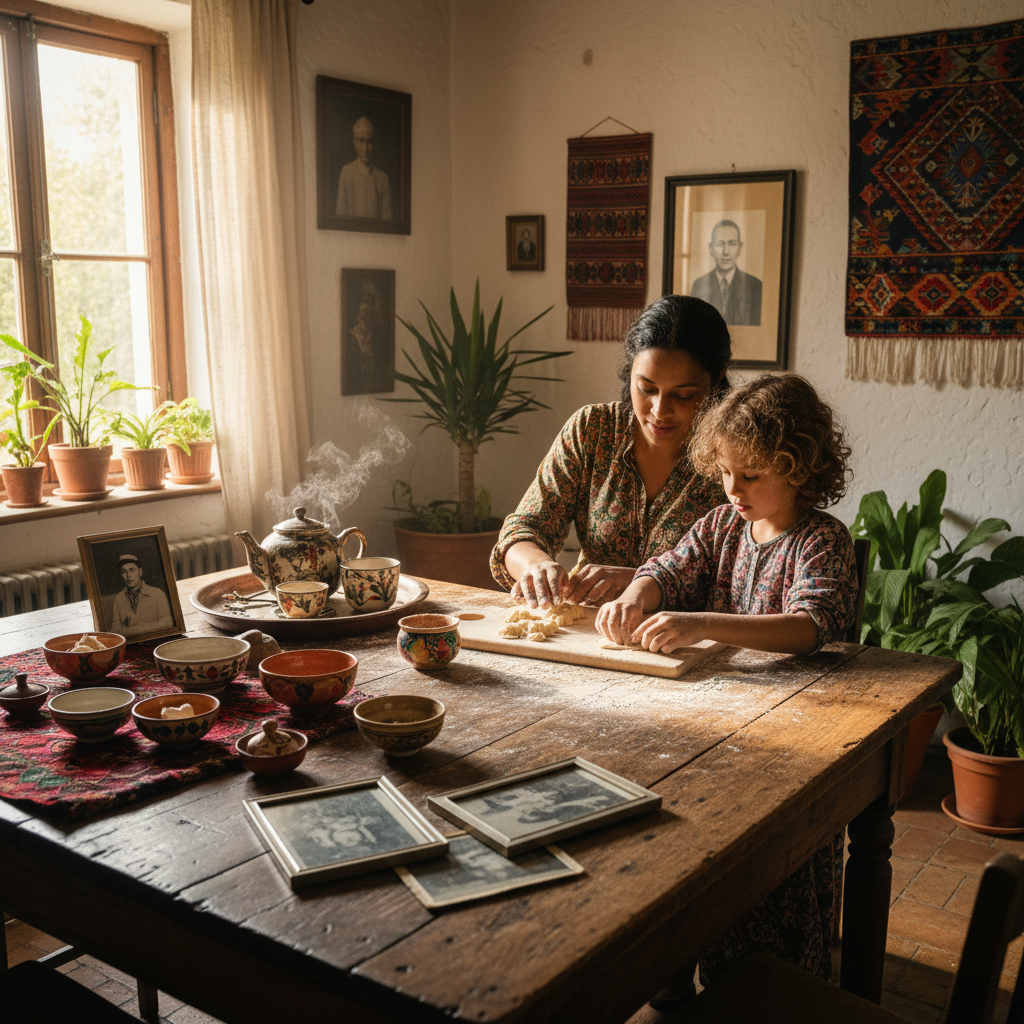
Food is often the easiest entry point because it turns heritage into something children can smell, taste, and help create. Instead of only serving a special meal once a year, build a small recurring ritual around it. Choose one family dish, make it together, and tell the story behind it while you cook.
To make this work with kids:
Food traditions are especially useful in homes where the heritage language is fading. Even if children do not understand every word, they can still attach memory, pride, and family meaning to the experience.
If you want to teach kids about their heritage, stories usually work better than lectures. Children remember a grandfather crossing an ocean, a grandmother sewing a holiday dress, or the reason a family always lights candles on a particular night more easily than they remember a general lesson about “culture.”
Try these story-building ideas:
If you are wondering how to explain heritage to a child, stories are often the answer. You can define culture more simply by grounding it in family life. Britannica Kids describes culture as the way of life of a group of people. For a child, that can become: “Culture is the way our family lives, celebrates, cooks, speaks, and remembers.”
Many families lose traditions because holiday practices stay too adult-centered. Children are more likely to love a tradition if they have a role in it. That does not mean turning a meaningful custom into entertainment. It means adapting it so kids can participate without losing the spirit of the tradition.
Examples of child-friendly adaptations include:
This also helps with one of the search patterns showing in GSC: how traditions adapt for younger generations. A tradition does not disappear because you simplify it for a six-year-old. It disappears when younger generations never get invited in at all.

You do not need full fluency to pass down culture through language. Even if parents are not confident speakers, small repeatable phrases still carry meaning. Greetings, kinship names, blessings, mealtime phrases, songs, and counting games can keep a heritage language emotionally present in the home.
Instead of aiming for an unrealistic full-language immersion plan, try:
This is especially helpful in bilingual or blended households. Heritage language can be carried in small rituals even when the dominant home language is different. What matters most is consistency and warmth, not perfection.
Some traditions live in objects: a cookbook, a scarf, a prayer book, a musical instrument, an embroidered cloth, a handwritten note, or a photograph from a migration story. Children often connect more deeply to heritage when they can see and hold something real.
A family memory book or heritage scrapbook works well because it combines stories, images, and participation. Include:
This turns heritage into an active project instead of a disappearing archive. It also helps if extended family lives far away, because the memory book becomes a portable form of continuity.

One reason children resist traditions is that adults expect too much too fast. Age matters. Toddlers need sensory participation. Early elementary kids like stories, crafts, songs, and repeated phrases. Older children can help cook, interview relatives, and compare traditions. Teenagers may respond best when invited into identity conversations, not treated like passive recipients.
For multicultural families, another issue appears: how do you honor more than one tradition without making one culture feel like the “main” one and the other feel decorative? The answer is not to force perfect balance every day. It is to create a home where both lineages are visible and respected.
Helpful principles include:
In other words, your job is not to preserve culture like a museum curator. It is to help children inherit traditions in a form they can actually live with.
If you are afraid your family's traditions may disappear, the solution is not to wait until children are older. The solution is to create continuity now. Traditions survive when they are easy to repeat, attached to family emotion, and recorded in some way that lasts beyond memory.
Use this simple system:
This is also where family memory habits help. If your child loses interest one year, that does not mean the tradition failed. Repetition, low pressure, and family story-making usually matter more than a perfect reaction in the moment.
Even families with strong cultural pride run into practical problems. Sometimes grandparents live in another country. Sometimes parents feel unsure because they did not fully learn the heritage language themselves. Sometimes siblings have different levels of interest. And in mixed-culture homes, one side of the family may worry that their customs will slowly become the “optional” ones.
The best response is not guilt. It is clarity. If a tradition is fading, ask what is making it hard to repeat. Is it too complicated? Too expensive? Too formal for your child's age? Too dependent on one relative being physically present? Once you identify the friction point, you can simplify the tradition without losing its meaning.
This is often the difference between tradition as pressure and tradition as belonging. Children are far more likely to stay connected when a custom feels welcoming, flexible, and emotionally real.
Parents often ask how to teach kids about heritage in a way that actually lands. The answer changes with age. A toddler does not need a history lecture. A school-age child can handle stories and comparisons. A teen may want context, nuance, and room to ask harder questions.
When parents match the tradition to the child's developmental stage, it stops feeling like forced performance and starts feeling like ownership. That matters if your real goal is not just one nice cultural activity, but traditions passed down through generations.
Traditions are usually passed down through repetition, stories, shared activities, language, food, holidays, and family objects that children experience often enough to remember and continue.
You can explain heritage to a child by saying it is the way your family remembers where you come from through stories, food, language, celebrations, and the things that matter to your relatives.
If your child is not interested, start smaller, make the tradition more interactive, connect it to something they enjoy, and focus on one repeatable ritual instead of trying to teach everything at once.
Yes, you can still pass down culture through songs, greetings, recipes, stories, holiday rituals, family photos, and a few meaningful phrases even if you are not fully fluent.
Multicultural families balance more than one tradition by making each culture visible in regular family life, inviting both sides of the family into shared rituals, and creating new traditions that fit the current household.
The best traditions are not always the biggest or most elaborate ones. They are the ones children can recognize, repeat, and eventually carry forward. If you want to pass down traditions successfully, start with what is real, meaningful, and sustainable in your home right now.
That could be a meal, a song, a phrase, a story, a holiday craft, or a memory book. What matters is not whether it looks impressive to anyone else. What matters is whether your child begins to feel, “This belongs to our family.” That is how traditions move from one generation to the next.
At Mamazing, we believe family culture grows best through small, lived moments. Start with one tradition this month, repeat it, document it, and let your child help shape it. That is how heritage stays alive.



How to Choose Sustainable Baby Gear Without Compromising Quality
Parenting Wins: When a Glider Became My Midnight Saver-Glider Saved My Midnight (Feedings)