
- by WengGracy
Baby Nap Schedule by Age: A Month-by-Month Guide
- by WengGracy
If your baby naps for 28 minutes, fights the last nap, or suddenly treats bedtime like a second afternoon, the problem may not be your whole routine. It may be that your baby's nap schedule has quietly outgrown their age and wake windows.
This baby nap schedule guide gives you a month-by-month starting point from newborn to 18 months, including how many naps a baby needs, when common nap transitions happen, and how to adjust without turning every day into a spreadsheet. Use the schedule as a map, then let your baby's sleepy cues, feeding needs, growth, and medical guidance fine-tune the route.
This article is educational and cannot replace care from your pediatrician, especially for premature babies, babies with feeding or growth concerns, or any baby with breathing, illness, or developmental concerns.
Most babies move from frequent, flexible naps in the newborn stage to three naps, then two naps, then one nap across the first 18 months. Total sleep still matters: the CDC lists 14 to 17 hours for newborns 0 to 3 months, 12 to 16 hours for infants 4 to 12 months, and 11 to 14 hours for toddlers 1 to 2 years, including naps where noted.
| Age | Typical Naps | Simple Rhythm | Watch For |
|---|---|---|---|
| 0-1 month | Many naps | Eat, brief awake time, sleep | Feeding and safe sleep first |
| 2-3 months | 4-6 naps | Short awake windows | Day-night rhythm emerging |
| 4-5 months | 3-4 naps | Morning, midday, afternoon, optional catnap | 4-month sleep changes |
| 6-8 months | 2-3 naps | Two core naps, catnap fading | 3-to-2 nap transition |
| 9-12 months | 2 naps | Morning nap and afternoon nap | Too-early one-nap switch |
| 13-18 months | 1-2 naps | Hold two if needed, move to one when ready | 2-to-1 nap transition |
The chart is a starting point, not a verdict. Some babies need the higher end of sleep, some need the lower end, and many switch back and forth during teething, travel, illness, growth spurts, or major milestones.
The first rule is that total sleep beats nap math. If your baby takes an unusual number of naps but is feeding well, growing, waking cheerful, and sleeping within a healthy total range, you may not need to "fix" anything. If your baby is cranky all day, falls asleep during feeds, wakes many times from overtiredness, or has very low total sleep, the nap schedule may need attention.
The second rule is that wake windows and cues work together. Check our baby wake windows by age guide for details. The short version is this: younger babies need sleep soon after waking, while older babies can handle longer awake stretches. Sleepy cues include staring, zoning out, red eyebrows, rubbing eyes, fussing, arching away from play, and suddenly becoming very clingy.
A common mistake is waiting for dramatic tired signs. By the time a baby is crying hard, they may already be overtired. Another mistake is using the same exact clock times after a bad night. A nap schedule by age should flex after early mornings, short naps, skipped naps, and unusually long naps.
In the first months, your baby is not failing a schedule. They are building one. HealthyChildren explains that babies do not have regular sleep cycles until about 4 months, and newborns may sleep only 1 or 2 hours at a time.

A newborn nap schedule is really a repeatable rhythm: feed, brief awake time, safe sleep, repeat. Newborns often sleep about 16 to 17 hours a day, but in short segments. During the first month, babies spend about 16 hours a day sleeping and naps may last about 3 to 4 hours between feedings.
At this age, do not chase a clock-based nap routine. Focus on full feeds when possible, diaper output, weight guidance from your pediatrician, and safe sleep every time. Daytime can be bright and normal; nighttime can be dim and quiet. That gentle contrast helps the body clock mature.
At 2 months, many babies still take 4 to 6 naps, and nap length may swing wildly. One nap may be 20 minutes, the next may be 2 hours. That can be normal. Instead of aiming for identical naps, look for a sustainable cycle: your baby wakes, feeds, has a short awake stretch, then goes back down before becoming frantic.
If evenings are rough, try protecting the late-afternoon nap. A baby who has been awake too long before bedtime may look energetic but actually be running on stress. A short catnap can rescue the evening.
By 3 months, you may notice a first nap that is easier than the rest. Use that. A brief pre-nap routine can be enough: diaper, sleep sack if used safely, short song, lights low, into the sleep space. Keep it boring and repeatable.
This is also a good time to separate "routine" from "rigid schedule." A 3-month-old baby nap schedule may have a similar flow each day, but exact nap times will still depend on when the baby woke and how long the previous nap lasted.
Around 4 months, naps often become more organized. Around 4 months, sleep rhythms start to become more set and many babies have 2 to 3 daytime naps. In real life, many 4-month-olds still need 3 to 4 naps while their sleep cycles mature.
A 4 month old nap schedule often includes three main naps and sometimes a short fourth nap. This is also the age when many parents notice shorter naps, more night waking, or a baby who suddenly needs more help settling. The answer is not always to drop a nap. Often, it is to tighten the pre-nap routine, watch wake windows, and avoid letting the final awake stretch get too long.
Sample rhythm: wake, first nap, feed and play, second nap, feed and play, third nap, optional catnap, bedtime. The optional catnap can be brief. Its job is simply to bridge the gap to bedtime.
Many 5-month-olds do well with three naps: a morning nap, a midday nap, and a shorter afternoon nap. If all naps are short, bedtime may need to move earlier. If the last nap pushes bedtime very late, cap it gently or wake your baby with enough time for a calm evening.
The best clue is mood. A baby who wakes happy after short naps may be doing fine. A baby who wakes upset from every nap, struggles through wake windows, and melts down before bedtime may need more nap support, a shorter wake window, or a calmer sleep environment.
At 6 months, some babies still need three naps, while others are ready to live mostly on two. This is a transition zone. If the third nap is becoming impossible but bedtime is still too far away, use an earlier bedtime for a while instead of forcing a late catnap.
A realistic 6 month old nap schedule may be wake, morning nap, afternoon nap, short bridge nap if needed, bedtime. As the two main naps lengthen, the bridge nap fades.
The 3-to-2 baby nap transition usually happens when the third nap regularly causes more trouble than it solves. Signs include refusing the third nap for several days, taking two solid naps and still making it to bedtime, or falling asleep too late at night because the catnap ended too late.
Do not drop the third nap after one strange day. Watch for a pattern over several days. During the transition, you can alternate: two-nap days when naps are strong, three-nap days when the morning starts too early or naps fall apart.
A simple two-nap rhythm looks like this:
This is where a schedule becomes easier to read. If the first nap starts too early, the whole day may slide early. If the afternoon nap ends too late, bedtime may become a wrestling match. Small shifts of 10 to 15 minutes often work better than one big change.
From 10 to 12 months, most babies still do best with two naps. Some will flirt with one nap by refusing a morning or afternoon nap, but that does not always mean they are ready. Crawling, standing, teething, separation anxiety, and new skills can all disrupt sleep temporarily.
A 10 to 12 month baby nap schedule often works best with a predictable morning nap and afternoon nap. If bedtime is too late, look at nap timing before dropping a nap. You may need to cap the second nap or start the first nap a little later.
Between 13 and 18 months, the 2-to-1 nap transition becomes more realistic. Young toddlers may still take two naps, but most drop to one nap a day by 18 months. If your toddler is 12 months and suddenly refusing naps, pause before switching. Many babies need two naps a little longer.
Signs your baby may be ready for one nap include a consistently refused second nap, bedtime moving too late, two naps becoming very short, and your baby staying reasonably cheerful on one well-timed midday nap. For the full step-by-step process, check our guide on when to drop to one nap.
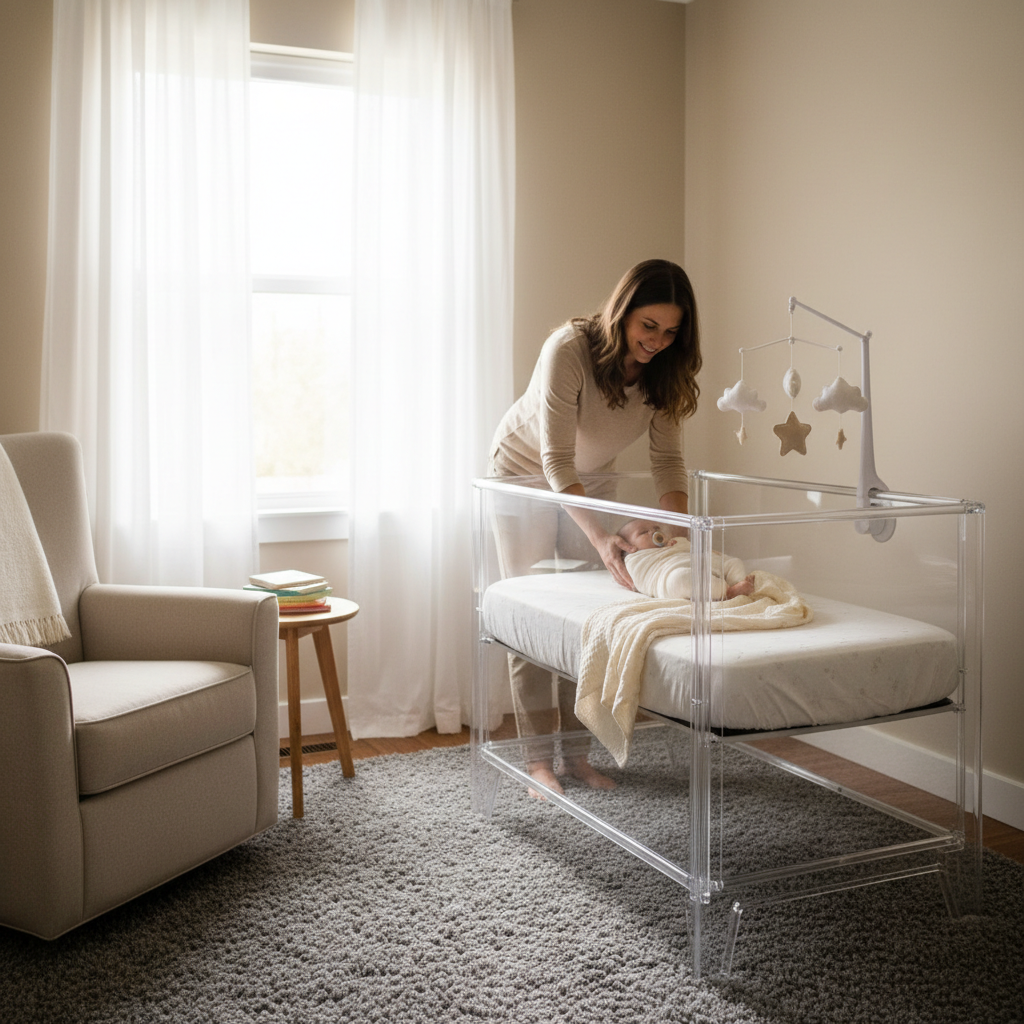
A good nap schedule does not matter if the sleep space is unsafe. The CDC says babies should be placed on their backs for all sleep times, including naps and nighttime, on a firm, flat sleep surface such as a mattress in a safety-approved crib with a fitted sheet. The AAP's 2022 safe sleep recommendations also emphasize a firm, flat, noninclined surface with no soft objects or loose bedding.
For naps, that means no pillows, loose blankets, bumpers, loungers, inclined sleepers, nursing pillows, or adult mattresses. If you are setting up a nursery or moving from a bassinet to a crib, choose a firm, flat, appropriately fitted sleep surface. Our collection of safe cribs can help you plan a simple nap setup around the same principle: clear, flat, and consistent.
One counterintuitive truth: boring is good. A plain sleep space may look less cozy to adults, but it is exactly what babies need for safer naps. Warmth can come from room temperature and an appropriately sized wearable layer, not loose bedding.
Most nap transitions happen gradually. The day may work on three naps, then two naps, then three again. That back-and-forth is not failure. It is often the cleanest way through.

Use this test before dropping a nap:
When you do transition, move slowly. Stretch one wake window by 10 to 15 minutes, hold it for a few days, then adjust again if needed. Use an earlier bedtime during the messy middle. If your baby becomes overtired, bring back the old nap pattern for a recovery day.
The most common overcorrection is dropping a nap too soon because naps are short. Short naps can mean undertiredness, but they can also mean overtiredness, hunger, light in the room, noise, developmental practice, or needing help linking sleep cycles. Look at the whole day before blaming the nap count.
Newborns may nap many times across 24 hours. Around 2 to 3 months, many babies take 4 to 6 naps. Around 4 to 5 months, 3 to 4 naps are common. Around 6 to 9 months, many babies move toward 2 to 3 naps. Around 9 to 12 months, two naps are typical. Between 13 and 18 months, many toddlers move from two naps to one.
Many babies move from 4 naps to 3 around 4 to 5 months, but it depends on nap length and wake windows. If the fourth nap is pushing bedtime late or your baby consistently manages three naps well, it may be time to phase it out.
The 3-to-2 nap transition often happens around 6 to 9 months. Signs include refusing the third nap, taking two longer naps, or needing a bedtime that becomes too late when the catnap stays.
Many babies are ready for one nap between 13 and 18 months, though some need two naps longer. Avoid switching after one odd week. Look for a steady pattern of nap refusal, late bedtime, and good mood on a one-nap day.
Sometimes. You may cap a late nap if it is making bedtime too late, or wake a baby for feeding if your pediatrician has advised it. For newborns, feeding and medical guidance matter more than preserving a long nap.
Short naps are common, especially before sleep cycles mature. Check wake windows, hunger, room light, noise, and whether your baby is overtired. If your baby wakes cheerful and total sleep is healthy, short naps may simply be your baby's current pattern.
Yes. A safety-approved crib with a firm, flat mattress and fitted sheet is an appropriate place for naps. Keep the crib clear of loose blankets, pillows, bumpers, toys, and soft objects.
Call your pediatrician if sleep issues come with poor feeding, low diaper output, fever, breathing concerns, unusual sleepiness, poor weight gain, loud snoring, pauses in breathing, or a sudden change that worries you.
The best baby nap schedule is age-aware, flexible, and safe. Start with the typical number of naps for your baby's age, then adjust based on wake windows, mood, feeding, night sleep, and total sleep. When a baby nap transition is coming, move gradually instead of rebuilding the whole day overnight.
PatPat designs nursery essentials for real family routines, including the quiet, repeated moments that make naps easier: a consistent place, a simple rhythm, and a sleep space that supports safer rest from the first newborn days through toddlerhood.
Featured Products


Why Does My Newborn Wake Up So Much at Night?
Baby Waking Up Too Early: Causes and Fixes