
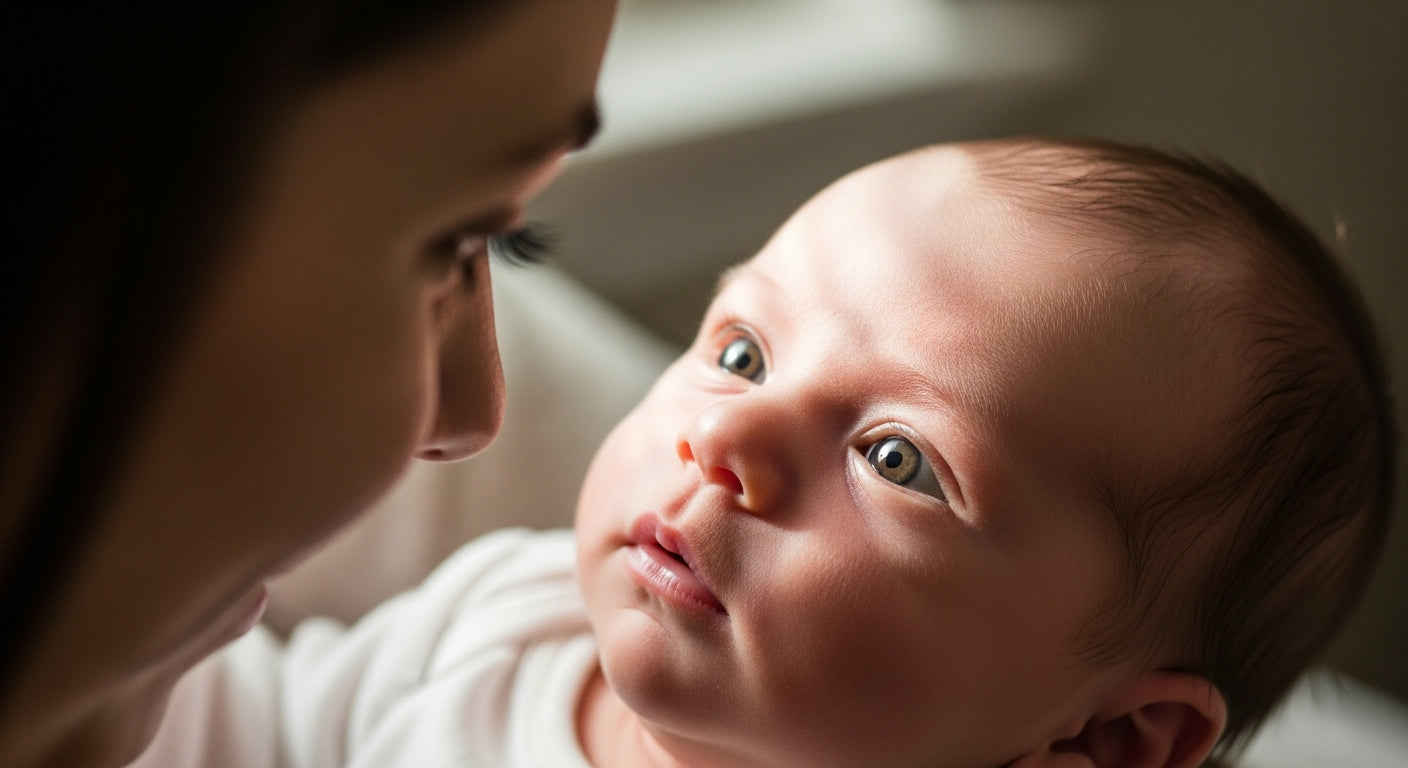
Baby Vision Timeline: When Do Babies Start Seeing Clearly?
- by xiaoyuyang
Short answer: Babies can see from birth, but newborn vision is blurry and works best at about 8 to 12 inches (20 to 30 cm). Most babies become better at tracking faces and toys by 2 to 3 months, show stronger color vision and hand-eye coordination by 4 months, and look much more visually organized by 6 months. Vision keeps sharpening through the first year.
If you have ever wondered whether your baby can actually see you during feeding, why their eyes sometimes drift, or when they will start seeing clearly across the room, you are asking exactly the right questions. A clear baby vision timeline helps you separate normal development from signs that deserve a call to your pediatrician.
In this guide, you will learn what newborns really see, how far they can focus, what changes month by month, and which warning signs are worth acting on. We also include simple ways to support healthy visual development at home, plus answers to the questions parents search most often.
Think of infant vision as a gradual upgrade, not a single moment when everything suddenly becomes sharp. According to HealthyChildren.org, newborns see best at close range, their eyes may occasionally wander for the first couple of months, and more reliable focusing and tracking develop over time.
The key point is this: babies start seeing at birth, but they start seeing more clearly and more usefully over the first several months.
Newborns are not born into a black screen. They can see from day one, but their world is soft, close, and low-detail. The most useful fact for parents is distance: HealthyChildren.org says a newborn sees best at roughly 8 to 12 inches, or 20 to 30 centimeters. That is almost exactly the distance between your face and your baby's face during feeding or cuddling.
This is why your baby may seem especially interested in your eyes, hairline, or high-contrast features when you are holding them close. It is not that they can study every detail of your face yet. It is that your face sits in the sweet spot where their early visual system works best.
At this stage, your baby is most likely to notice:
It is also common for a newborn's eyes to drift or cross from time to time. On the same AAP-backed guidance, this random eye movement is described as normal early on and should gradually settle down by 2 to 3 months as both eyes learn to work together.
If you want the clearest way to understand when babies start seeing clearly, use a month-by-month lens. Parents often expect one magic milestone, but vision develops in layers: first close focus, then better tracking, then stronger color perception, then more reliable depth and object awareness.
| Age | What your baby may see and do | What you may notice |
|---|---|---|
| Birth to 1 month | Best focus at 8 to 12 inches, stronger response to contrast and movement, limited coordination between both eyes. | Your baby stares at your face during feeding, prefers high-contrast patterns, and may have eyes that briefly wander. |
| 2 to 3 months | Better focus on faces and close objects, improved ability to follow movement. | Longer eye contact, more interest in your face, and smoother tracking of a toy from side to side. |
| 4 to 6 months | More color awareness, better hand-eye coordination, stronger recognition of nearby objects. | Your baby reaches toward toys, studies faces, and looks more visually engaged with the room. |
| 7 to 9 months | Vision supports movement, exploration, and object tracking over greater distances. | Your baby notices people across the room, follows motion, and visually checks spaces while crawling. |
| 10 to 12 months | Sharper recognition of objects, stronger visual problem-solving, and more purposeful exploration. | Your baby looks for dropped items, spots familiar people sooner, and uses vision while pulling up or cruising. |
This stage is about closeness, contrast, and bonding. Your baby is learning how to use their eyes at all, so short periods of gaze, blinking at bright light, or looking toward your face are all meaningful beginnings. The goal is not crisp detail. The goal is early visual connection.
By about 2 months, the CDC's 2-month milestones say many babies watch you as you move and look at a toy for several seconds. HealthyChildren also notes that by 3 months, babies should be able to focus on faces and close objects and follow a moving object with their eyes. This is often the phase when parents feel, “Okay, now my baby really sees me.”
This is the stretch when parents usually start asking whether their baby sees more clearly, because the change becomes easier to notice. On HealthyChildren.org, the AAP explains that by 4 months, infants use vision to detect nearby objects and are better at seeing colors and different shades. By 6 months, they should be able to tell differences between objects and use that information to identify them. In everyday life, this is when toys, faces, books, and your expressions hold their attention longer.
Once your baby becomes more mobile, vision starts doing more practical work. They scan spaces before reaching, notice where a toy rolled, and look back and forth between you and an object they want. This is also when depth, distance, and body movement begin to feel more connected in daily play.
By the end of the first year, your baby is using vision for exploration, memory, and coordination. The CDC's 1-year milestones include looking for things they see you hide and using vision while pulling up to stand or walking while holding furniture. That does not mean vision is fully adult-like at 12 months, but it is much more functional and organized than it was in the newborn stage.

This is one of the highest-intent questions parents ask, and the answer is refreshingly specific: newborns usually see best at about 8 to 12 inches, or 20 to 30 centimeters. That is the distance between your baby's face and yours during feeding, skin-to-skin contact, or a close cuddle. The same number is given on HealthyChildren.org's baby vision page.
That distance matters because it explains a lot of common parent observations:
If your baby seems to ignore faraway objects in the first weeks, that alone is not a reason to worry. At that age, distance vision is supposed to be limited. The more useful question is whether your baby responds to faces, movement, and changing light up close.

Parents usually mean one of three different things when they ask this question: when does my baby see me, when does my baby focus better, and when does my baby see the world more sharply. Those are not the same milestone.
A practical way to think about it is this:
So if you want the shortest honest answer, it is this: babies start seeing from birth, but most parents notice a clear jump in visual clarity somewhere between 2 and 6 months, with especially obvious progress around 4 months and beyond.
That is also why the exact phrase “when does a baby start seeing clearly” can be misleading. There is no single switch. There is a progression from close-range blur to better focus, better tracking, better color vision, and more useful distance awareness.
The 4-month mark deserves its own section because it sits right at the point where many parents notice a dramatic change. By 4 months, babies are usually more interested in faces, toys, and movement, and they are better at using vision to detect things close to them. The AAP's baby vision guidance notes that infants this age are better at seeing colors and different shades and often show interest in curved or circular patterns.
In daily life, a 4-month-old may:
If your baby is not doing every one of those things on the same day, that does not automatically mean something is wrong. Development is messy, and babies do not read milestone charts. But 4 months is a useful checkpoint because vision is no longer just about survival and bonding. It is becoming part of how your baby explores the world.
Depth perception develops gradually as both eyes learn to coordinate and the brain gets better at combining visual information with movement. Parents often notice the earliest meaningful signs during the middle of the first year, when babies start reaching more accurately, judging where a toy is, and using vision more confidently while rolling, sitting, or preparing to crawl.
You do not need to run a home science test to see this develop. Watch what happens during play:
Those small behaviors often tell you more than any single word like “depth perception.” In practical terms, depth starts making more sense to your baby as eye coordination improves and movement becomes more intentional in the 4- to 9-month range.
You do not need expensive gear to help healthy vision development. What babies benefit from most is close human interaction, safe visual variety, and time to explore.
If you are already reading, singing, talking face to face, and letting your baby watch your expressions, you are doing something powerful for visual development. If you want to build a broader developmental routine, you may also like Mamazing's guides on when babies start laughing, when to start baby sign language, and baby walking milestones.

Most vision development differences are normal, but a few signs deserve closer attention. On HealthyChildren.org's warning signs page, the AAP notes that newborn eyes can look misaligned at first, but regular inward crossing or outward drifting after 4 months is typically not normal.
You should contact your pediatrician if you notice:
It is also worth bringing up any concern you cannot shake. Parents often notice patterns before anyone else does. Early evaluation matters because some eye problems are much easier to treat when caught early.
Babies can see from birth, but most parents notice much clearer focusing and tracking between 2 and 6 months, with a particularly obvious jump around 4 months and beyond.
A newborn usually sees best at about 8 to 12 inches, or 20 to 30 centimeters, which is roughly the distance to your face during feeding or cuddling.
By 4 months, many babies can focus better on faces and nearby toys, notice colors more easily, and use vision to reach for objects they want to grab.
Depth perception develops gradually, but many parents begin to notice more accurate reaching and more coordinated visual awareness during the middle of the first year, especially around 4 to 9 months.
Yes, occasional eye wandering or crossing can be normal in the newborn period, but regular crossing or drifting after 4 months should be discussed with your pediatrician.
You should ask your pediatrician about persistent eye crossing after 4 months, poor visual attention, unusual pupil color, or ongoing redness, tearing, or discharge.
If you remember just one thing, remember this: your baby starts seeing at birth, but clear, coordinated, useful vision builds step by step. In the first weeks, your baby sees you best up close. By 2 to 3 months, they should focus better and follow movement more reliably. By 4 to 6 months, vision becomes much more interactive and obviously functional. Through the rest of the first year, your baby keeps sharpening how they notice, judge, and explore the world.
That is why a baby vision timeline is so helpful. It gives you a better question than “Can my baby see yet?” Instead, you can ask, “What kind of seeing is normal at this age?” That shift usually makes parent worries feel more manageable and helps you know when to be reassured and when to ask for help.
At Mamazing, we love turning big parenting questions into practical milestones you can actually use. If you are building your own first-year roadmap, keep this guide bookmarked and pair it with other age-based development guides so you can see the full picture, not just one milestone in isolation.



How Much Should a 3 Month Old Weigh? Average Weight, Percentiles, and When to Worry
How to Stop Toddler Biting: What to Do Right Away, Why It Happens, and How Long It Lasts