
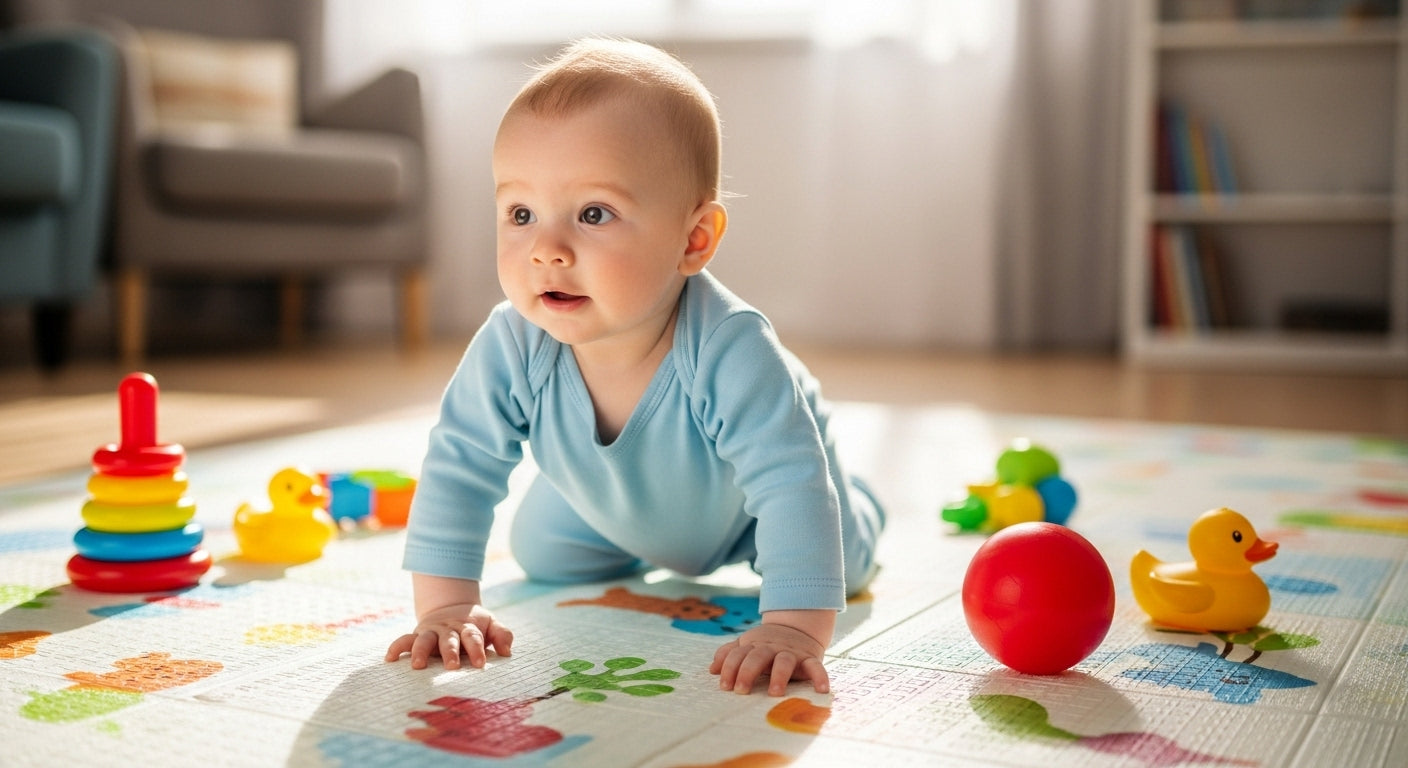
If you are wondering when babies start crawling, you probably want more than a single month number. You want to know what counts as normal, what signs usually show up first, whether crawling backward or army crawling counts, and when a baby who is not crawling yet is still well within the normal range.
Here is the quick answer: many babies start crawling somewhere between about 7 and 10 months, but the normal range is wider than many parents expect. Some babies start earlier, some later, and some never do a classic hands-and-knees crawl at all. That is why the better question is not only when do babies crawl, but also what other movement milestones are showing up around the same time.
This guide is built around the search intent behind when do babies start crawling, age for crawling, 7 stages of crawling, and 9 month old not crawling. You will get a simple timeline first, then signs of crawling readiness, common crawling stages and styles, what you can do to encourage crawling safely, and the moments when it makes sense to talk with your pediatrician.
Quick Answer: When Do Babies Start Crawling?
Most babies begin some form of crawling or crawl-like movement in the second half of the first year, often around 7 to 10 months. HealthyChildren's How Active is Your Baby? notes that around 6 to 9 months babies often move from sitting toward early crawling movements, and by 9 to 12 months many infants may be learning to crawl from sitting and pulling up to move around.
That does not mean every baby follows the same script. HealthyChildren's Crawling Styles page makes an important point: not every infant crawls in the traditional manner. Some belly crawl, some bottom scoot, some bear crawl, and some move toward standing and cruising sooner than parents expect.
This is also why parents comparing babies in the same playgroup often end up more worried than they need to be. One baby may spend weeks rocking before moving forward. Another may scoot backward for a while and then suddenly crawl across the room. Another may barely crawl in the classic sense before pulling up and cruising. The timeline matters, but the pattern of overall progress matters even more.
So if you came here just wanting the shortest answer possible, use this: many babies start crawling around 7 to 10 months, but different styles and slightly earlier or later timing can still be normal.
Baby Crawling Timeline Chart
The chart below is the fastest way to understand the most common progression parents notice before and during crawling.
| Approximate age | What you may see | What still counts as normal |
|---|---|---|
| 4 to 6 months | More tummy time push-ups, rolling, pivoting, reaching, rocking, stronger trunk control | Your baby may look eager to move without actually crawling yet |
| 6 to 9 months | Independent sitting, pushing backward, belly scooting, getting into hands-and-knees position | Backward movement or rocking before forward crawling is common |
| 7 to 10 months | First clear crawling attempts, army crawl, classic crawl, bear crawl, or other crawl-like mobility | Not every baby uses a classic hands-and-knees crawl |
| 10 to 12 months | Faster crawling, pulling to stand, cruising, climbing over obstacles, moving toward walking | Some babies spend a short crawling phase here, and some shift quickly toward standing and cruising |

If your baby seems to be moving toward crawling without crawling yet, that still matters. A baby who rolls, pivots, scoots, sits independently, reaches across the body, or rocks on hands and knees is showing the building blocks that usually come first.
Signs Your Baby Is Getting Ready to Crawl
Parents often notice readiness signs weeks before they notice true forward crawling. HealthyChildren's movement and activity guidance describes the months around crawling as a period when babies become much more active on the floor, shifting from supported sitting and reaching toward getting around on purpose.
Common pre-crawling signs include:
- More confident tummy time. Your baby can stay on the floor longer without immediately protesting.
- Pushing up on arms. The chest comes farther off the floor and the baby can look around more easily.
- Rolling both ways. Rolling is often one of the first ways babies learn to move from place to place.
- Sitting without support. The CDC's 9 month milestones include sitting without support and getting to a sitting position independently, both of which support later mobility.
- Pivoting or moving in circles on the belly. Some babies rotate before they travel straight.
- Rocking on hands and knees. This is one of the most recognizable “almost crawling” signs.
- Pushing backward first. Many babies figure out the wrong direction before they figure out the right one.

What matters most is the overall direction of movement development. A baby may not be crawling yet but still be making clear progress toward mobility. That is usually more reassuring than fixating on one milestone in isolation.
A helpful way to think about readiness is to ask whether your baby is becoming more organized on the floor. Are they shifting weight, reaching with purpose, turning to follow a toy, or trying harder to get from one position to another? Those are the kinds of signs that often matter more than whether a baby has produced an official-looking crawl on command.
7 Common Crawling Stages and Styles
Parents searching for the 7 stages of crawling are usually trying to understand whether their baby's unusual movement still “counts.” The most helpful answer is that crawling is often a progression, not a single event, and babies do not all move through the same pattern in the same order.
Here is a practical 7-stage version many parents can recognize:
- Tummy time tolerance: your baby can stay on the floor longer and lift the head and chest more confidently.
- Rolling and pivoting: your baby begins changing position and turning toward toys.
- Push-up strength: arms straighten more, and the torso is supported higher off the floor.
- Backward scooting or rocking: your baby pushes backward or rocks in place on hands and knees.
- First travel attempts: belly crawling, army crawling, or short bursts of forward movement appear.
- More organized crawling: your baby uses hands and knees, bear crawl, or another repeatable pattern to move across the floor.
- Fast crawling plus pull-to-stand: crawling becomes confident and is soon joined by cruising or pulling up.
HealthyChildren's Crawling Styles describes several normal variations, including classic hands-and-knees crawling, bear crawl, belly or commando crawl, bottom scooting, crab crawl, and even rolling to get around. That is one reason it is so important not to treat only one style as “real crawling.”

If you want a deeper look at the progression itself, Mamazing's Baby Crawling Stages: 7 Development Milestones is a natural next read.
How to Encourage Crawling Safely
The best ways to encourage crawling are usually simple and low-pressure. HealthyChildren's movement guidance keeps coming back to the same theme: babies learn by floor play, reaching, practicing, and being given safe chances to move.
Here are the most useful ways to support crawling:
- Protect daily tummy time. Tummy time builds the shoulder, neck, trunk, and arm strength crawling depends on.
- Put toys just out of reach. The CDC's 9 month milestone page suggests encouraging babies to crawl, scoot, or roll toward toys on the floor.
- Give floor time, not too much container time. Babies need room to move more than they need long stretches in seats, swings, or jumpers.
- Let your baby practice transitions. Moving from belly to sitting, from sitting to hands and knees, and from hands and knees back down all matter.
- Use a safe surface. A firm play mat or clean carpet usually works better than a slippery floor.
Just as important, avoid turning crawling into a daily pressure test. Your baby's job is to practice. Your job is to make practice safe, regular, and encouraging.
What usually helps least is over-coaching. Babies do not need complicated drills or constant repositioning every few minutes. Too much adult interference can make floor time frustrating instead of useful. Short, repeated chances to move during a normal day are often more helpful than one long, over-managed “practice session.”
It also helps to remember what not to do. Avoid slippery setups that make pushing off difficult, do not depend on walkers to build crawling skills, and try not to keep your baby in seats, loungers, or containers for most of their awake time. Floor freedom is what teaches floor movement.
Once mobility increases, safety changes fast. HealthyChildren's Safety for Your Child: 6 to 12 Months reminds parents that babies who crawl, sit, and pull up can suddenly reach hazards they could not reach before. Gates, anchored furniture, covered outlets, and locked cabinets matter more as soon as movement becomes purposeful.
What If My Baby Is Not Crawling Yet?
This is often where parent anxiety peaks. A baby not crawling yet can mean very different things at 7 months, 9 months, and nearly 12 months.
At 7 or 8 months, a baby may still be well within the normal pre-crawling window, especially if they are rolling, sitting, pivoting, and getting stronger on the floor.
At 9 months, it makes sense to look for the foundation skills instead of only for crawling itself. The CDC's 9-month milestones focus on getting to sitting independently and sitting without support, not on requiring every baby to be crawling by that birthday. So a 9 month old not crawling is not automatically a red flag if other movement progress is clearly happening.
At 10 or 11 months, many babies are crawling, cruising, or pulling up, but there is still variation. HealthyChildren's 12 month milestones describe the 8- to 12-month period as a time when babies may crawl forward on the belly, creep on hands and knees, pull to stand, or walk while holding furniture. That range matters: mobility can look different from child to child.
At 12 months, the question becomes more important if your baby is still not crawling and is also not showing related mobility gains such as getting into sitting, pulling to stand, bearing weight, cruising, or using the body symmetrically.
If your baby was born prematurely, remember to use corrected age. The CDC's 9 month online milestone checklist notes that if your child was born more than 3 weeks early, you should use corrected age when tracking milestones. That can make a real difference in how “late” crawling actually looks.
For example, a baby who is 10 months old by birthday but was born 2 months early may be much closer to an 8-month developmental picture for milestone tracking. That does not erase concerns if something feels truly off, but it can stop families from worrying unnecessarily when the timeline needs to be adjusted.
When to Talk With Your Pediatrician
You do not need to panic over every late crawler. But you also do not need to sit on concerns if the bigger developmental picture feels off. The CDC's milestone pages repeatedly make the same point: if your child is not meeting milestones, has lost skills, or you have concerns, talk with your doctor and ask about developmental screening.
Reasons to check in sooner include:
- No interest in floor movement plus weak progress in other mobility skills.
- Strong asymmetry. Your baby always drags one side, avoids bearing weight on one side, or moves in a clearly uneven pattern.
- Difficulty getting into or holding sitting.
- Not bearing weight through the legs when supported.
- Loss of a skill your baby used to do.
- A nearly 12-month-old who is not crawling and is also not pulling to stand, cruising, or showing other forward movement gains.
A pediatrician visit is not a failure report. It is how concerns get sorted. Sometimes the answer is simple reassurance. Sometimes the next step is more tummy time, more floor practice, or a referral for early intervention or physical therapy support.
That distinction matters because “late” and “concerning” are not the same word. A baby can be late to one milestone and still be developing typically overall. What pediatricians look for is the whole movement picture: strength, symmetry, coordination, transitions, weight-bearing, and whether skills are moving forward over time.
If you are tracking more first-year milestones in general, Mamazing's When Do Babies Start Laughing? is another reassuring reminder that developmental timelines often come in ranges, not exact deadlines.
FAQ
When do babies usually start crawling?
Many babies start crawling somewhere around 7 to 10 months, but the normal range is broader than that. Some begin earlier, some later, and some skip a classic crawl while still moving into other mobility milestones.
What are signs a baby is ready to crawl?
Common signs include stronger tummy time, rolling, sitting without support, pivoting on the belly, rocking on hands and knees, and trying to move toward toys. These skills usually show up before true forward crawling.
Is it normal for a baby to crawl backward first?
Yes. Backward movement is common before babies figure out how to coordinate themselves forward. Rocking, pushing backward, and moving in circles can all be part of a normal early crawling phase.
What if my 9- or 10-month-old is not crawling yet?
That can still be normal, especially if your baby is making other mobility progress such as sitting independently, pivoting, scooting, getting into hands-and-knees position, or pulling up. The bigger picture matters more than one exact crawling date.
Do all babies crawl before walking?
No. Some babies use unusual crawl styles, and some move fairly quickly toward pulling up, cruising, and walking without spending long in a classic hands-and-knees crawl.
How can I encourage my baby to crawl safely?
Use daily tummy time, floor play, and toys placed just out of reach, and give your baby a safe space to practice moving. As mobility increases, babyproof the home so your baby can explore with less risk.
Final Takeaway
If you have been asking when babies start crawling, the most useful answer is not one magic month. It is a pattern: many babies begin around 7 to 10 months, readiness signs often show up first, movement styles vary, and the bigger developmental picture matters more than whether your baby performs one exact kind of crawl on schedule.
The most reassuring mindset is to watch progress, not perfection. If your baby is stronger on the floor, more curious about reaching a toy, or closer to sitting, scooting, rocking, or pulling up than they were a few weeks ago, those gains matter. Crawling is part of a larger mobility story, not a pass-fail test.
If your baby is getting stronger, more mobile, and more curious on the floor, that progress counts. If your baby is not crawling yet and the rest of the movement picture worries you, talk with your pediatrician early. Reassurance and early support are both easier when you do not wait alone with the question.


What Age Do Babies Sit Up? Sitting With Support, Sitting Without Support, and When to Worry
Newborn Congestion: How Long It Lasts, When It Goes Away, and What to Do