
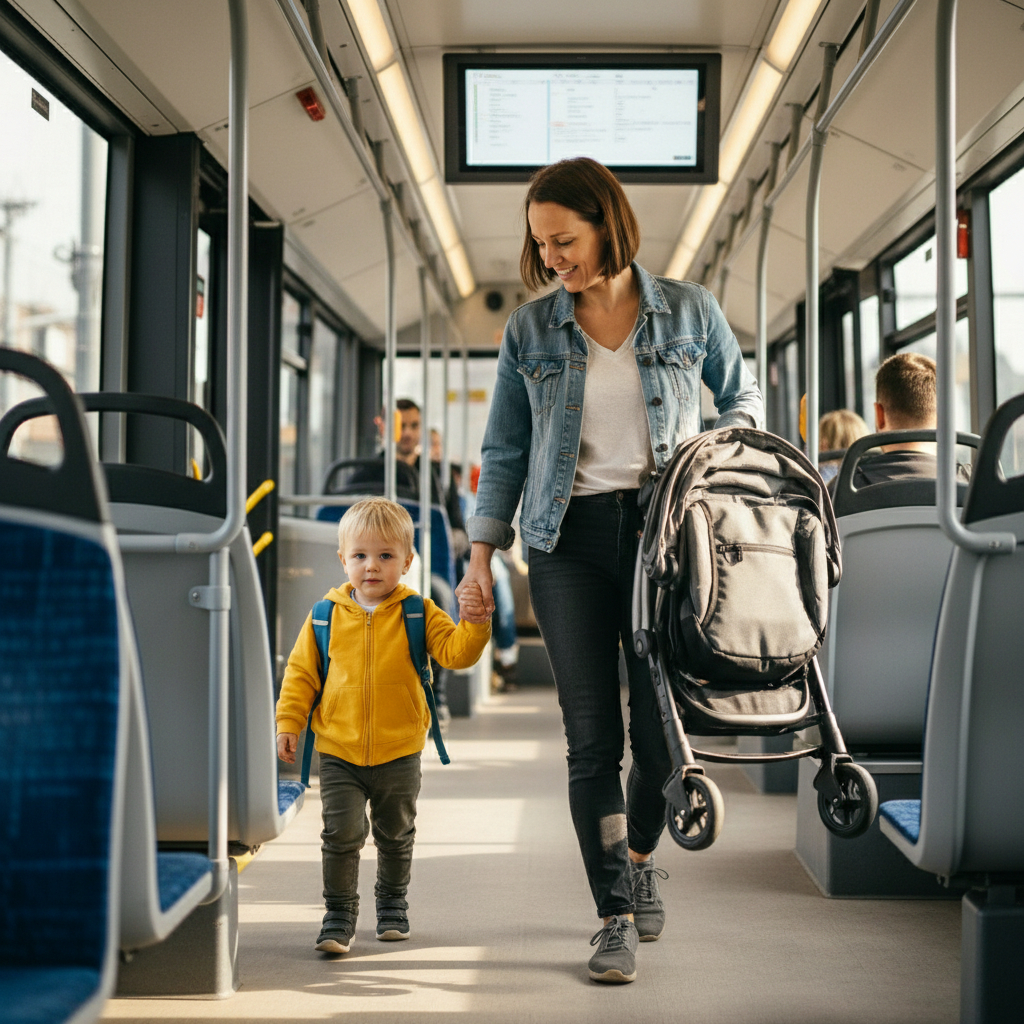
If you ride transit with a baby, the goal is not to keep your stroller open at all costs. The goal is to stay movable. On a quiet route with clear space, you may be able to keep the stroller open for a short ride. On a crowded bus, a tight train vestibule, or any platform where you need to move fast, a foldable stroller works best when you treat it like a tool you can switch modes in seconds.
That is the real answer behind most “stroller on bus” searches: keep it open only when the transit agency allows it, the aisle stays clear, and you can keep full control of the stroller. Otherwise, fold before the pressure starts. If you do that, public transit stops feeling like a test of patience and starts feeling manageable again.
A compact stroller can help, but routine matters even more. If you leave home knowing when to fold, where to stand, what to do with stairs, and which features make a stroller easier to carry, you can commute with much less stress. And if you are still comparing gear, Mamazing’s compact travel stroller format is the kind of low-bulk setup that tends to work better than a full-size suburban stroller on buses and trains.
- Assume you may need to fold before boarding, even if you hope to keep the stroller open.
- Use elevators whenever possible, and have a backup plan if a lift is out of service.
- Choose a stroller that is lightweight, quick to fold, easy to carry, and reliable on brakes and harness use.
- Prioritize your child, the aisle, and the wheelchair area over convenience or speed.
Stroller on Bus Rules: When to Keep It Open and When to Fold
The hardest part of using public transit with a stroller is that there is no one universal rule. Different systems allow different things, and some only allow an open stroller when the vehicle is not crowded. For example, Washington Metro says you can keep a stroller open in the priority seating area if space is available, but you may need to collapse it if a senior or rider with a disability needs that space. The same guidance says the stroller cannot block the aisle or door, the child should be strapped in, the brakes should be on, and you should hold it at all times.
That policy is more flexible than some riders expect, but it still points to the same transit habit: be ready to fold. TriMet recommends a folding umbrella-style stroller because large and double strollers are not practical on buses and trains. Transport for London also advises choosing a buggy that is lightweight, small, and foldable for public transport.
The practical takeaway is simple:
- Keep the stroller open only when the operator allows it and the vehicle has enough room.
- Fold it before boarding if the bus is crowded, the driver asks you to move, or you are about to block a doorway.
- Default to folding earlier than you think you need to. It feels slower for ten seconds, but it usually saves you from a messy boarding moment.
- If you are standing, keep one hand on the stroller and one hand available for a pole, rail, or your carrier.
In other words, the best stroller-on-bus strategy is not “never fold” or “always fold.” It is “stay adaptable without becoming an obstacle.” That mindset makes you safer and makes you a better transit neighbor too.

Before You Board: Build a 60-Second Transit Routine
Parents who look calm on transit usually are not winging it. They are repeating the same small sequence every time. That sequence matters more than buying ten accessories.
The order that keeps you moving
- Check the next step before you reach the door. If the bus is full, start folding before the driver opens the doors. If the platform is busy, move to the side before you stop.
- Secure the child first. If your baby will come out of the stroller, move them into your arms or a baby carrier before you deal with bags.
- Clear anything hanging loose. Blankets, snack cups, toy straps, and shopping bags are what usually turn a quick fold into a frustrating one.
- Fold once, then move. Do not stop in the doorway to reorganize. Board, clear the entrance, and adjust after you are out of the traffic stream.
This sounds obvious, but it solves the exact problem behind many frustrated “strollers on buses” searches. The pain point is rarely the stroller alone. It is the stroller plus the diaper bag plus the closing doors plus the toddler who picked the wrong moment to go limp.
What to pack so your hands stay free
Keep your transit load lean. A foldable stroller is most useful when your other gear does not sabotage it.
- Use a crossbody diaper bag or backpack instead of multiple tote bags.
- Keep fare payment, phone, and keys in one fast-access pocket.
- Bring a baby carrier for routes with elevator uncertainty or multiple transfers.
- Clip only essential items to the stroller frame, not the handlebar area.
If you regularly combine bus rides with longer day trips, Mamazing’s guide to holiday travel with a foldable stroller is a useful companion because it focuses on packing and movement, not just product specs.
One more habit matters here: plan step-free access before you leave. TfL specifically recommends using its planning tools to check lifts and step-free routes in advance, which is a good reminder even if you do not live in London. The less you improvise around broken elevators, the smoother your whole commute feels.
Timing helps too. If your schedule has any flexibility, give yourself one extra train or bus in the plan. Parents often think they need a better stroller when what they actually need is a wider margin. Five spare minutes gives you time to move away from the door, refold without panic, and wait for a less crowded vehicle if the first one arrives already packed.
Bus, Train, and Monorail: Similar Principles, Different Pressure Points
The rules are similar across transit types, but the pressure points are different. A bus usually gives you one fast boarding zone and less storage flexibility. A train gives you more standing room but more gaps, doors, and platform movement. A monorail often feels closer to train etiquette, but because space can tighten quickly around luggage and family groups, it is smart to assume you may need to fold unless the operator clearly allows otherwise.
| Transit type | What matters most | Best stroller tactic |
|---|---|---|
| Bus | Narrow aisles, priority seating, fast boarding | Keep it open only if the agency allows it and the space stays clear; otherwise fold before boarding. |
| Train or light rail | Door gaps, platform crowding, escalator and elevator decisions | Use elevators, stand clear of doors, and keep the stroller compact enough to pivot quickly. |
| Monorail or resort rail | Tighter car layouts, luggage clusters, unpredictable family traffic | Start from a fold-first mindset unless staff guidance or posted rules clearly support an open stroller. |
The reason this matters for search intent is that people do not just want “public transit stroller tips.” They want scenario judgment. They want to know what changes when the vehicle is packed, the platform is crowded, or the elevator is down. The answer is that your best move is the one that keeps your footprint smaller than the pressure around you.
If you want a shortcut, use this test: if you would feel uncomfortable turning the stroller ninety degrees without bumping someone, it is time to fold.
How to Handle Stroller Stairs, Elevators, and Crowded Platforms
This is where transit with a stroller stops being theoretical. “Stroller stairs” is a real search because stairs turn a manageable trip into a tactical problem fast.
WMATA’s rail guidance says not to take the escalator if you are using a stroller, wheelchair, handcart, or heavy load, and tells parents to use the elevator. Its separate elevator and escalator safety page is even clearer: if your child is in a stroller, do not use an escalator; use the elevator instead. TfL’s buggy guide also advises using the lift where available and taking extra care when escalators are unavoidable.
That gives you a realistic transit hierarchy:
- Elevator first. It is slower, but it is the safest, lowest-drama option.
- If there is no elevator, remove the child before any escalator decision. Never roll an occupied stroller onto an escalator.
- Fold before the choke point, not inside it. A stair landing, escalator entrance, or yellow-line platform edge is the wrong place to learn you need two hands.
- On crowded platforms, stand back and stage your move. TfL explicitly tells riders to stay behind the yellow line, which is smart advice everywhere.
When a lift is out of service, your backup plan matters more than your confidence. If your stroller is very light, you may be able to carry it folded with one hand and keep your child in the other arm or in a carrier. If your setup is too heavy for that, rerouting is often the better decision. Missing one train is annoying. Losing control on stairs is worse.
It also helps to think one stop ahead. If you know your destination station has unreliable elevators, fold before you arrive and switch the baby into the carrier while the ride is still calm. That one habit reduces the frantic rush that makes parents feel they are holding everyone up.

What Makes the Best Stroller for Public Transportation?
The best stroller for public transportation is usually not the most feature-packed stroller. It is the stroller you can fold quickly, lift confidently, and place in a narrow space without thinking about it.
- Low weight: TfL recommends a lightweight buggy for public transport because sooner or later you will need to carry it.
- Small folded footprint: Compact matters more than plush when aisles, vestibules, and elevators are tight.
- Reliable brakes and harness: The CPSC says stroller hazards behind its federal standard include parking brake failures, restraint issues, locking mechanism problems, and stability concerns.
- Simple fold mechanics: If you need a tutorial every time, it is not a transit-friendly fold.
- A shape that moves cleanly through doors: Narrower profiles are easier on buses, fare gates, and train doors.
If you are still deciding between models, browse Mamazing’s comparison of foldable strollers for urban parents. Transit parents usually care less about oversized storage and more about what happens in the ten seconds before boarding.

A good public-transit stroller also has a certain emotional quality: it does not make you hesitate. You know where the fold release is. You know how it balances once folded. You know you can carry it for one flight of stairs without feeling like you are gambling. That confidence is worth more than another accessory pocket.
Safety Habits That Matter More Than Fancy Features
Transit exposes the small stroller mistakes that feel harmless on a neighborhood walk. A stroller that is perfectly fine in a park can become risky near tracks, doors, curbs, and bus brakes.
- Use the harness every time your child is seated. The CPSC warns that a child who is not secured with the safety harness can slip through the opening between the seat and tray and be seriously injured.
- Set the brake any time you stop. TfL tells parents to keep the brake on whenever the buggy is stationary, including while waiting on platforms and at bus stops.
- Hold the stroller even with the brake on. Transit stops and starts can shift weight faster than you expect.
- Watch door grooves and platform gaps. TfL specifically notes thin train-door grooves can catch slim wheels.
- Keep your standing position deliberate. Face the stroller toward the safest stable direction, not toward the busiest stream of passengers.
There is also a mindset shift here: transit safety is less about having the perfect product and more about reducing your margin for surprise. Buckled child. Brake on. Bag secured. Exit strategy known. Those basics are boring, but they are what turn a difficult route into an ordinary one.
Common Mistakes That Slow You Down on Transit
- Waiting too long to fold. If you only decide after the doors open, you force the busiest moment to become your setup moment.
- Using a full-size stroller for a tight daily commute. A stroller that feels luxurious at the mall can feel huge on a weekday bus.
- Stopping in front of the door to reorganize. Clear the flow first, then fix the blanket, toy, or bag.
- Ignoring elevator reliability. Your trip may look step-free on paper but still fail if one lift is down.
- Treating etiquette as optional. Riders are more patient when they can see you are actively keeping the aisle clear and making room when needed.
If you want a reality-check perspective beyond specs and checklists, Mamazing’s real-world foldable stroller review is useful because daily handling tells you more than marketing language does.
A related mistake is overcommitting to the stroller even when the carrier would be easier. On a route with multiple stair transfers, rush-hour boarding, or repeated elevator failures, a short stretch with your baby in a carrier can be more efficient than fighting to keep the stroller active. The stroller still earns its place once the platform opens up again; you are simply choosing the right mode for the tightest part of the route.
FAQ
Do you have to fold a stroller on a bus or monorail?
Not always. If the transit agency allows open strollers and there is clear space, you may be able to keep it open. If the vehicle is crowded, the aisle is narrow, or staff ask you to move, folding it is the safer default.
Can strollers stay open on public transit?
Sometimes, yes. The safest assumption is that an open stroller is acceptable only when it does not block doors, aisles, or priority space and you can keep the child strapped in with the brakes on when stopped.
How do you handle stairs when traveling with a stroller?
Use the elevator whenever possible. If there is no elevator, take the child out first, fold the stroller before the choke point, and carry it only if you can do so with full control.
What is the best stroller for public transportation?
The best stroller for public transportation is lightweight, quick to fold, compact when folded, easy to carry, and dependable on brakes and harness use. In transit, simple and controlled beats bulky and feature-heavy.
Final Takeaway
If you remember one rule, make it this: the best stroller on public transit is the one you can shrink, steer, and secure without hesitation. That matters more than trendiness, and it matters more than trying to prove you can keep the stroller open through every ride.
For city families, the sweet spot is a compact stroller plus a practiced routine. Check the route, know your elevator backup, fold before the bottleneck, and keep your child secure. If you are choosing a stroller with that exact everyday rhythm in mind, start with a lightweight foldable stroller and build from there. That is how Mamazing can fit into the picture: not as a hard sell, but as a practical option for parents who want smoother bus and train days.


How to Choose the Best Travel Stroller for Your Next Trip
Stroller Hacks That Actually Help: Smart Tips for Storage, Travel, and Cleanup