
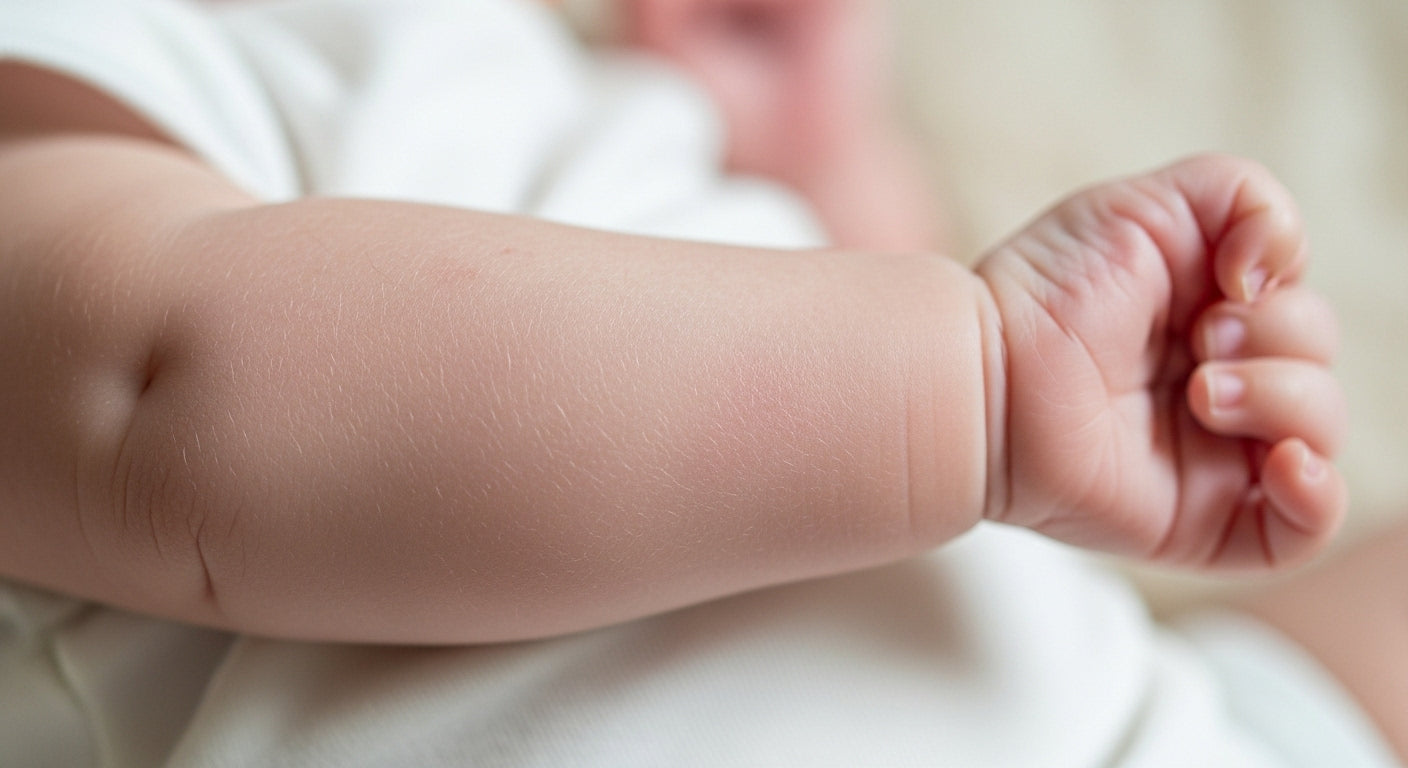
If your newborn has dry, flaky, or peeling skin, the reassuring answer is that this is often normal in the first days and weeks after birth. The skin is adapting from a warm, fluid-filled environment to dry air, clothing, baths, and everyday contact. The American Academy of Pediatrics notes that peeling skin is usually normal and often does not need treatment, especially in the newborn period, as explained in HealthyChildren's overview of how a newborn looks.
What most parents need to know is not just why it happens, but how to tell the difference between ordinary newborn dryness and something that needs a pediatrician's attention. In most cases, gentle care works better than aggressive treatment. You usually do not need a long product routine, strong cleansers, or a shelf full of baby skincare.
This guide walks you through what normal newborn dry skin looks like, why it often shows up on the face, how to treat it safely, how long it usually lasts, and which warning signs mean it is time to call your pediatrician.
Is newborn dry skin normal?
Yes. Mild dryness, flaking, and peeling are very common in newborns. A baby can be born with skin that already looks a little dry, or the peeling can become more noticeable over the first several days. This is especially common on the hands, feet, ankles, belly, and sometimes the face.
The key clue is the overall pattern. Normal newborn dry skin usually looks superficial rather than angry. The skin may appear papery, flaky, or slightly rough, but your baby otherwise looks well, feeds normally, and does not seem to be in pain when the area is touched. The skin should also slowly improve rather than become more inflamed.
This is why many parents feel confused by what they see online. A search for newborn dry skin often mixes normal peeling, baby acne, eczema, irritation, and infections into one scary bucket. In real life, mild peeling alone is often the least concerning version of that picture.
If your baby was born after the due date, the peeling can look more dramatic because there may be less vernix left on the skin by the time of birth. If your baby was born early, the skin can also be more delicate and may need an even gentler approach. The goal in either case is the same: protect the skin barrier without over-handling it.
Why newborn skin gets dry or peels
Newborn skin gets dry because it is going through a major environmental adjustment. Before birth, your baby's skin is protected by amniotic fluid and vernix, the creamy coating that helps reduce water loss and irritation. After birth, the skin suddenly has to deal with open air, fabrics, changing room temperatures, lower humidity, saliva, milk dribbles, and bathing.
The AAP notes in its Bathing Your Baby guidance that vernix acts as a natural moisturizer, which is one reason delayed first baths are now encouraged. In other words, some newborn dryness is not a sign that you have done anything wrong. It is part of the transition from womb life to ordinary life.
Skin adjusting after birth
During the first weeks, the skin barrier is still learning how to hold onto moisture efficiently. That is why your newborn may have dry patches even if you are already being careful. The skin on the feet and hands often peels first, but rough or dry-looking areas can also show up around the cheeks, forehead, chin, or body folds.
This early stage can look a little dramatic because newborn skin is so thin and visible. What matters most is whether the skin is simply dry or whether it looks inflamed, wet, crusted, or painful. Simple dryness tends to improve with time and gentle handling. Inflamed skin usually asks for more attention.
Why overdue or premature babies may look different
Babies born after 40 weeks often have more obvious peeling because they may have less vernix left by birth. Their skin may look especially dry on the wrists, ankles, or feet. Premature babies, on the other hand, may have thinner, more fragile skin that loses moisture more easily and can become irritated more quickly.
That does not mean every dry-looking patch is a problem. It means you should match your expectations to your baby's stage. A post-term newborn may peel more. A premature baby may need an even more minimal skincare routine and closer medical guidance. The principle is still the same: simple care first, medical review if the skin seems increasingly irritated or the baby seems unwell.
Dry skin on your newborn's face: what is common and what is not
Dry skin on a newborn's face is one of the most common reasons parents worry, partly because the face is always visible and partly because facial dryness can overlap with other skin issues. A few dry patches on the cheeks, forehead, or around the mouth can still be normal, especially if the rest of the skin also looks a little dry.
The face also takes more day-to-day contact than parents realize. It is wiped after spit-up, brushed by blankets, exposed to drool and milk, and touched during feeds. All of that can make newborn facial skin look rougher than the skin on the torso.
What is still within the common range? Mild flaking, slightly rough texture, or tiny dry patches without spreading redness, yellow crusting, or oozing. What is less reassuring? Bright red areas, wet-looking skin, cracks that bleed, thick honey-colored crusts, or a rash that seems to be expanding instead of settling.
If you are searching for phrases like dry skin on newborn face, dry face newborn, or 1 month old baby dry skin on face, the timeline matters. A little facial dryness in the first month can be ordinary. But if it keeps worsening, seems itchy, or comes with other symptoms, it stops being just a cosmetic question.
That is also why it helps to avoid over-cleaning the face. Repeated wiping with soaps, scented wipes, or rough cloths often makes the skin barrier more irritated, not less. When in doubt, gentler is usually better.
How to treat newborn dry skin safely
The safest approach to newborn dry skin is to support the skin barrier instead of trying to “fix” it fast. In many cases, that means shorter baths, less soap, gentle drying, and a simple moisturizer only when it seems useful.

Bathing and cleansing
AAP guidance says newborns do not need a bath every day, and bathing too often can dry out the skin. HealthyChildren notes that three baths per week during the first year may be enough, and mild soaps should be used sparingly in babies because soap can be drying. You can read the full recommendations in the AAP's Bathing Your Baby article.
For a newborn with dry skin, that translates into a few practical rules:
- Keep baths short and use lukewarm, not hot, water.
- Do not scrub peeling skin or try to rub flakes off.
- Use cleanser only where it is really needed, such as the diaper area or visibly dirty skin.
- Pat the skin dry instead of rubbing it.
If you have also been wondering about first-bath timing, Mamazing's guide on when to give your newborn a first bath at home can help connect the dots between vernix, bathing, and skin dryness.
When a simple moisturizer helps
If the skin looks rough, feels uncomfortable, or seems drier after bathing, a simple fragrance-free moisturizer or ointment can help reduce water loss. You do not need a complicated formula. In fact, the simpler the ingredient list, the easier it is to avoid extra irritation.
The texture matters too. Lotions feel lighter but are often less protective than creams or ointments. If the dryness is mild, a gentle fragrance-free cream may be enough. If there are tiny cracked spots, a more occlusive ointment can be more helpful for those focused areas.
Where parents get into trouble is adding too many products too quickly. If one simple moisturizer does not seem to help, it is usually better to step back and ask your pediatrician than to layer oils, balms, creams, and wipes all at once.
What to avoid
Skip products that add more irritation risk than benefit. That includes strongly scented baby products, harsh cleansers, adult skincare, exfoliants, essential oils, and “natural” treatments that have not been discussed with your pediatrician. If you suspect eczema rather than ordinary dryness, the American Academy of Dermatology recommends lukewarm baths, fragrance-free products, and moisturizers, while also watching closely for infection signs such as pus, sores, or yellow-orange crusts in its baby eczema treatment advice.
A good rule is this: if the skin is simply dry, keep the routine simple. If the skin is red, inflamed, or persistently worsening, do not keep experimenting at home for too long.
How long newborn dry skin lasts
For many babies, the most noticeable peeling improves over the first two to four weeks. Some babies improve faster. Some, especially babies born a little late, can continue to look dry for longer. What matters more than the exact number of days is the direction of the change.
| What you may notice | Often still normal | Worth calling about |
|---|---|---|
| Week 1 | Peeling on hands, feet, or body | Spreading redness, drainage, pain |
| Weeks 2-4 | Dry patches slowly improving | Skin getting rougher, wetter, or more inflamed |
| After the first month | Mild dryness that comes and goes | Persistent red, itchy, or crusted areas that suggest eczema or irritation |
This is where long-tail searches like 4 week old dry skin and how long does newborn dry skin last matter. At four weeks, some dryness can still be normal if it is clearly getting better and your baby otherwise seems well. If it looks more inflamed than before, however, time alone is no longer the best answer.
If your newborn also seems unsettled after baths or fussy during skin care, simplifying the routine often helps. Skin care does not need to become another overstimulating part of the day. Some parents also find that a calm post-bath cuddle or gentle skin-to-skin time helps settle both the baby and the routine.
When dry skin could be eczema, irritation, or infection
This is the section most parents really want when they search “when to worry.” The answer is not that every red patch is dangerous. It is that ordinary dryness should be superficial and gradually better, while more concerning skin problems tend to become more inflamed, more uncomfortable, or more widespread.
Eczema is possible if the skin looks persistently red, rough, inflamed, or keeps coming back instead of settling down. Irritant dermatitis is also possible if one area keeps getting wiped, rubbed, or exposed to saliva. Infection is more concerning when the skin becomes wet-looking, develops pus, forms crusts, or seems painful.
The AAP's newborn rash symptom checker says urgent review is needed if the skin looks infected, such as with spreading redness, sores, or pus, or if a newborn younger than 1 month looks or acts abnormal in any way, as outlined in HealthyChildren's newborn rash guidance.
Fever changes the picture too. The AAP advises that if a baby 3 months or younger has a temperature of 100.4 degrees Fahrenheit (38 degrees Celsius) or higher, you should call your pediatrician immediately, as explained in Fever and Your Baby.
Call your pediatrician promptly if you notice any of the following:
- Spreading redness or a rash that looks more inflamed each day
- Yellow crusting, pus, oozing, or sores
- Cracks that bleed or seem painful to touch
- Blisters or rapidly worsening facial rash
- Fever in a baby under 3 months old
- Your baby seems unusually sleepy, very fussy, feeds poorly, or simply does not seem right
The safest mindset is this: mild dryness can be watched. A sick-looking newborn should not be watched at home without medical advice.
How to choose a moisturizer for newborn dry skin
If you do want to use a moisturizer, choose one that respects how delicate newborn skin is. That usually means fragrance-free, dye-free, and as simple as possible. You are not shopping for a miracle ingredient. You are choosing something that helps hold moisture in without adding more irritation.
Here is a practical way to think about it:
- For mild dryness: a simple fragrance-free cream may be enough after baths.
- For small cracked spots: a plain ointment may give better protection.
- For facial dryness: use less product, apply gently, and avoid getting it into the eyes or mouth.
- For persistent redness or repeated flares: ask your pediatrician whether this still looks like simple dryness.
If you are searching for the best moisturizer for newborn, the more useful question is often: “Does my baby need one right now, and if so, what is the simplest option?” That framing usually leads to better decisions than chasing the most heavily marketed product.
And remember: a moisturizer should support the routine, not become the whole plan. Shorter baths, less soap, gentler wiping, and realistic expectations are still the foundation.
Frequently asked questions
Is newborn dry skin normal?
Yes. Mild dry or peeling skin is common in newborns, especially in the first few weeks as the skin adjusts after birth. It should gradually improve rather than spread, ooze, or become very inflamed.
How long does newborn dry skin last?
For many babies, the driest peeling improves over the first two to four weeks, though some babies, especially those born a little late, may look dry for longer. If the skin keeps getting worse instead of better, call your pediatrician.
What can you put on a newborn's dry skin?
Start with gentle care: shorter baths, lukewarm water, mild fragrance-free cleanser only when needed, and a simple fragrance-free moisturizer or ointment after bathing if the skin seems uncomfortable or rough. If your baby is under 12 weeks and the skin is very red, cracked, or painful, ask your pediatrician before trying multiple products.
Why does my newborn have dry skin on the face?
A newborn's face can look dry because the skin barrier is still adjusting after birth, the air is drier than the womb, and the face gets frequent contact from milk, saliva, cloths, and wiping. Mild dryness is common, but weeping, crusting, or spreading redness is not.
When should you worry about newborn dry skin?
You should call your pediatrician if your baby has fever, spreading redness, yellow crusting, oozing, bleeding cracks, blisters, obvious pain, or if your newborn seems unusually sleepy, fussy, or unwell.
Can dry skin be eczema in a newborn?
Sometimes. If the skin is persistently red, inflamed, rough, or keeps coming back instead of settling, eczema is possible. That is a good reason to ask your pediatrician or a dermatologist how to treat it safely.
Final takeaway
Most newborn dry skin is more reassuring than alarming. The biggest wins usually come from doing less, not more: fewer baths, less soap, gentler wiping, and a simple moisturizer only when it seems helpful. That approach supports the skin barrier while your baby's skin matures on its own timeline.
If you keep one rule in mind, let it be this: dry, flaky skin that slowly improves is usually manageable at home, but skin that becomes red, wet, crusted, painful, or comes with fever needs a pediatrician's input. Mamazing is here to help you sort those differences more calmly, so you can spend less time spiraling over every dry patch and more time feeling confident about what your baby actually needs.


Baby Refusing Bottle? Why It Happens and How to Help Your Newborn Take It Again
Toddler Meals for Picky Eaters: 75 Easy Ideas That Actually Get Eaten