
- by xiaoyuyang
How Much Should a 3 Month Old Weigh? Average Weight, Percentiles, and When to Worry
- by xiaoyuyang
If you are asking how much a 3 month old should weigh, you probably do not want a long lecture first. You want the number, the context around the number, and a clear sense of whether your baby seems to be on track. That is exactly the right way to think about it, because baby weight only becomes useful when you match the number with growth over time.
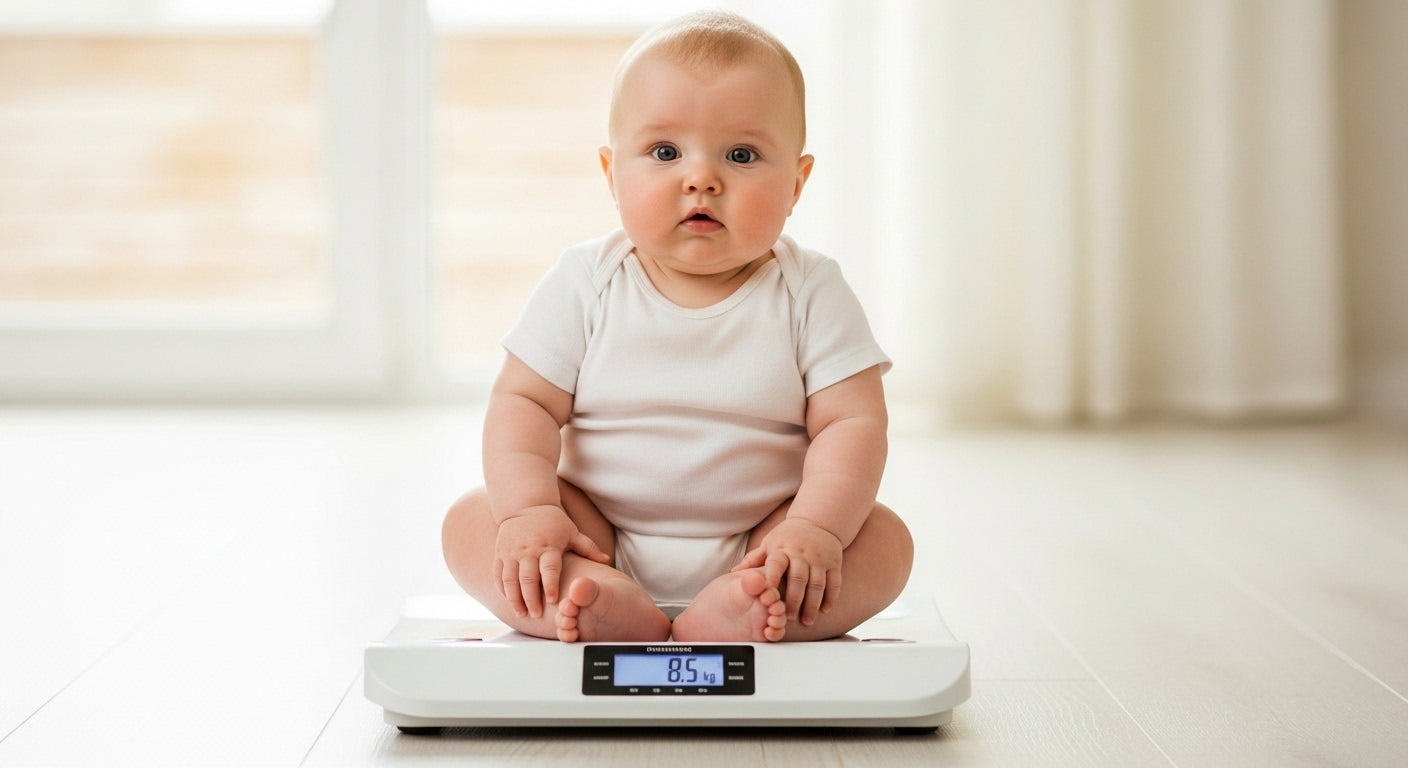
The short answer is this: many healthy 3-month-old babies land somewhere around 12 to 14 pounds, but there is not one “correct” weight for every baby. On the World Health Organization growth charts used for babies under age 2, the 50th percentile at 3 months is about 14 pounds (6.4 kg) for boys and about 12 pounds 14 ounces (5.8 kg) for girls. Plenty of healthy babies are below or above those exact numbers.
What matters most is whether your baby is gaining weight steadily, feeding well, and following their own growth curve. This guide will help you understand the typical numbers, what 12 or 14 pounds can mean at 3 months, how percentiles actually work, and when a lower or higher number should lead to a call to your pediatrician.
If you just want a practical answer, most healthy 3-month-old babies fall somewhere in the broad middle of the WHO growth charts, not at one magic number. CDC and the American Academy of Pediatrics recommend using WHO growth charts for babies from birth to 2 years, and those charts show that a typical 3-month-old boy is around 14 pounds (6.4 kg) and a typical 3-month-old girl is around 12 pounds 14 ounces (5.8 kg).
That does not mean your baby must match those numbers exactly. Think of them as reference points, not pass-fail marks. Some healthy 3-month-olds weigh a bit less, some weigh more, and both can be normal if growth is steady and feeding is going well.
| 3-month-old milestone | Typical reference point | What matters more |
|---|---|---|
| Boy at 3 months | About 14 lb / 6.4 kg at the median | Whether weight is rising steadily over time |
| Girl at 3 months | About 12 lb 14 oz / 5.8 kg at the median | Whether growth stays consistent on the chart |
| 12-pound baby | Can be normal for some babies at 3 months | Feeding, diapers, alertness, and growth trend |
| 14-pound baby | Also can be very normal at 3 months | How that number fits your baby's own curve |
Parents often search this topic in slightly different ways: “3 month baby weight,” “average weight of a 3 month old girl,” or “how many pounds should a 3 month old weigh.” Those are all versions of the same question, and they deserve a direct answer.
Using the WHO growth standards adapted by CDC for U.S. clinical use, the middle of the chart at 3 months is about 14 pounds (6.4 kg) for boys and about 12 pounds 14 ounces (5.8 kg) for girls. That is why searches for 12 pounds, 14 pounds, and average weight all cluster around this page: parents are trying to map a home scale number against a “normal” reference point.

The key is not to confuse “average” with “required.” A baby who lands above the median is not automatically healthier, and a baby who lands below it is not automatically in trouble. HealthyChildren explains that percentiles help doctors see the growth trend over time. That trend matters much more than chasing the 50th percentile.
Percentiles can sound more dramatic than they really are. Parents hear “10th percentile” and worry that it sounds low, or hear “90th percentile” and assume that bigger must be better. But percentiles are not grades and they are not report cards. They are simply a way to compare your baby's measurements with those of other babies of the same age and sex.
If your baby has been following roughly the same curve for months, that is usually more reassuring than one “average” number on its own. A baby at the 15th percentile who keeps growing steadily may be doing beautifully. A baby who was tracking steadily and then begins dropping off their curve may need more attention, even if the scale number still seems ordinary.
CDC also emphasizes that growth charts are not meant to be the sole diagnostic tool. They contribute to the full picture. That means weight should always be read alongside length, head growth, feeding, diapers, and your pediatrician's overall assessment.
Parents are often asking two different questions without realizing it. One is “What should my baby weigh today?” The other is “How much should my baby have gained by now?” The second question is often more useful.
HealthyChildren notes that babies from about 1 to 4 months often gain about 1.5 to 2 pounds per month. That is an average, not a rule for every baby, but it gives you a helpful sense of what typical early growth can look like.
That is why doctors usually ask about the pattern of weight gain rather than just today's number. If your baby regained birth weight, has continued to gain steadily, has enough wet diapers, and seems satisfied after feeds, that tells a much stronger story than one measurement alone.
This is also why a baby can be slightly lighter than you expected at 3 months and still be fine. If the line is moving up at a normal pace, your pediatrician is usually much more reassured than if the baby sits near an “average” number but has flattened out compared with prior checks. Growth is a story, not a snapshot.
If you are trying to make sense of a recent weight check, compare it with the last several measurements instead of mentally comparing it only with the internet's favorite number. That habit alone can prevent a lot of unnecessary panic.
Yes, either can be normal. This is one of the most useful takeaways for anxious parents. A 12-pound 3-month-old may be doing completely fine, especially if they were smaller at birth, are following their own curve, and are feeding well. A 14-pound 3-month-old may also be completely normal, particularly for a boy, a baby with a bigger birth weight, or a baby whose family tends to run larger.
The right question is not “Is 12 pounds bad?” or “Is 14 pounds too much?” The better question is “Does this number make sense for my baby's curve and overall health?” That is why isolated comparisons with friends' babies almost always create more confusion than clarity.
If you are looking at a number that feels unexpectedly low or high, step back and check the context: sex, birth size, prematurity, recent illness, feeding pattern, and whether weight has been trending steadily. Those details matter far more than a single home scale result.
In other words, a scale number becomes meaningful only after you ask what came before it and what is happening around it. That is the difference between informed tracking and panic-checking.
There is a difference between “not average” and “concerning.” Weight becomes more concerning when the number is part of a bigger pattern: poor feeding, fewer wet diapers, low energy, repeated vomiting, dehydration, or a baby who is not gaining as expected over time.
HealthyChildren's guidance on faltering weight explains that doctors diagnose weight concerns by looking at growth over time, health history, and physical exam, not by reacting to one isolated measurement. That is important because some babies are simply small, while others may truly need a feeding or medical evaluation.
Call your pediatrician sooner if your baby seems hard to wake for feeds, is taking much less milk than usual, has far fewer wet diapers, is losing weight, vomits repeatedly, or appears to be sliding off their expected curve. Those are more meaningful red flags than being a little below the median.
It can also help to remember what usually does not count as a red flag by itself. A baby who is content, alert, producing normal wet diapers, and steadily growing may still be on the smaller side of the chart. That alone is not a crisis. What doctors worry about most is a change in pattern, not a baby who has always been constitutionally small.
If your baby was recently sick, started sleeping longer stretches, or had a few days of weaker feeding, mention that when you call. Context matters. A pediatrician can make better sense of the scale when they also know what has been happening at home.
One reason parents get confused by baby weight is that several normal factors change the number.
Some breastfed babies and some formula-fed babies grow differently at different points in infancy, but that does not automatically mean one pattern is better. The key is whether your baby is getting enough milk and growing steadily, not whether they match someone else's feeding story.
This is why blanket comparisons can backfire. Two 3-month-olds may both be healthy while eating differently, growing at slightly different speeds, and looking very different on the chart. If feeds are going well and weight is trending in the right direction, the story is usually much more reassuring than the internet makes it sound.
Babies who were smaller at birth do not all end up “behind,” and babies who were bigger at birth do not all stay at the top of the chart. Still, birth size and family build can absolutely influence where a healthy baby lands at 3 months.
If your baby was born early, use corrected age when you think about growth and development in the first two years. HealthyChildren explains corrected age as your baby's age adjusted for how early they were born. That means a premature baby may look “small” by calendar age but still be growing appropriately when corrected age is used.
This is why a preemie FAQ should never be treated as a throwaway footnote. For many families, corrected age changes the interpretation completely.
For example, if your baby is 3 months old by the calendar but was born one month early, your pediatrician may think about growth more like a 2-month-old's pattern when interpreting milestones and weight expectations. Without that adjustment, parents can end up worrying about a “low” number that is actually appropriate for their baby's corrected age.
Tracking weight can be helpful, but over-checking can make perfectly normal variation feel like a crisis. Home scales are not always consistent, diapers and feeding times can change the reading, and one off-day does not rewrite your baby's growth story.
A calmer approach usually works better: use pediatric visits, look at trend rather than one number, and focus on the bigger signs that feeding and growth are going well. If you want more context around early baby development, Mamazing's guide to how long the newborn stage lasts can help frame what is changing around this age.
If your baby seems otherwise well but you are still uneasy, bring the actual weights and dates to your pediatrician instead of trying to interpret them in isolation. A simple list of measurements over time is much more useful than a general feeling that the number “seems off.”
You can also make home tracking less stressful by keeping the process consistent. If you weigh your baby at home, do it at similar times, in similar clothing conditions, and without expecting the number to move smoothly every single day. Babies are not little spreadsheets. Short-term fluctuation happens.
For many parents, the healthiest mindset is this: use home weights only as a support tool, not as a source of daily reassurance. If the number helps you notice a trend, great. If it turns into repeated checking that makes you more anxious and less clear, it is probably time to let the pediatric visits do the heavy lifting.
On WHO growth charts used for babies under 2, the median at 3 months is about 14 pounds for boys and about 12 pounds 14 ounces for girls. Many healthy babies weigh somewhat less or more than that.
Yes, 12 pounds can be normal for a 3-month-old, especially depending on sex, birth size, and growth trend. What matters most is whether your baby is gaining steadily and feeding well.
Yes. Fourteen pounds can also be a very normal weight at 3 months. It is close to the median for boys and still within a healthy pattern for many babies overall.
Some babies gain differently depending on feeding pattern, but there is no single rule that always makes one group lighter or heavier at every point. The more important question is whether your baby is getting enough milk and growing consistently.
A low percentile can still be perfectly healthy if your baby is following their own curve, feeding well, and developing normally. Percentiles are only concerning when the pattern over time suggests poor growth.
For premature babies, use corrected age rather than calendar age in the first two years when you think about growth and milestones. That gives a more accurate picture of whether your baby's weight is on track.
If you came here hoping for one exact number, here is the most honest answer: there is an average weight for a 3-month-old, but there is no single “right” weight that fits every baby. Your pediatrician cares more about steady gain, feeding, diapers, and the growth curve than whether your baby lands on one specific line.
That means a 12-pound baby and a 14-pound baby can both be normal at 3 months. The goal is not to match another baby. The goal is to understand your own baby's pattern. If the pattern is steady, that is reassuring. If the pattern is slipping or your baby seems unwell, that is the moment to call your pediatrician rather than keep guessing from the scale.
That is often the most genuinely reassuring answer parents can get.
Featured Products


Separation Anxiety in Babies: When It Starts, Peaks, and What Helps at 8 and 18 Months
Baby Vision Timeline: When Do Babies Start Seeing Clearly?