
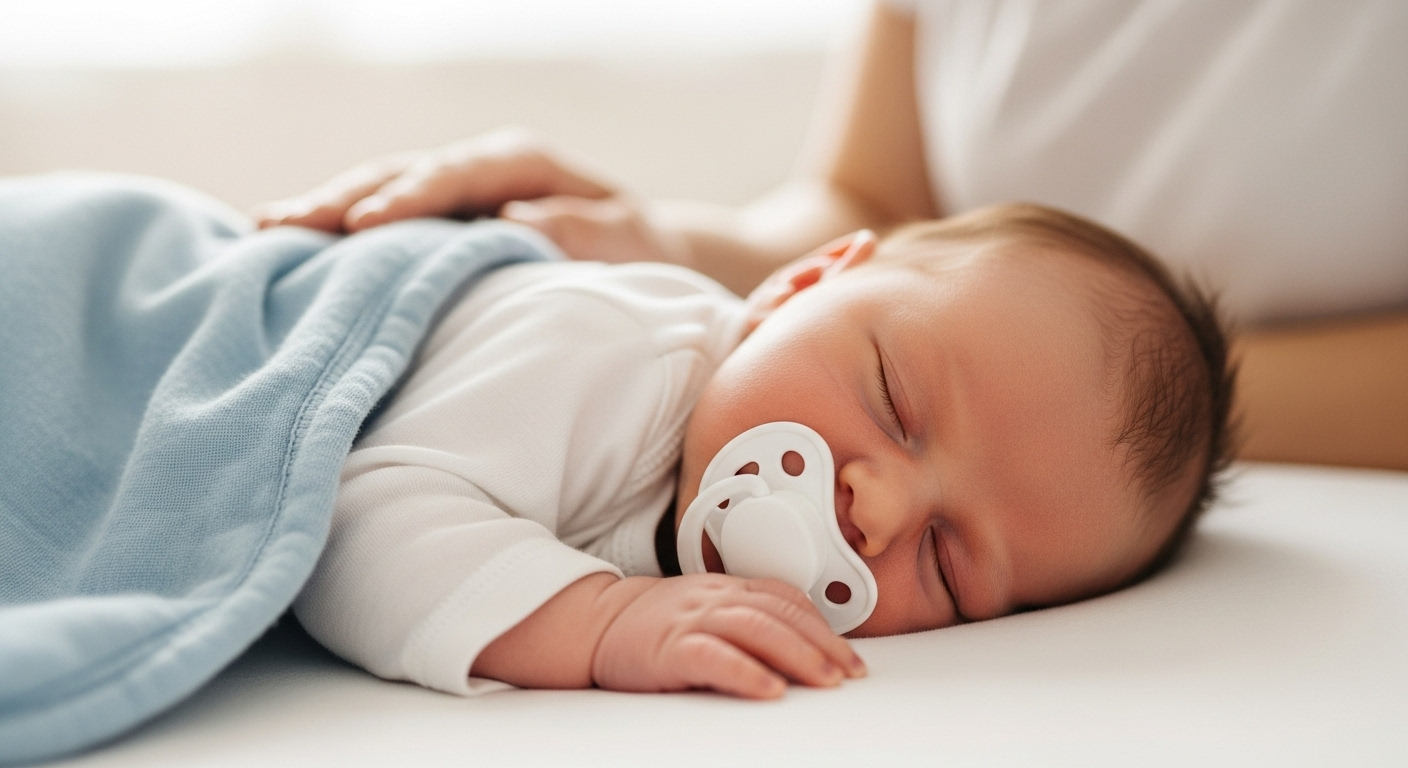
Yes, a newborn can usually sleep with a pacifier. The safest way to do it is to offer the pacifier when you lay your baby down for sleep, use it only in a bare crib or bassinet, and never attach it with clips, straps, strings, or stuffed holders. If you are breastfeeding, wait until feeding is going well before introducing a pacifier. If the pacifier falls out after your baby is asleep, you do not need to put it back in.
That quick answer covers most of what worried parents need at 2 a.m., but the details still matter. Parents are not just searching whether pacifiers are allowed. They are asking whether a 2-day-old or 4-day-old baby can use one, whether it is safe in a bassinet, whether a swaddled baby can keep one, and what to do if it falls out overnight.
This guide answers those questions directly, using mainstream safe-sleep guidance from pediatric sources and practical tips you can actually use during the newborn stage.
Key Takeaways
- Newborns can usually sleep with a pacifier at naps and bedtime if the sleep space follows standard safe-sleep rules.
- If you are breastfeeding, wait until breastfeeding is well established before introducing a pacifier.
- A pacifier is fine in a crib or bassinet, but clips, cords, strings, and stuffed attachments are not safe for sleep.
- If the pacifier falls out after your baby falls asleep, you do not need to reinsert it.
- A swaddled baby can use a pacifier, but swaddling should stop as soon as your baby shows signs of trying to roll.
Quick Answer: Can Newborn Sleep With Pacifier?
Yes. The American Academy of Pediatrics recommends offering a pacifier at nap time and bedtime because pacifier use during sleep is associated with a lower risk of sudden infant death syndrome (SIDS). HealthyChildren's safe-sleep guidance also says that if the pacifier falls out once your baby is asleep, you do not have to put it back in.
The answer changes slightly based on feeding stage, not because pacifiers are unsafe, but because breastfeeding needs time to get established. The CDC advises waiting until breastfeeding is going well before offering a pacifier regularly. For formula-fed babies, pacifiers can usually be introduced right away if your pediatrician has not given you a different instruction.
| Baby stage | Can baby sleep with a pacifier? | Feeding note | Safe-sleep reminder |
|---|---|---|---|
| Formula-fed newborn from birth | Usually yes | No breastfeeding-establishment delay is needed | Use a bare crib or bassinet with no pacifier attachments |
| Breastfed newborn in the first days | Often wait unless your care team says otherwise | Focus first on latch, supply, and frequent feeding | A pacifier should not replace feeding cues |
| Breastfed baby once feeding is well established | Yes | This is often around 3 to 4 weeks, but follow your baby's feeding pattern | Offer it; do not force it |
| Any newborn at night | Yes, if the sleep setup is safe | Feed first if baby is showing hunger cues | If it falls out, leave it out |

Can a 2 Day Old or 4 Day Old Baby Sleep With a Pacifier?
This is one of the clearest long-tail opportunities in GSC, and the practical answer depends mostly on how your baby is being fed. A formula-fed 2-day-old or 4-day-old baby can usually use a pacifier for sleep. A breastfed baby may need a little more time so feeding can get established first.
That does not mean every breastfed baby must wait for a rigid calendar date. It means the safer rule is to prioritize effective latch, good milk transfer, frequent feeding, and normal diaper output before making pacifier use part of the routine. If you are unsure whether breastfeeding is established yet, your pediatrician or lactation consultant is the best person to ask.
In other words, the answer to “can a 4 day old baby sleep with a pacifier?” is often yes for some babies, not yet for others. The difference is not age alone. It is whether feeding is secure and the pacifier is being used as a soothing tool instead of replacing hungry feeds.
Can I Give My Newborn a Pacifier at Night?
Yes, you can usually give your newborn a pacifier at night. In fact, nighttime is one of the most common and recommended times to offer it. The key is that the pacifier should be part of a safe-sleep setup, not a substitute for one.
That means your baby should sleep on their back on a firm, flat mattress with a fitted sheet only. No blankets, loose bedding, sleep positioners, pacifier clips, strings, or toys should be in the sleep space. HealthyChildren's AAP safe-sleep explanation treats the pacifier as one part of the safer setup, not permission to loosen the other rules.
If your newborn wakes often and seems unsettled, a pacifier may help with calming, but it should not be used to delay feeding when your baby is hungry. If night wakings are the bigger issue, Mamazing's guide to newborn crying in sleep can help you sort normal active-sleep noises from true wake-ups.
Can a Newborn Have a Pacifier in a Bassinet?
Yes. A newborn can have a pacifier in a bassinet as long as the bassinet itself follows safe-sleep rules. The pacifier is the allowed item; extra accessories are not. The bassinet should have a firm, flat sleep surface, a fitted sheet, and nothing else loose inside it.
This is an important distinction because many parents searching “can newborn have pacifier in bassinet” are really asking two questions at once: is the pacifier itself okay, and do I need a clip or holder so it stays put? The first answer is yes. The second answer is no. A pacifier should be free, not tethered, during sleep.
If you use a bedside bassinet, the same guidance applies. The location can be beside your bed, but the baby still needs their own flat sleep surface. Pacifier clips, loveys, and weighted items should stay out of the bassinet.
Can a Swaddled Baby Sleep With a Pacifier?
Usually yes. A swaddled newborn can sleep with a pacifier if swaddling is being done safely and your baby is still in the stage where swaddling is appropriate. The pacifier does not make swaddling unsafe by itself.
What matters is remembering that swaddling has its own rules. Your baby should still be placed on their back, the swaddle should not be loose around the face, and swaddling should stop as soon as your baby shows signs of trying to roll. A pacifier does not change those milestones.
If your baby sleeps more calmly with both a swaddle and a pacifier, that combination is common in the first weeks. But once rolling attempts start, stop swaddling even if your baby still likes the pacifier. For a broader picture of what normal newborn sleep looks like, Mamazing's guide on how much newborns sleep can help set expectations.
How Long Can a Baby Keep a Pacifier in Their Mouth While Sleeping?
If your baby falls asleep with a pacifier still in their mouth, that is usually fine. There is no official minute limit where you need to remove it. The more useful rule is this: offer the pacifier at sleep onset, then let your baby sleep. If it stays in, fine. If it falls out, also fine.
This exact question is already ranking at position 1 in GSC, so the answer should be crystal clear: you do not need to pull the pacifier out once your baby is asleep, and you do not need to keep pushing it back in all night either. The pacifier is there as an optional soothing tool, not something you have to manage continuously.
Parents often worry that leaving the pacifier in the baby's mouth all night is somehow unsafe. For most newborns, the concern is not the pacifier staying in. The real safety problems come from the wrong type of pacifier, damaged nipples, or unsafe attachments added to keep it from falling.
What If the Pacifier Falls Out During Sleep?
You do not need to put it back in. This is one of the most important points to surface because so many parents assume they are supposed to keep replacing the pacifier overnight. They are not.
HealthyChildren states that if your baby falls asleep with the pacifier and it drops out, you do not have to put it back. That single sentence answers a surprising number of high-impression queries: `falls out`, `do not reinsert`, `leave it in mouth while sleeping`, and `at night`.

Why Pacifiers Are Recommended for Sleep
The main reason this advice surprises parents is simple: many people assume pacifiers are merely a habit tool, while pediatric safe-sleep guidance treats them as potentially protective during sleep. Researchers do not know every reason for that association, but pacifier use at naps and bedtime has consistently been linked with a lower risk of SIDS.
That does not mean pacifiers replace the fundamentals. They work best as one layer of a full safe-sleep setup that includes back sleeping, a flat firm surface, no loose items, and a smoke-free environment. If your baby hates pacifiers, do not force one. It is helpful, but it is not mandatory.
If you are trying to understand why your baby's nights are still messy even with a pacifier, Mamazing's article on baby sleep patterns is a useful next step. A pacifier can support sleep, but it does not erase normal newborn sleep cycles.
How to Use a Pacifier Safely for Sleep
- Choose a one-piece pacifier designed for your baby's age.
- Check it regularly for tears, sticky spots, cracks, or other damage.
- Offer it when placing your baby down to sleep, but do not force it if your baby refuses.
- Never coat it in sugar, syrup, or other sweet substances.
- Keep clips, cords, strings, and stuffed pacifier holders out of the crib and bassinet.
- Clean and replace pacifiers according to the manufacturer's instructions.
Some parents also want reassurance that a pacifier is not the only way to help a newborn settle. That is true. Feeding, burping, swaddling when age-appropriate, and a consistent wind-down routine all matter too. The pacifier is one tool, not the entire plan.
Frequently Asked Questions About Newborn Pacifier Sleep Safety
Can I give my newborn a pacifier at night?
Usually yes. You can offer a pacifier at bedtime or naps if your baby's sleep space is otherwise safe. If your baby is breastfeeding, wait until breastfeeding is going well before making the pacifier a regular part of sleep.
Can a newborn have a pacifier in a bassinet?
Yes. A pacifier is fine in a bassinet if the bassinet has a firm, flat surface with a fitted sheet only. Do not add clips, strings, stuffed holders, blankets, or other loose items.
Can a 2 day old or 4 day old baby sleep with a pacifier?
A formula-fed newborn usually can. A breastfed newborn may need more time until feeding is established. If you are unsure, ask your pediatrician or lactation consultant rather than relying on age alone.
Can a swaddled baby sleep with a pacifier?
Yes, a swaddled newborn can usually use a pacifier for sleep. Just follow all swaddling safety rules and stop swaddling as soon as your baby shows signs of trying to roll.
How long can a baby keep a pacifier in their mouth while sleeping?
If your baby falls asleep with it in, that is generally fine. You do not need to remove it. If it falls out during sleep, you also do not need to put it back.
Do I need to put the pacifier back if it falls out?
No. Once your baby is asleep, you do not need to reinsert the pacifier if it drops out. The safest approach is to let your baby continue sleeping without attachments or repeated reinsertion.
Final Takeaway
If you want the shortest practical answer, it is this: yes, newborns can usually sleep with a pacifier, including at night and in a bassinet, as long as the rest of the sleep setup is safe. If you are breastfeeding, wait until feeding is established. If the pacifier falls out, leave it out. And never use clips or attachments in the sleep space.
That combination of rules is simple enough to remember even when you are exhausted, and it matches the exact questions parents are asking right now. The goal is not to make nighttime perfect. It is to make your decisions calmer, clearer, and safer.
Early Signs of Autism in 6-Month-Old Babies: What Parents Should Watch For
Hand Preference Age: When Hand Dominance Is Normal and When Early Preference Is a Red Flag