
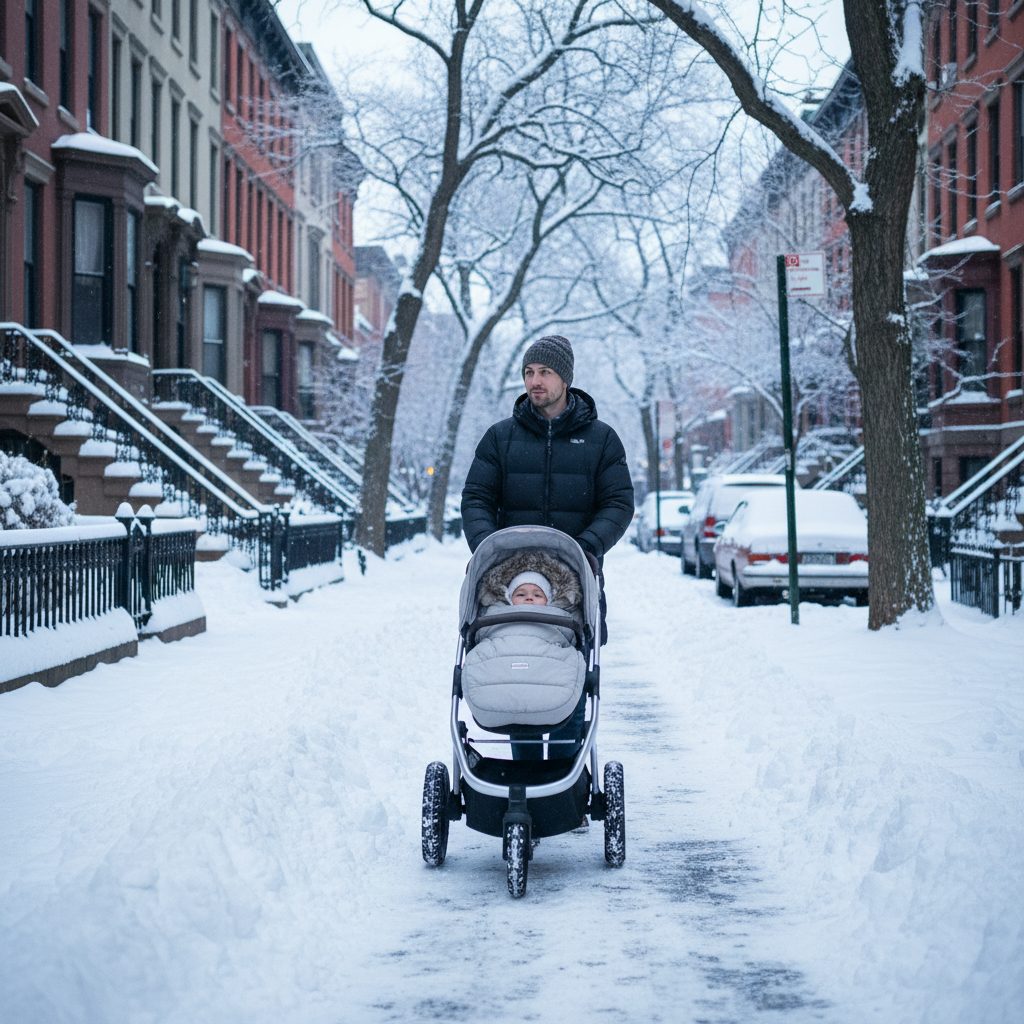
If you want the best stroller for winter, start with this rule: choose for snow traction and cold-weather control first, then worry about how small the fold is. That single shift explains why many “cute” travel strollers feel fine in October but frustrating once sidewalks turn slushy, curbs get icy, and the wind starts cutting across your route.
For most families, the best stroller for winter is an all-terrain or jogging-style model with larger wheels, reliable suspension, a secure harness, and enough canopy coverage to make cold walks easier—not a tiny stroller with small hard wheels. A foldable stroller can still be the right answer, but usually for cleared city sidewalks, short errands, travel days, and lighter winter conditions, not repeated use in snow.
This guide reframes the page around what parents are actually searching for: the best stroller for snow, the best stroller for winter weather, whether jogging strollers are good for winter, and when a lighter foldable option still makes sense. I also keep the current product list where it is genuinely useful, including the Mamazing Ultra Air Compact and Mamazing Ultra Air X, but with clearer winter boundaries so you can buy more confidently.
Best Stroller for Winter and Snow: The Short Answer
- Best overall winter stroller: Baby Jogger City Mini GT2 for the strongest balance of traction, suspension, and everyday convenience.
- Best stroller for snow and rougher winter paths: BOB Gear Revolution Flex 3.0 if you routinely deal with uneven sidewalks, packed snow, or longer outdoor walks.
- Best budget winter stroller: Baby Trend Expedition Jogger if you want bigger wheels without paying premium prices.
- Best lightweight stroller for city winter use: Mamazing Ultra Air Compact if your route is mostly cleared pavement and portability matters.
- Best ultra-portable foldable pick: Mamazing Ultra Air X for lighter winter use, travel, and quick in-and-out errands.
| Stroller | Best For | Winter Strength | Watch-Out |
|---|---|---|---|
| Baby Jogger City Mini GT2 | Most families | Strong all-around traction, suspension, and easy fold | Not the lightest option |
| BOB Gear Revolution Flex 3.0 | Snowier routes and serious outdoor use | Large air-filled tires and rugged ride quality | Bigger footprint and higher price |
| Baby Trend Expedition Jogger | Budget-minded winter buyers | Big tires and solid cold-weather value | Bulkier than a compact stroller |
| Mamazing Ultra Air Compact | City sidewalks and travel | Very light, quick to carry and fold | Not built for repeated deep-snow use |
| Mamazing Ultra Air X | Mild winter errands | Portable and easy for trunk or transit use | Better for cleared routes than snow buildup |
The big takeaway is simple: if you regularly walk through snow, slush, or rough winter pavement, buy for wheel performance. If you mostly need something easy to fold after short winter errands, then portability can move back up your priority list.
What Makes a Stroller Good for Winter or Snow?
The best stroller for winter weather is not defined by one label. “All-terrain,” “travel,” and “foldable” can all sound useful, but winter performance comes from the actual setup: wheel size, tire material, suspension, brake confidence, canopy coverage, and how stable the stroller feels when the surface gets unpredictable.
Wheels and tires matter more than marketing language
If you only remember one buying factor, make it this one. Small hard wheels are where winter frustration usually starts. They catch on slush, lose momentum faster, and feel twitchy on cracked or frozen pavement. Larger wheels with better tread patterns give you a smoother push and better control, which is why the strongest snow-friendly picks in this article lean all-terrain or jogging-style.
That does not mean every family needs a giant jogging stroller. If your version of winter is mostly cold air, cleared sidewalks, and a quick fold into the trunk, a lighter stroller may still be the smartest fit. But if you are shopping specifically for the best stroller for snow, wheel performance has to outrank compact size.
Suspension, canopy coverage, and brake confidence
Suspension matters more in winter than many parents expect. Once sidewalks become uneven from salt, refreezing, or packed snow, better suspension helps you keep the ride steadier for your baby and less irritating for your hands. Canopy coverage also matters because cold wind often feels worse than the temperature number itself.
Just as important, winter is not the season to get casual about safety basics. The American Academy of Pediatrics recommends checking for a five-point harness, reliable brakes, and a stroller that stays stable without tipping. That advice becomes even more useful in winter, when bulky gear, diaper bags, and slippery stops can make a stroller feel less predictable.
Foldability is helpful, but it is not the first filter
This is the biggest correction the original article needed. Foldability is a nice feature. It is not the main reason a stroller succeeds in winter. A foldable stroller is great when you live in a walk-up apartment, use transit, pack the stroller in the car often, or travel between indoor and outdoor stops. But if the route itself is snowy, icy, or rough, foldability should be a secondary lens—not the main topic.
That is why I would treat “foldable” as a tiebreaker after you answer the real winter questions: How much snow do you actually walk through? Are sidewalks consistently cleared? Do you need something for neighborhood loops, or just store runs and pediatrician visits?
Best Strollers for Snow and Winter Weather: Top Picks by Use Case
Below, I kept the existing product set but reframed it the way winter shoppers actually compare options: by route, surface, and lifestyle. That is much more useful than asking only whether the stroller folds.

Baby Jogger City Mini GT2 — Best overall winter stroller
If you want one pick that will satisfy the largest number of parents searching for the best stroller for winter, the City Mini GT2 is the safest answer. The reason is balance. In the original article, it already stood out for its forever-air rubber tires, all-wheel suspension, quick fold, adjustable handlebar, and near-flat recline. That combination matters because winter parenting is rarely one-dimensional. You may need traction in the morning, a compact fold by noon, and a comfortable seat for a longer bundled-up walk in the afternoon.
The City Mini GT2 makes the most sense if you want a stroller that feels more capable than a lightweight travel stroller without going fully into large jogging-stroller territory. It is especially strong for mixed winter conditions: cleared sidewalks, patches of slush, rough curb transitions, and everyday family use. If your winter walks are frequent but not extreme, this is the best all-around answer.
BOB Gear Revolution Flex 3.0 — Best for snow and serious outdoor use
If your mental image of winter stroller use involves uneven paths, repeated outdoor walks, or packed snow rather than polished mall floors, the BOB Gear Revolution Flex 3.0 is the more convincing specialist. The original article highlighted its mountain-bike-style air-filled tires, adjustable suspension, locking front wheel, large basket, and premium build. Those are exactly the features that matter when the surface is inconsistent and you want the stroller to keep moving instead of fighting you every few feet.
This is the pick for parents who want the strongest case for a best snow stroller within the current lineup. It is also the easiest recommendation for families who already know they prefer longer outdoor walks and do not mind the larger frame. The tradeoff is obvious: you give up some portability, but you gain more winter confidence.
Baby Trend Expedition Jogger — Best budget winter stroller
The Baby Trend Expedition Jogger is the value play if you want large wheels and winter-friendly capability without jumping straight to premium pricing. In the original article, it was positioned as a budget all-terrain option with 16-inch rear tires, a 12-inch front wheel, a locking swivel front wheel, good storage, and a padded reclining seat. Those basics make it easier to recommend now that the page is centered on winter and snow rather than just “cold weather.”
No, it is not the sleekest pick on this list. But budget shoppers searching “good strollers for winter” usually care less about sleekness and more about whether the stroller can handle cold-season surfaces without feeling flimsy. On that front, this model still earns its place.
Mamazing Ultra Air Compact — Best lightweight option for city winter walks
The Mamazing Ultra Air Compact deserves to stay in the article, but in a more honest lane. At about 11.5 pounds with a fast one-hand fold and easy maneuverability, it is not the best stroller for snow. It is a very sensible choice for parents who mainly need a lightweight stroller for city winter walks, quick errands, apartment living, and travel.
In other words, this is the kind of stroller you choose when the weather is cold but the route is manageable: plowed sidewalks, indoor-outdoor errands, train stations, elevators, and shorter trips where carrying the stroller matters almost as much as pushing it. If that sounds like your real life, the Ultra Air Compact may fit better than a bulkier winter specialist.
Mamazing Ultra Air X — Best ultra-portable pick for mild winter use
The Mamazing Ultra Air X sits even further on the portability side of the spectrum. The original article described it as a 9.9-pound travel stroller with rear suspension, swiveling front wheels, wheel locks, recline, and strong portability. That makes it useful for families who are not dealing with real snow depth but still want something practical for winter errands and cold-weather travel.
This is the right pick if “winter” for you mostly means low temperatures, dry pavement, quick car transfers, and frequent folding. It is the wrong pick if you want one stroller to push through repeated snow buildup. That boundary actually helps this page rank better, because the content becomes more trustworthy instead of pretending every stroller is equally good in every winter situation.
Are Jogging Strollers Good for Winter?
Usually, yes—if your winter problem is traction and uneven ground. Jogging strollers often make sense in winter because they tend to have larger wheels, stronger suspension, and frames that feel more composed on rough or partially snowy paths. That is why the BOB Gear Revolution Flex 3.0 and Baby Trend Expedition Jogger become more appealing the colder and messier your route gets.
But there is an important limit. A jogging stroller is not a magic pass for ice. If sidewalks are slick, deeply rutted, or not cleared, a bigger stroller still cannot create grip where there is almost none. So when parents ask, “Are jogging strollers good for winter?” my real answer is: they are often better for winter, but winter safety still depends on the route, your pace, and your willingness to skip a walk when conditions are too risky.
If your winter routine includes longer outdoor loops, parks, suburban sidewalks, or rougher pavement, a jogging-style frame can absolutely be the smartest choice. If your winter routine is mostly apartment elevator, coffee stop, grocery store, and trunk storage, a big jogging stroller may feel like overkill.
All-Terrain vs Foldable Strollers for Winter: Which One Should You Buy?
This is where many families get stuck, because both priorities feel real. You want something that works in winter, but you also do not want a stroller that turns every doorway, stair, and car transfer into a wrestling match.

Choose an all-terrain or jogging stroller if most of these are true:
- You regularly walk on packed snow, slush, rough pavement, or uneven neighborhood routes.
- You do longer outdoor walks instead of just short errands.
- You care more about control and push comfort than the smallest fold.
- You want one stroller that feels more stable once winter gets annoying.
Choose a lightweight or foldable stroller if most of these are true:
- Your sidewalks are usually cleared quickly.
- You need to carry the stroller upstairs, onto transit, or in and out of the trunk often.
- Your winter use is mostly city errands, doctor visits, airports, or indoor-outdoor stops.
- You are willing to avoid deeper snow instead of forcing a compact stroller through it.
That is the real decision. For many families, the best stroller for winter is simply the one that matches their route honestly. If you overshop for ruggedness, you may end up with a stroller you hate lifting. If you undershop for traction, you may dread every snow day.
What Wheels, Tires, and Suspension Work Best in Snow?
If your query is specifically “what works in snow,” aim for larger wheels with better tread and enough suspension to reduce bounce over broken winter surfaces. The original article was directionally right here: tiny plastic wheels are the first thing to struggle, while larger rubberized or air-filled tires tend to track more confidently.
Here is the practical version:
- Best for snow and rough winter routes: larger all-terrain or air-filled tires with visible tread.
- Best for mixed city winter use: medium-to-larger rubber wheels with solid suspension.
- Least ideal for snow: very small wheels designed mainly for smooth indoor flooring or light travel use.
Suspension matters because winter routes are rarely just “snowy.” They are often patched, salted, cracked, half-melted, and then refrozen. A stroller with better suspension feels less chattery, and that can be the difference between an annoying push and a manageable one.

If this section changes your shopping list, that is a good thing. It means you are no longer choosing based on broad stroller marketing; you are choosing based on the winter surface you actually push on.
How to Use a Baby Stroller Safely in Winter Weather
Buying the right stroller helps, but winter comfort and safety also depend on how you use it. HealthyChildren.org advises dressing infants and children in warm, thin layers and usually one more layer than an adult would wear in the same conditions. That is a better winter starting point than piling on one bulky outfit that restricts movement and becomes hard to adjust indoors.

For stroller use, that means thinking in systems: base layers, mittens, a warm hat, a footmuff or bunting if you use one, and enough canopy or weather cover to cut the wind. What you do not want is a baby who starts the walk comfortable, overheats halfway through, and then gets cold when you stop.
The American Academy of Pediatrics also emphasizes basic stroller safety such as using the harness, locking brakes when stopped, and avoiding tip risks from overloaded handles or unstable setups on slopes and curbs. In winter, that advice matters even more because puffy bags, blankets, and slippery footing can make a stroller less stable faster than you expect.
My practical winter rules are:
- Use the harness every time, even on short neighborhood walks.
- Slow down before icy curb cuts and uneven crosswalks.
- Skip the walk if the route is mostly ice rather than packed snow or wet pavement.
- Layer your baby so you can remove or add warmth easily once you move between indoors and outdoors.
- Prioritize your route as much as your stroller; a safe winter stroller still needs a safe winter path.

Final Verdict: Which Winter Stroller Makes the Most Sense for You?
If you want the easiest recommendation for the broadest number of families, buy the Baby Jogger City Mini GT2. It is the best stroller for winter if your goal is a smart middle ground: capable enough for real cold-weather use, practical enough for daily life, and not so specialized that it becomes annoying outside of winter.
If snow performance is your top concern, move up to the BOB Gear Revolution Flex 3.0. If budget matters most, go with the Baby Trend Expedition Jogger. If you mostly need a stroller that survives winter errands without becoming a burden to carry, look at the Mamazing Ultra Air Compact or Ultra Air X and be realistic about the fact that foldable and snow-ready are not the same thing.
That is really the smartest way to use this page. Shop your route, not just the product photo. And if you want to compare more lightweight and everyday options after narrowing your winter priorities, browse the Mamazing stroller collection to see where portability, travel convenience, and daily use may fit into your decision.
Mamazing works best for you when the stroller matches your actual season, your actual sidewalks, and your actual routine. That is how you get a stroller you still like in February—not just one that sounded good on a product page in September.
FAQ
What is the best stroller for winter weather?
The best stroller for winter weather is usually an all-terrain or jogging-style stroller with larger wheels, dependable suspension, a secure harness, and enough canopy coverage to handle cold wind and rougher surfaces. For most families in this guide, the Baby Jogger City Mini GT2 is the best overall balance of winter capability and everyday convenience.
What is the best stroller for snow?
The best stroller for snow is the one with the strongest wheel and tire setup for the routes you actually use. In this lineup, the BOB Gear Revolution Flex 3.0 is the strongest pick for repeated snowy or rough outdoor paths, while the City Mini GT2 is the better all-around choice if you want winter capability without going fully oversized.
Are jogging strollers good for winter?
Yes, jogging strollers are often good for winter because they usually have larger wheels, better suspension, and more stability on rough or partially snowy ground. They are still not a cure for ice, so they work best on packed snow, slushy pavement, and uneven sidewalks rather than truly slick conditions.
Can you use a foldable stroller in snow?
Yes, but only within reason. A foldable stroller can work in winter if sidewalks are mostly cleared and your main need is portability. If you regularly push through snow buildup or rough winter surfaces, a foldable stroller is usually a secondary choice behind a stronger all-terrain or jogging model.
What wheels are best for snow and icy sidewalks?
Larger wheels with better tread and stronger suspension are usually best for snow and uneven winter sidewalks. Very small hard wheels tend to struggle the most. Even with better wheels, icy sidewalks still require slower walking and better route judgment.
Is an all-terrain stroller better than a lightweight stroller for winter?
An all-terrain stroller is usually better for winter if you deal with snow, slush, rough pavement, or longer outdoor walks. A lightweight stroller can still be the better buy if your winter use is mostly short errands, travel, and cleared city sidewalks where carrying and folding matter more than maximum traction.
Day Trips With a Baby: How to Pack and Use a Foldable Stroller
How to Clean Stroller Fabric, Wheels, and Frame: A Deep-Clean Guide