
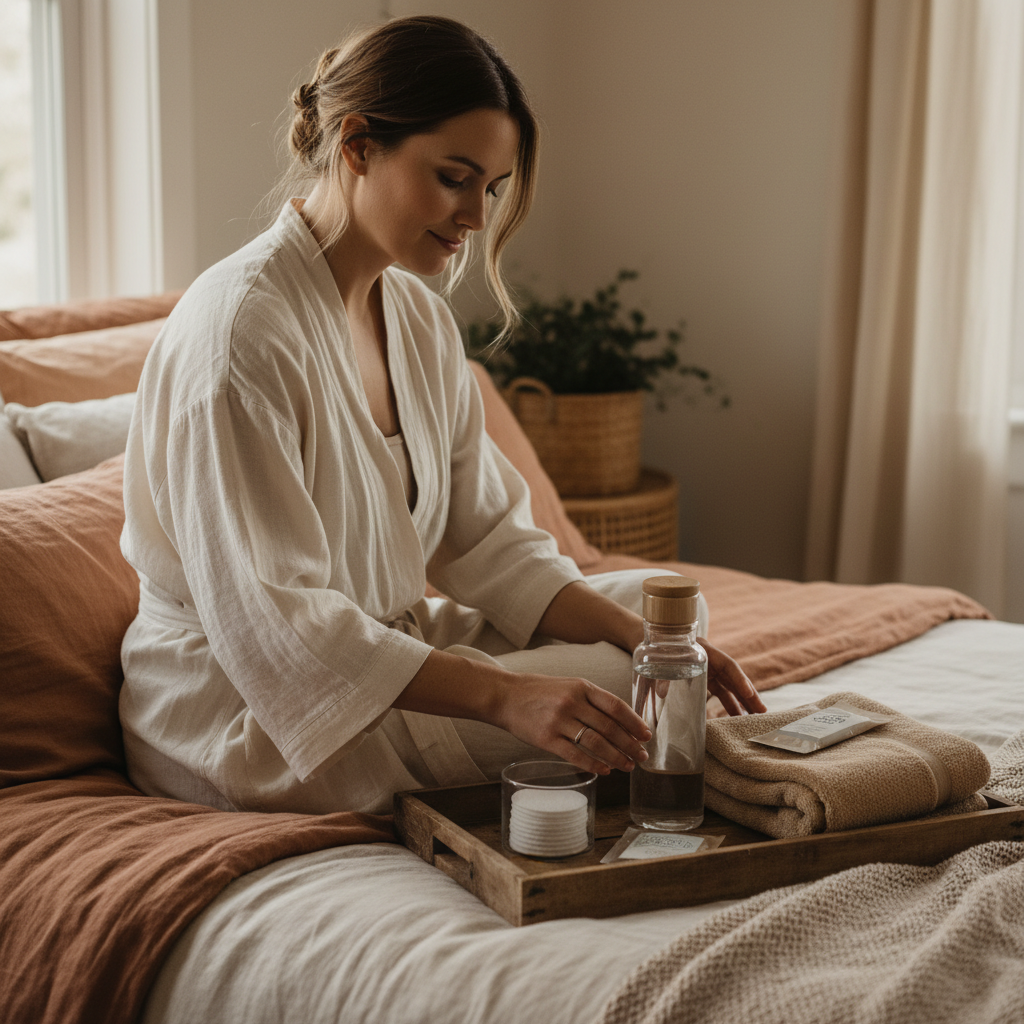
If you are searching for witch hazel postpartum, you are probably trying to solve a very specific problem: you want relief after birth, but you do not want to put the wrong thing on already sore, swollen, or stitched tissue. That is a reasonable concern. Witch hazel can be a useful part of postpartum care for some moms, especially for external soreness, swelling, and hemorrhoid discomfort. But it is not a cure-all, and it is not the right answer for every postpartum symptom.
Here is the short version: many women use alcohol-free witch hazel pads or wipes for a few days to a few weeks after a vaginal birth to soothe the perineal area or hemorrhoids. The safest approach is external use only, simple ingredients, and a low threshold for calling your OB-GYN or midwife if pain is severe, bleeding is heavy, symptoms are getting worse, or you think you may have an infection. This guide walks through what witch hazel may help with, how long to use witch hazel pads after birth, what to avoid, and when to stop self-treating.
Key Takeaways
- Witch hazel may help soothe external postpartum soreness, swelling, and hemorrhoid discomfort, especially after vaginal birth.
- For postpartum use, alcohol-free and fragrance-free products are usually the safest place to start.
- Many moms use witch hazel most in the first 1 to 2 weeks, then taper as symptoms improve.
- Do not apply it inside the vagina, and do not use it on an open or infected C-section incision unless your clinician specifically tells you to.
- Severe pain, fever, foul-smelling discharge, rapidly worsening swelling, heavy bleeding, or concerns about wound healing need medical care, not just another pad.
Quick Answer: Is Witch Hazel Good for Postpartum?
Yes, witch hazel for postpartum can be helpful when the problem is external irritation: perineal soreness after a vaginal delivery, swollen hemorrhoids, or the tender, puffy feeling many moms notice in the first days after birth. What it usually does best is cool, soothe, and temporarily calm irritated tissue. What it does not do is treat infection, repair a severe tear on its own, replace pain medicine your clinician recommended, or explain symptoms that are getting worse instead of better.
| Postpartum concern | Can witch hazel help? | Typical use window | Important caution |
|---|---|---|---|
| Perineal soreness after vaginal birth | Often yes, for cooling and comfort | Usually first few days to 2 weeks | Use externally only and stop if it stings or irritates |
| Stitches or small tears | Sometimes, if your clinician says topical care is appropriate | Varies by healing progress | If pain, odor, or swelling worsens, get checked |
| Postpartum hemorrhoids | Often yes, especially with pads or wipes | Days to a few weeks | Persistent bleeding or severe pain needs medical review |
| C-section incision concerns | Usually not directly on the incision itself | Case by case | Do not put it on an open, draining, or infected incision unless told to do so |
If you want the simplest answer, it is this: witch hazel postpartum care makes the most sense as a gentle external comfort measure, not as the main plan for symptoms that are severe, unusual, or persistent.
What Does Witch Hazel Do Postpartum?
A lot of moms are really asking what does witch hazel do postpartum. In practical terms, it is used because it can feel cooling and calming on irritated skin and swollen tissue. That is why it shows up so often in postpartum pads, wipes, foams, and hemorrhoid products. The main appeal is not that it is miraculous. It is that it is simple, widely available, and easy to use during a period when almost everything down there can feel tender.
In postpartum recovery, witch hazel is most commonly used for:
- Perineal soreness: the bruised, swollen, or tender feeling after a vaginal birth
- Hemorrhoid discomfort: burning, itching, pressure, or swelling around the rectal area
- General external irritation: when the skin feels hot, rubbed, or inflamed after pads, stitches, or frequent bathroom trips
What matters is the match between the product and the problem. If you are dealing with external soreness or hemorrhoids, witch hazel may be worth trying. If you have worsening pain, a foul smell, fever, pus, significant wound separation, or symptoms that make you think something is wrong, you need a clinician to look at the bigger picture.
How Long to Use Witch Hazel Pads After Birth
This is one of the highest-value questions for this page: how long to use witch hazel pads after birth. The real answer depends on what you are using them for and how your recovery is going, but the table below is a practical, conservative guide.

| Recovery stage | Vaginal soreness | Stitches / minor tears | Hemorrhoids | C-section |
|---|---|---|---|---|
| First 24 to 72 hours | Often helpful for short-term comfort | Only if your clinician has not told you to avoid topical products | Commonly used during flare-ups | Usually not for the incision |
| Days 4 to 14 | Use as needed if symptoms are improving | Check healing progress if pain is not easing | Still reasonable for many moms | Use around intact skin only if approved |
| Weeks 2 to 6 | Many moms are tapering off by now | Ongoing need may justify a postpartum exam | Some continue using it if hemorrhoids are still irritated | Not a standard incision-healing treatment |
| Beyond 6 weeks | Usually no longer needed for routine soreness | Persistent pain needs evaluation | If symptoms keep recurring, ask about other hemorrhoid treatment options | Use clinician guidance, not guesswork |
The key principle is not to keep using any postpartum comfort product indefinitely just because it seems harmless. If you still feel like you need frequent witch hazel use several weeks later, ask why. Sometimes the answer is simple. Sometimes it is hemorrhoids, pelvic floor strain, a healing issue, or another postpartum problem that deserves more direct care.
First 24 to 72 hours
This is when many moms find witch hazel most helpful. Cooling pads or wipes can feel especially good when the perineum feels swollen and raw after delivery.
Days 4 to 14
If your symptoms are gradually easing, it is reasonable to keep using witch hazel as needed. If things are not clearly improving, that is more important than the calendar.
Weeks 2 to 6
Some moms still reach for it during this stage, especially for hemorrhoids. But by this point, you should expect a general trend toward improvement, not escalation.
When not to keep self-treating
Do not let a soothing product talk you into ignoring red flags. If you have severe pain, heavy bleeding, fever, wound concerns, worsening swelling, or symptoms that feel wrong, switch from self-care mode to clinician mode.
Alcohol-Free Witch Hazel for Postpartum: What to Choose
If you only take one buying tip from this article, make it this: choose alcohol-free witch hazel for postpartum use whenever possible. Postpartum tissue is already sensitive. Products that contain alcohol can sting, dry, or feel harsher than they are worth.

When comparing products, look for these features first:
- Alcohol-free: especially important for sore postpartum skin
- Fragrance-free or very simple ingredients: less likely to irritate already stressed tissue
- External-use format: pads, wipes, or foam that is clearly meant for postpartum or hemorrhoid-area comfort
- Short ingredient list: fewer extras means fewer things to react to
Be more cautious with products that are heavily scented, menthol-heavy, or packed with essential oils just because they sound soothing. "Natural" is not the same as postpartum-friendly. A product can be botanical and still irritate broken-down or inflamed skin.
If your search is really about best witch hazel for postpartum, the best choice is usually not the fanciest one. It is the one that is simple, alcohol-free, easy to use, and well tolerated by your skin.
How to Use Witch Hazel Safely After Birth
How you use witch hazel matters as much as what you buy. The safest postpartum approach is usually gentle external use.
Pads or pad liners
Place alcohol-free witch hazel pads or liners on top of your postpartum pad so they rest against the sore area. This is often the easiest option when you want contact time without needing to spray or wipe repeatedly.
Wipes after the bathroom
Some moms prefer wipes for hemorrhoids or for gentle external dabbing after rinsing with a peri bottle. Use a soft touch. This is not the time to scrub irritated tissue.
Foam or liquid on a pad
If you use a liquid or foam product, apply it to a pad or to clean tissue first rather than soaking the entire area. More product is not automatically better. Start small and see how your skin responds.
What to avoid
- Do not insert witch hazel internally unless a clinician explicitly told you to use a specific product that way.
- Do not put it on an open, draining, or infected wound.
- Do not keep using it if it burns, causes a rash, or seems to make irritation worse.
- Do not rely on it alone when you clearly need medical advice.
If you had a more complicated birth, including extensive tearing, significant swelling, or wound concerns, ask your OB-GYN or midwife what topical care they prefer. Postpartum recovery is not one-size-fits-all.
Do You Need Witch Hazel After a C-Section?
This is a smart question because C-section recovery changes the answer. Do you need witch hazel after a C-section? Not usually for the incision itself. Witch hazel is much more naturally matched to external perineal or hemorrhoid discomfort than to a fresh abdominal surgical wound.

| Scenario after C-section | Usually reasonable | Ask your clinician first | Usually avoid |
|---|---|---|---|
| Hemorrhoids after C-section | Yes, often | If symptoms are severe or bleeding | - |
| Intact skin near the incision | Sometimes | Yes, especially if the area is still tender or healing | - |
| Open, draining, red, or worsening incision | - | - | Yes. This needs medical review, not a home topical experiment. |
So the answer is not "never" after a C-section. It is just more limited. If your concern is hemorrhoids or external rectal discomfort, witch hazel may still be useful. If your concern is the incision, use your surgical aftercare plan and ask before improvising.
Can You Use Witch Hazel While Pregnant? (And Why This Guide Focuses on Postpartum)
This page ranks for pregnancy-flavored queries too, including can you use witch hazel while pregnant. That is a different question from postpartum care. This guide focuses on after-birth topical use, where the most common use cases are perineal soreness and hemorrhoids.
If you are pregnant and wondering about witch hazel, talk with your prenatal clinician about why you want to use it. A simple hemorrhoid question in pregnancy is not the same as unexplained irritation, discharge, or pain. The same product may be tolerated differently depending on the skin, the location, and the reason you are using it. In other words: do not assume that a postpartum answer automatically applies during pregnancy.
Best Witch Hazel Products for Postpartum: How to Compare Formats
Instead of chasing a generic "best brand" answer, it is more useful to compare products by format and fit.
| Format | Best for | Pros | Watch-outs |
|---|---|---|---|
| Pre-soaked pads or liners | Perineal soreness after vaginal birth | Easy, consistent, good contact time | Bulky products can feel uncomfortable for some moms |
| Wipes | Hemorrhoids or bathroom clean-up | Simple, portable, easy to use externally | Some wipes contain fragrance or other irritants |
| Foam or spray | Moms who want fast application | Quick to apply, easy to layer with pads | Check ingredients carefully; some formulas are more irritating |
| Liquid witch hazel on your own pad | Low-cost, flexible use | You control amount and application | Ingredient quality matters more because you are choosing the bottle yourself |
If you want the easiest decision framework, use this order:
- Start with alcohol-free.
- Choose fragrance-free if your skin is easily irritated.
- Pick the format that matches the problem: pads for contact time, wipes for hemorrhoids, foam or spray for quick external application.
- Stop using a product that feels worse just because other moms love it.
When to Call Your Doctor Instead of Reaching for Another Pad
Witch hazel belongs in the comfort-care category. It does not belong in the delay-care category. Contact your OB-GYN, midwife, or postpartum care team if you have:
- fever or chills
- foul-smelling discharge
- severe or worsening pain instead of gradual improvement
- heavy bleeding or large clots
- increasing redness, drainage, or separation around stitches or an incision
- new dizziness, nausea, or systemic symptoms that feel out of proportion to a normal postpartum day
If your postpartum symptoms are broader than local soreness, Mamazing also has guides on postpartum nausea and postpartum digestive issues. And if recovery is affecting your mood, sleep, or sense of control, it is worth reading about postpartum depression symptoms and postpartum rage too.
Frequently Asked Questions
Is witch hazel good for postpartum?
It can be. Witch hazel is often used for external postpartum soreness, swelling, and hemorrhoid discomfort. It is most helpful as a comfort measure, not as treatment for severe, worsening, or unusual symptoms.
How long should I use witch hazel pads after birth?
Many moms use them most in the first few days through the first 2 weeks, then taper as symptoms improve. If you still need them frequently several weeks later, or symptoms are not improving, ask your clinician what else may be going on.
Is alcohol-free witch hazel better for postpartum?
Usually yes. Alcohol-free products are generally less likely to sting or dry out already sensitive postpartum tissue, which is why they are usually the safer starting point.
Can I use witch hazel with stitches after birth?
Sometimes, but use caution. Small tears or stitches may tolerate gentle external witch hazel care, but if your clinician gave specific wound instructions, follow those. Worsening pain, odor, drainage, or swelling needs medical review.
Do you need witch hazel after a C-section?
Not usually for the incision itself. But if you have hemorrhoids or external rectal discomfort after a C-section, witch hazel may still be useful. For the incision, do not improvise on open or suspicious-looking skin without clinician guidance.
What is the best witch hazel for postpartum?
The best postpartum witch hazel product is usually alcohol-free, fragrance-free, simple in ingredients, and offered in a format that matches your need, such as pads for contact time or wipes for hemorrhoids.
Final Takeaway
Witch hazel postpartum care can be genuinely useful, but the best way to use it is with realistic expectations. Think of it as a gentle external tool for soreness, swelling, and hemorrhoid discomfort, not as a substitute for evaluation when recovery is going off track.
If you want the simplest rule set, use alcohol-free products, keep use external, taper as healing improves, and get checked sooner rather than later when symptoms are severe, persistent, or confusing. That is the version of postpartum self-care that is actually protective.
Painful Urination After C-Section (1-2 Weeks): Is It Normal, UTI Signs, and When to Worry
Fundal Massage After Birth: Why They Push on Your Stomach and If You Need It