
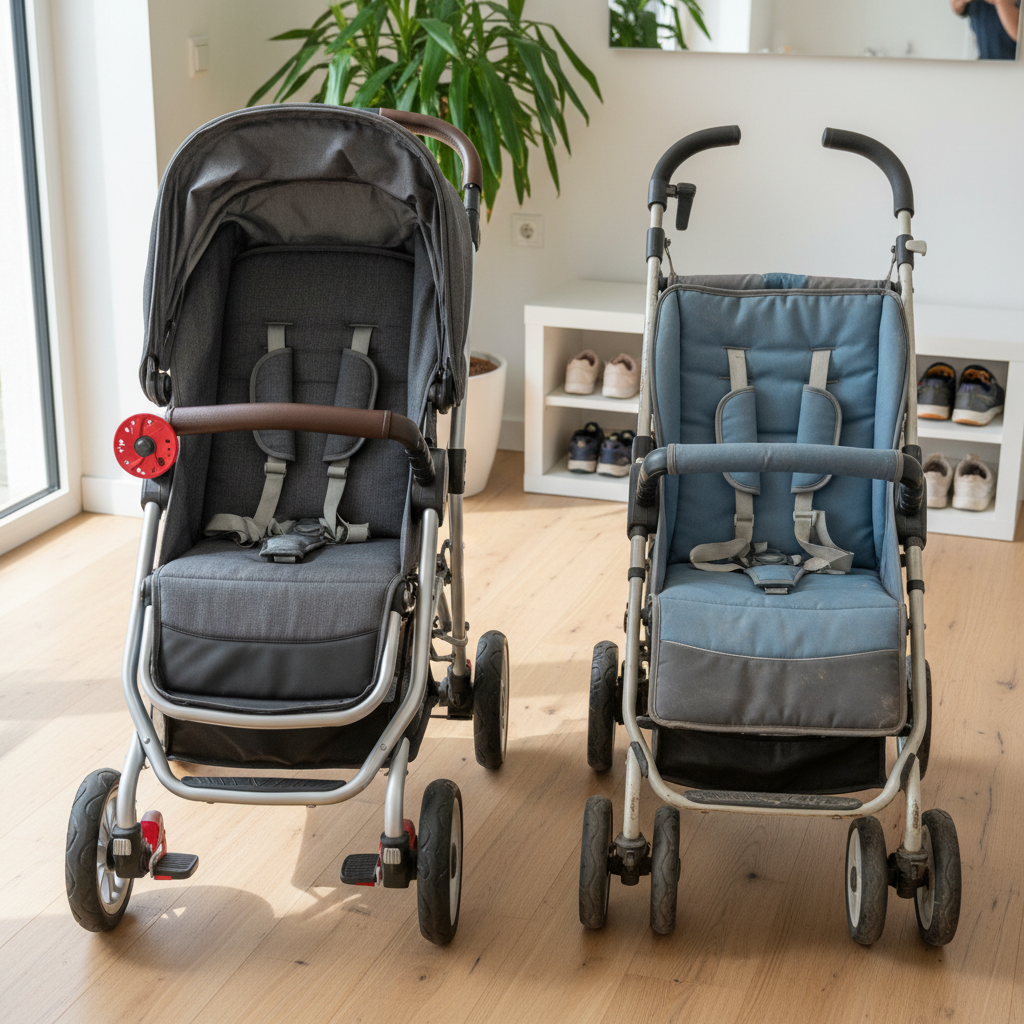
If you are debating a used stroller vs a new one, the short answer is this: a secondhand stroller can be a smart buy, but only if you treat it like safety equipment rather than a bargain find. A used stroller is usually worth buying when the model is recent, the seller can identify the exact make and manufacturing date, there is no active recall, the brakes and harness work properly, and the frame shows no signs of bending, cracking, rust, or missing parts. If any of those pieces are unclear, the lower price stops being a deal.
That is why the real question is not simply “new or used?” It is “can you verify that this stroller is still safe, complete, and practical for your routine?” The U.S. Consumer Product Safety Commission guidance for carriages and strollers highlights exactly the kinds of failures parents should care about: brakes, restraint systems, latching and folding mechanisms, structural integrity, stability, and wheels. Those are the deal-making parts on a used stroller too.
So if you want the practical version, here it is: buy used when you can inspect it carefully, verify its history, and still save meaningful money. Buy new when you want warranty support, guaranteed compliance labeling, easier replacement parts, or peace of mind for daily heavy use. Mamazing works with plenty of parents who want that trade-off explained clearly rather than emotionally, so this guide walks you through what is actually worth checking before you say yes.
Are Used Strollers Worth Buying?
Yes, used strollers are often worth buying when you need solid function for a shorter season of life and the stroller still passes a strict safety check. Many families use a stroller hardest in a fairly concentrated window, then sell it before the frame, canopy, or wheels are truly worn out. That is why the secondhand market can be full of perfectly usable options for grandparents, travel-only households, daycare drop-off routines, or families who want a backup stroller instead of one premium do-everything model.
The biggest upside is not just the lower sticker price. It is flexibility. A used stroller can let you try a category you are not fully committed to yet: maybe you want a compact stroller for errands, a cheaper spare for the car trunk, or something practical while you figure out whether your baby really tolerates longer stroller outings. In that case, paying far less for a well-kept model can be completely reasonable.
Used can also make sense when you are shopping above your new-product budget. A sturdier mid-range stroller bought secondhand can be a better real-world choice than a flimsy, ultra-cheap new one that feels unstable, folds awkwardly, or gets frustrating after a month. That is especially true if the used model still has smooth steering, intact fabric, and easy-to-find replacement accessories.
But not every cheap stroller is a smart buy. A bargain becomes expensive when you end up paying for deep cleaning, replacement wheels, missing harness pads, or a seat that reclines poorly and no longer suits your child. If the stroller is too old to verify, too worn to trust, or too incomplete to use comfortably, new is often the better value even at a higher price. That is the real decision framework: do not compare used price to new price alone; compare usable life, safety confidence, and total cleanup or repair effort.
Is It Safe to Buy a Used Stroller?
It can be safe to buy a used stroller, but only if you can confirm that the specific stroller in front of you is still safe to use. That distinction matters. “This brand is popular” is not enough. “It looks clean” is not enough. Safety depends on the exact model, its age, whether it was ever recalled, how it was stored, whether any parts were replaced incorrectly, and whether the key functions still work the way they should.
The American Academy of Pediatrics, through HealthyChildren’s stroller safety guidance, advises parents to focus on easy-to-use brakes, a stable base, locking mechanisms, a five-point harness, and practical habits such as not hanging heavy bags from the handles. Those tips are even more important with secondhand gear, because small weaknesses become more obvious after repeated folding, storage, loading, and curb use.
There is one non-negotiable rule: check for recalls before you buy. The CPSC says in its online selling guidance that selling recalled products is unlawful, and it directs consumers to search recalls before buying or selling. If a seller cannot tell you the exact model number and manufacturing date, you may not be able to do that check accurately. At that point, the stroller is already failing one of the most important safety tests.
So yes, secondhand can be safe. But safe secondhand gear is traceable, inspectable, and complete. If the history is fuzzy, the hardware feels weak, or the seller expects you to “trust that it is fine,” walk away.
How to Check a Used Stroller Before You Buy
If you want to know how to tell whether a used stroller is safe to buy, start with verification before you start bargaining. You are not buying decor. You are buying a moving piece of child equipment with folding parts, rolling parts, and restraint parts. Check it in a bright place, put your hands on everything, and assume that anything loose, sticky, or inconsistent deserves a second look.
Start with the model name, manufacturing date, and recalls
Start by asking for the full brand name, model name, and manufacturing date label. CPSC stroller guidance notes that durable infant products should carry identifying information such as the model designation and manufacturing date, which helps you verify whether the product still aligns with current support information and recall notices. If the label is missing, unreadable, or intentionally removed, treat that as a serious warning sign.
Then search the exact model on the CPSC recalls page. If the stroller was recalled and the seller cannot clearly show that the official remedy was completed, do not buy it. This is one of the easiest ways to avoid a risky secondhand purchase, and it only takes a minute. While you are there, check whether the manual is still available online. A stroller without a manual is not automatically unsafe, but a stroller that is impossible to identify, register, or troubleshoot becomes much harder to trust.
Test the brakes, harness, fold lock, frame, and wheels
Next, test the stroller the way you would actually use it. Lock and unlock the parking brake more than once. Fold and unfold the frame. Tug gently on the seat, canopy, handlebar, and footrest. Push the stroller forward, turn sharply, and stop suddenly. You are looking for hesitation, drift, wobble, squeaking, or resistance that feels mechanical rather than cosmetic.
- Make sure the brakes engage firmly and do not slip on a smooth floor.
- Check that the stroller opens fully and locks into position without forcing it.
- Inspect the harness buckle, strap adjustment points, and crotch strap anchor for damage or missing pieces.
- Spin the wheels and look for uneven wear, looseness, or a wheel that rubs against the frame.
- Look at hinge points closely for cracks, rust, bent metal, or signs that screws have been swapped out.
A stroller can look stylish and still fail this test badly. Cosmetic scuffs are fine. Structural uncertainty is not.
Look for the red flags that should end the deal immediately
Finally, check the soft goods and the seller’s story. A musty smell can point to poor storage or mildew. Stiff fabric may mean the stroller was left wet and dried poorly. Deep-set grime around buckles or seat seams can mean more hidden wear than you first noticed. Ask whether the stroller was ever gate-checked on flights, stored in a garage, involved in a crash while attached to a travel system, or repaired with non-original parts.
- Walk away if the frame is cracked, bent, or visibly asymmetrical.
- Walk away if the brakes are weak, inconsistent, or difficult to engage.
- Walk away if the harness is incomplete, frayed, or does not tighten properly.
- Walk away if screws, clips, or seat supports are missing.
- Walk away if mold, mildew, rust, or a strong odor suggests long-term poor storage.
- Walk away if the seller cannot identify the model or says recall history is “probably fine.”
Those are not tiny imperfections. They are signs that the stroller may no longer perform predictably when your child is buckled in.

When Should You Walk Away From a Secondhand Stroller?
You should walk away from a secondhand stroller whenever the product creates more doubt than savings. The easiest time to waste money is when the price is low enough to make you rationalize obvious issues. Parents do this all the time with “just needs a little cleaning” listings that turn out to need replacement wheels, replacement fabric, a new bumper bar, and far more patience than expected.
Skip the stroller if it is very old, visibly unstable, or impossible to verify. Skip it if the seller describes it as “good except for the brake,” “missing one small part,” or “folds better once you get used to it.” Those are not harmless quirks. They are clues that the stroller is already outside the simple, dependable experience you want from gear you use around curbs, parking lots, elevators, and distracted mornings.
You should also walk away if your use case is intense. If this will be your everyday primary stroller, used across rough sidewalks, school runs, travel days, and frequent folding, a questionable secondhand option can become frustrating very quickly. In that situation, durability, spare parts, and warranty support matter more than getting the lowest purchase price.
And if your baby is still very young and you need specific compatibility with a bassinet, infant insert, or travel system, be extra careful. Older used models often come with partial accessories, discontinued adapters, or unclear compatibility claims. That confusion alone can erase the convenience you thought you were buying.

New Stroller vs Used Stroller: Which One Makes More Sense?
A new stroller makes more sense when you want certainty, daily reliability, and full support. A used stroller makes more sense when your priority is value and you are willing to inspect carefully. Neither choice is automatically smarter. The better option depends on how long you plan to use it, how often you will fold and transport it, and how much uncertainty you are willing to manage.
| Question | Used stroller is often better | New stroller is often better |
|---|---|---|
| Budget pressure | You want solid function for less and can inspect in person. | You prefer predictable cost over possible cleanup or repair surprises. |
| How often you will use it | Backup stroller, travel stroller, grandparents’ house, short-term phase. | Daily primary stroller for errands, naps, and long walks. |
| Need for warranty and support | You are comfortable without it. | You want warranty coverage, manuals, and easier replacement parts. |
| Compatibility needs | Your child is older and you do not need special adapters. | You need bassinet, infant seat compatibility, or a full system from day one. |
| Your tolerance for uncertainty | You are happy to inspect, clean, and verify details. | You want a straightforward purchase with fewer unknowns. |
In plain English, buy used when the stroller is simple, sturdy, and easy to verify. Buy new when the stroller has to work hard for your family from day one and you do not want to troubleshoot gear history. If you already know you prefer a compact everyday model, Mamazing’s guide to choosing your first foldable stroller can help you narrow down what matters most in a new purchase.

Where to Buy a Used Stroller Safely
The safest place to buy a used stroller is any place where you can inspect it properly and ask direct questions without pressure. Local parent groups, neighborhood marketplaces, consignment shops that accept children’s gear, and trusted family referrals can all work. The best listing is not the one with the prettiest photos. It is the one with the clearest model information, the cleanest history, and a seller who answers practical questions without getting defensive.
Ask for photos of the label, brake area, wheel condition, seat fabric, and folded frame before you meet. Ask whether all original parts are included. Ask whether it was stored indoors. Ask whether it was ever gate-checked, repaired, or used heavily on rough terrain. A good seller usually gives detailed answers because they know the gear. A vague seller usually gives you more risk than value.
If you shop online, insist on enough information to search recalls before you hand over money. That matters because secondhand listings often move quickly, and many buyers feel pressure to decide based on price alone. Slow the decision down. If the seller will not wait long enough for you to verify the model and inspect it, that is useful information too.
Once you bring the stroller home, clean it thoroughly, recheck all hardware, and practice folding and braking it before you put your child in. That first dry run catches a surprising number of issues that are easy to miss when you are meeting a seller in a parking lot.
What Makes a Used Stroller a Better Bet?
The best secondhand strollers are usually the least dramatic ones: mainstream models with straightforward folds, common replacement parts, intact harness systems, and a design that still feels stable several years after launch. In general, a used stroller is a better bet when the seller has owned it from new, used it for one child, stored it indoors, and still has the manual or can identify the exact model without guessing.
It also helps when the stroller has not been heavily customized. Aftermarket hooks, clips, cushions, liners, or improvised repairs can make a listing feel upgraded, but they often make inspection harder. You want the stroller itself to be trustworthy before you care about accessories.
Simple urban or travel strollers can be especially good secondhand buys if the fold is still crisp and the wheels track well. On the other hand, if you need a more specialized newborn setup, you may be better off comparing new options, including newer bassinet-compatible models such as those discussed in this roundup of the best bassinet strollers for new parents. That is where support, compatibility, and clear product history often matter more than saving money upfront.
If you already own a stroller and just want to get more out of it, Mamazing also has practical ideas in these stroller hacks every parent should know. Sometimes the smarter move is not replacing gear at all, but making your existing setup easier to live with.
If You Decide New Is the Better Choice
If you read this and realize you would rather buy new, that is not overcautious. It may simply mean your routine needs something more dependable. New can be the better call if you walk a lot, fold the stroller daily, need infant compatibility, or want warranty support and replacement parts without detective work.
In that case, focus on the same fundamentals that matter in the used market: good brakes, a secure harness, smooth folding, stable steering, and a setup that actually matches your family’s lifestyle. Fancy extras matter less than reliability. A stroller you can open one-handed, steer easily, and trust on everyday routes is usually a better investment than one with a longer feature list but weaker real-life usability.
If you are ready to compare a modern lightweight option, you can start with Mamazing’s Ultra Air X travel stroller. The point is not that every family needs a new stroller. It is that once you know what a safe, practical stroller should feel like, it becomes much easier to judge whether a secondhand listing is truly worth it.
Frequently Asked Questions
Are used strollers worth buying?
Used strollers are worth buying when the model is still easy to identify, has no unresolved recalls, all major safety features work properly, and the savings are large enough to justify buying without a warranty.
Is it safe to buy a used stroller?
It can be safe to buy a used stroller if you can verify the exact model, check recall history, test the brakes and harness, and confirm that the frame, wheels, and fold lock are still working correctly.
How do you check if a used stroller is safe?
Check the model name and manufacturing label first, search for recalls, then test the brakes, harness, folding mechanism, frame, and wheels in person while also looking for rust, cracks, missing parts, mildew, or signs of unsafe repairs.
When should you not buy a secondhand stroller?
You should not buy a secondhand stroller if the seller cannot identify the model, the stroller has been recalled without proof of remedy, the brakes or harness are faulty, or the frame shows cracks, bending, rust, mold, or missing components.
Where can I buy a used stroller safely?
You can buy a used stroller more safely through local sellers, parent groups, or resale shops that let you inspect the stroller carefully, ask questions about its history, and verify the model before paying.
Do strollers expire?
Strollers do not have one universal expiration date, but older strollers become harder to trust when parts are discontinued, safety guidance changes, labels disappear, or wear makes the brakes, frame, wheels, and harness less dependable.
If you are still choosing between used and new, keep the rule simple: savings should only come after safety is clear. If you cannot verify the stroller confidently, move on. And if you would rather skip the uncertainty entirely, Mamazing can help you compare newer stroller options with fewer question marks and a better fit for everyday family life.
When to Transition From Bassinet to Crib and Choose the Best Travel Stroller
Stroller Sizes and Prices Guide: Dimensions, Costs, and How to Choose