
- by xiaoyuyang
Flying with a Baby for the First Time: Practical Tips for a Smooth First Flight
- by xiaoyuyang
If you are flying with a baby for the first time, the good news is that most trips go better than parents expect. The hard part is not one single moment on the plane. It is the combination of timing, packing, airport logistics, feeding, sleep, and your own stress level. Once you simplify those decisions, your baby's first flight becomes much more manageable.
Here is the short answer most parents want first: a healthy full-term baby can usually fly after the newborn period, but many families find that waiting until around 2 to 3 months feels easier because feeding is more established and babies handle the airport environment better. The best flight is usually the one that fits your baby's most reliable sleep-and-feeding window, not the one that looks cheapest or most convenient on paper.
This guide walks you through what matters most before your first flight with baby: when babies can fly, the best time to book, whether to use a lap infant or buy a seat, what to pack, how to get through TSA, and how to handle takeoff, landing, sleep, and crying without spiraling. You do not need a perfect trip. You need a plan that holds up when the day gets messy.
What matters most on your baby's first flight is not fancy gear or complicated hacks. It is choosing a realistic flight, protecting feeding and sleep as much as you can, and reducing the number of decisions you have to make while you are tired and holding a baby in public.
If you get those five decisions right, the rest of the trip becomes much easier to improvise.
Most healthy babies can fly once they are past the earliest newborn period, but the easiest timing depends on your baby's age, health, and the kind of trip you are taking. According to HealthyChildren from the American Academy of Pediatrics, air travel is generally safe for most full-term, healthy babies after the first week, though waiting until around 2 to 3 months is ideal when possible because infants are less vulnerable to early infections and parents often have a better routine by then.
A healthy full-term newborn can often fly sooner than many parents expect, but that does not automatically mean it is the easiest choice. If your trip is optional, waiting a little longer often gives you a calmer experience. Babies who are just a few weeks old still have highly unpredictable feeding, sleep, and soothing patterns, and parents are usually still recovering too. That combination can make even a short flight feel bigger than it looks on the itinerary.
If your baby is closer to 2 or 3 months, the trip may feel easier because feeds are usually more established, wake windows are a little more predictable, and you have had more time to learn what actually calms your baby. That matters as much as the plane itself.
You should check with your pediatrician before booking if your baby was born prematurely, has a heart or lung condition, has had recent illness, or still needs close medical follow-up. The same goes for babies who have had feeding issues, low birth weight concerns, or any condition that has made routine outings harder than expected.
If this is an international trip, it is also smart to think beyond the flight itself. The CDC's guidance for traveling with children recommends preparing early for destination-specific health questions, including vaccines, medications, and environmental risks. That is especially important if your trip involves long-haul flying, multiple airports, or a destination where medical care may be harder to access.
It may be smarter to delay the trip if your baby is currently sick, struggling with feeding, recovering from a recent medical issue, or at an age where every day still feels chaotic and you have flexibility to wait. Delaying is not overcautious. It is often the most practical decision when the trip is optional and the current phase would make travel much harder than necessary.
If the trip is essential, your goal shifts from "Is this the perfect time to fly?" to "What needs to be true for this to feel manageable?" That is a much more useful question for real family travel.
The best time to fly with a baby is the time that best matches your baby's most reliable feeding-and-sleep rhythm while keeping the trip as short and simple as possible. There is no universal best hour for every family. A morning flight can be great for one baby and a disaster for another if it cuts into the easiest nap of the day or requires a rushed 4 a.m. wake-up.
Morning flights often work well because delays are usually less severe earlier in the day and both parents and babies tend to have more patience before the day gets long. But the tradeoff is the early airport start. If getting out the door ruins the whole morning, the "better" flight time on paper may not be better for your family at all.
Nap-time flights can work beautifully if your baby already naps predictably in motion or on a caregiver. They can also backfire if your baby fights sleep in bright, noisy places. Red-eyes sound tempting because parents imagine everyone sleeping, but they can be rough if your baby sleeps lightly, if you are using a lap infant setup, or if you arrive completely exhausted and still need to function the next day.
For many families, the best time of day to fly with a baby is simply a flight that avoids the most fragile part of the baby's schedule and does not create too many transitions before boarding. If you have to choose between a cheaper flight with a connection and a simpler nonstop that fits your baby's rhythm, the simpler option is often worth more than it looks.
The best flight timing changes with age. Very young babies may sleep through more of the airport and flight if you keep them fed and comfortable. Babies in the 4- to 8-month range may be more aware of the environment and need more active soothing. Older babies and young toddlers often do better when the schedule protects movement, feeding, and one reliable sleep window, not just the plane time itself.
If you are flying with a 3-month-old for the first time, try to book around a period when your baby is usually easiest to feed and settle, not necessarily the period when you hope they will magically nap the entire flight. That small mental shift helps you plan more realistically.
The biggest difference on a baby's first flight usually happens before you even leave home. Route, seat setup, and connection strategy shape how much stress you will carry into the airport and how many recovery options you have once things stop going to plan.
If you can afford it, booking a seat for your baby is often the more comfortable and safer setup, especially on longer flights. The FAA says the safest place for a child under 2 on an airplane is in an approved child restraint system or device, not on an adult's lap. That does not mean a lap infant ticket is forbidden. It means you should be honest about what kind of flight you are taking and how manageable it will feel to hold your baby the whole time, including turbulence and delays.
A lap infant setup can work on a short, simple flight with a young baby who still feeds and sleeps easily on you. Booking a seat becomes much more valuable on longer flights, with older babies who need more space, or when you already know you will be less stressed if you can put your baby down safely for part of the trip.
When you are flying with a baby for the first time, your first priority is fewer transitions. Every connection adds extra walking, waiting, re-boarding, diaper decisions, feeding timing, and opportunities for the day to go sideways. Nonstop flights are not always possible, but when the price difference is reasonable, they often buy you more sanity than almost anything else in the booking process.
Seat choice matters too. An aisle seat gives you easier access for diaper changes and walking a fussy baby, while a window can reduce visual distraction for some babies and toddlers. If you are traveling with another adult, an aisle and window in the same row can sometimes leave the middle open on lighter flights, though that is never guaranteed. For international flights, look into bassinet rows early because availability is limited and rules vary by airline.
Before you finalize anything, check airline rules for lap infants, bassinets, strollers, and gate-check policies. Airline rules are not interchangeable, and small policy differences can change what feels realistic on travel day.
Your carry-on should be built for delays, not just for the scheduled flight time. That means enough diapers, wipes, feeding supplies, backup clothes, and easy comfort items to survive if boarding is late, the plane sits on the tarmac, or baggage takes longer than expected.
The goal is not to bring your whole nursery onto the plane. It is to make sure the next two hours of needs are always easy to reach.

One of the biggest first-flight stress points is not the plane. It is worrying that you will get stuck at security with formula, breast milk, stroller gear, or too many baby items. The easiest fix is to know the rules in advance and pack so screening is straightforward.
According to TSA's traveling with children guidance, you must carry your child through the metal detector, and strollers and child carriers usually need to go through the X-ray machine. TSA also states that formula, breast milk, toddler drinks, baby food, and cooling accessories are allowed in reasonable quantities, though they may need additional screening. That means you should separate them clearly in your bag and tell the officer about them before screening starts.
Give yourself more time than you think you need. First-flight airport stress usually comes from rushing, not from the rules themselves. If you babywear through the terminal, be ready for the possibility that an officer may ask for extra screening depending on the carrier and the checkpoint setup. If you are using a stroller, keep the fold simple and remove loose items before you reach the front of the line.
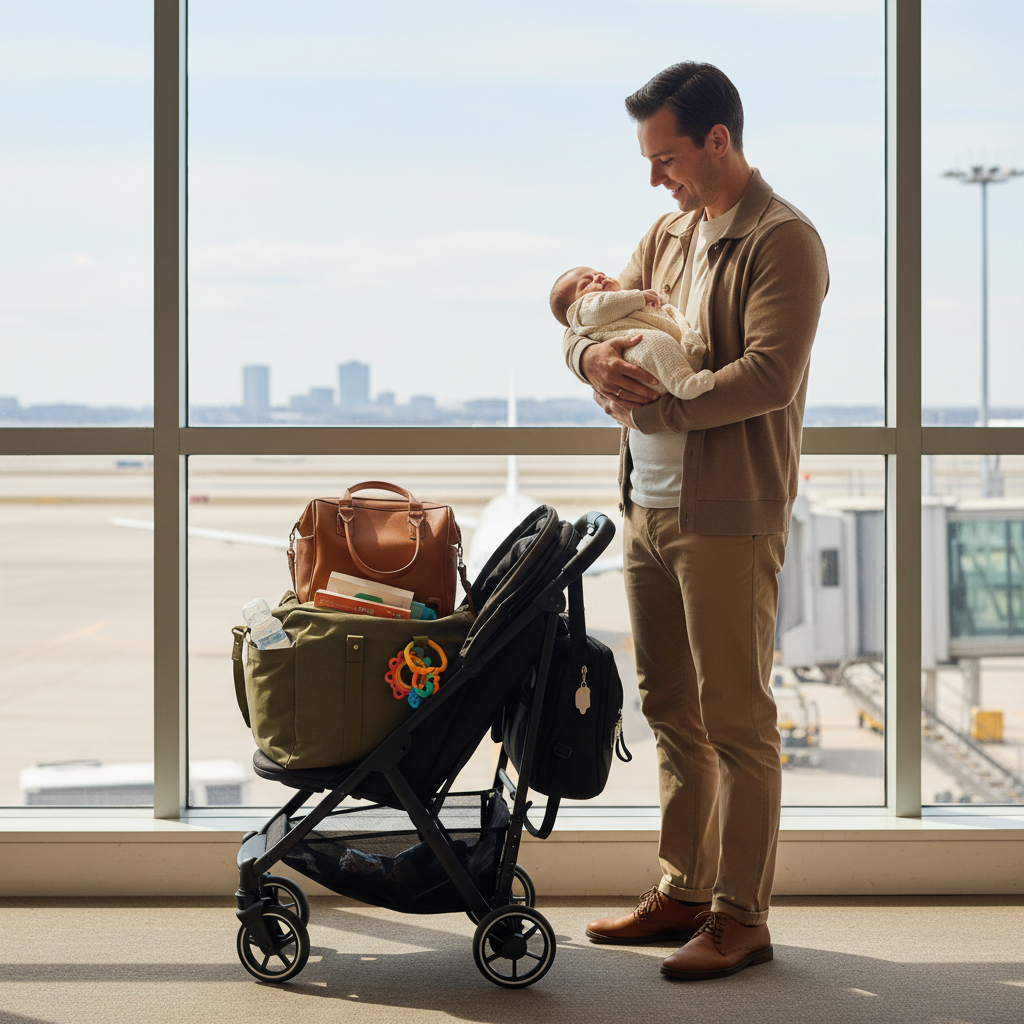
This is also where a compact stroller can help. If you want to keep airport movement lighter, Mamazing's guide to the best travel stroller features for easier journeys is worth reading before you travel. A stroller that folds quickly and moves well through terminals can remove a surprising amount of friction from the day.

During the flight, your job is not to stop every sound your baby makes. It is to stay one step ahead of pressure changes, hunger, overtiredness, and discomfort. Once you think in that order, the most common in-flight problems become easier to manage.
Takeoff and landing are the two moments parents worry about most because pressure changes can make babies uncomfortable. Feeding, offering a bottle, breastfeeding, or using a pacifier during ascent and descent can help because swallowing supports pressure equalization. You do not need a complicated ritual. You just want some kind of familiar sucking or swallowing option ready before the plane starts climbing or descending.
If your baby is not interested in feeding at exactly the right second, do not panic. Even a short feed, a pacifier, or a calm upright hold can help. What matters most is being prepared before the change happens, not scrambling once your baby is already upset.
Sleep on planes is rarely perfect, and that is okay. Your goal is not to reproduce the nursery. It is to make sleep possible enough that your baby can settle. Keep the routine simple: feed, burp, dim stimulation where you can, use the same comfort item you use at home, and accept that plane naps may be shorter or messier than usual.
For diaper changes, change your baby before boarding if there is any doubt. Airplane lavatories are workable, but never pleasant. Having one small diaper kit ready for the bathroom makes a big difference because you do not want to carry your entire bag into that space.
If your baby cries, focus on comfort instead of apology. Check the obvious causes first: hunger, pressure change, temperature, overstimulation, wet diaper, trapped gas, or plain overtiredness. Most passengers understand that babies cry. Your calm matters more than trying to prove that you have everything under control.
The most common first-flight mistakes are usually planning mistakes, not parenting failures. Avoiding them is often enough to make the whole trip feel more manageable.
If you are also figuring out what stroller setup makes sense for airports and city walking, Mamazing's articles on how to choose the perfect stroller for travel and travel stroller vs. everyday stroller can help you plan the ground part of the trip, not just the flight itself.
International flights with a baby require the same core prep as domestic travel, but the stakes are higher because the days are longer and the backup options are fewer. That means health prep, documentation, and recovery planning matter more.
Use the CDC's child travel guidance as a pre-trip checkpoint for vaccines, medications, food and water questions, and destination-specific risks. If you are crossing multiple time zones, think about the first 24 hours after arrival before you leave home. A baby who handles the flight reasonably well can still unravel after landing if the next step is a long car ride, late hotel check-in, and no easy place to reset.
For long-haul travel, seat space becomes more important, the value of a simple carry-on system goes up, and the benefit of booking around your baby's easiest stretch of the day becomes even clearer. If you can reduce one stress point on an international trip, make it the route, not the packing list.
Here is the balanced version most first-time parents actually need: a few core planning questions, plus a few practical questions that tend to hit right before airport day.
A healthy full-term newborn can usually fly after the earliest newborn period, but many families find it easier to wait until around 2 to 3 months if the trip is optional. If your baby was born early or has medical concerns, ask your pediatrician before you book.
The best time of day to fly with a baby is the time that best matches your baby's most reliable feeding and sleep window while keeping the trip simple. Morning flights often reduce delay risk, but the best choice depends on your baby's actual rhythm, not a universal rule.
Yes, booking a seat and using an approved child restraint system is the safer setup when it is possible, especially on longer flights. A lap infant ticket can still work on short, simple trips, but holding a baby for the whole flight is usually harder than parents expect.
Yes, TSA allows formula, breast milk, baby food, toddler drinks, and related cooling accessories in reasonable quantities, though they may require additional screening. The easiest approach is to separate them clearly and tell the TSA officer about them before screening starts.
Feeding, offering a bottle, breastfeeding, or giving a pacifier during takeoff and landing can help because swallowing supports pressure equalization. You do not need a complicated routine, but it helps to have one soothing option ready before the plane starts climbing or descending.
For domestic flights, airlines usually do not require a government-issued ID for a lap infant, but they may ask you to confirm your baby's age. For international flights, your baby needs a passport, and some destinations may require additional travel documents.
A practical rule is to pack enough diapers for the full airport-to-arrival window, not just the time in the air. Many parents feel safer with one diaper for every two to three hours of total travel plus several extras in case of delays, blowouts, or missed nap timing.
You should not give Benadryl or another sedative just to make your baby sleep on the plane unless your pediatrician has specifically told you to do so. Medication can affect babies unpredictably, so it is much safer to rely on timing, feeding, comfort items, and a calmer schedule.
If your baby cries on the plane, start with the basics: feeding, pressure changes, temperature, a diaper check, gas, or overtiredness. Most crying spells feel longer to parents than they do to everyone else, so focus on settling your baby instead of apologizing to the whole cabin.
Flying with a baby for the first time gets easier when you stop chasing perfect and start protecting the few decisions that matter most: when to fly, how simple the route is, what goes in the carry-on, and how you will handle feeding, pressure changes, and sleep. Most first flights are not easy because parents guessed correctly about every detail. They are easier because parents made the day simple enough to recover when something went off-script.
If you want the smoothest possible airport setup, pair this flight plan with the right travel gear before you leave. Mamazing's travel stroller guides can help you choose a setup that makes the walk to the gate, the connection, and the first day at your destination feel lighter too.



Postpartum Depression:Symptoms, Treatment & Recovery
3-Day Potty Training Method: Day-by-Day Schedule, What to Expect & Troubleshooting